TL;DR
No. As of 2026, AI voice agents are automating specific, repetitive parts of the sales motion (lead qualification, appointment setting, inbound call handling, speed-to-lead callbacks, follow-ups, and FAQ answering), not replacing the human salespeople who close complex, high-value, relationship-driven deals.
The evidence is strong on both sides. Voice agents are dramatically cheaper (cents per minute versus a fully loaded SDR cost of roughly $110,000 to $160,000 per year) and never miss a call, but consumers still prefer humans (Twilio found 69% prefer interacting with real people) and regulators now require consent and disclosure for AI calls.
The realistic 2026 picture is augmentation and role-shifting: voice agents handle top-of-funnel volume so human reps spend more time closing. Gartner predicts that by 2028 AI agents will outnumber human sellers tenfold, yet fewer than 40% of sellers will say those agents improved their productivity.
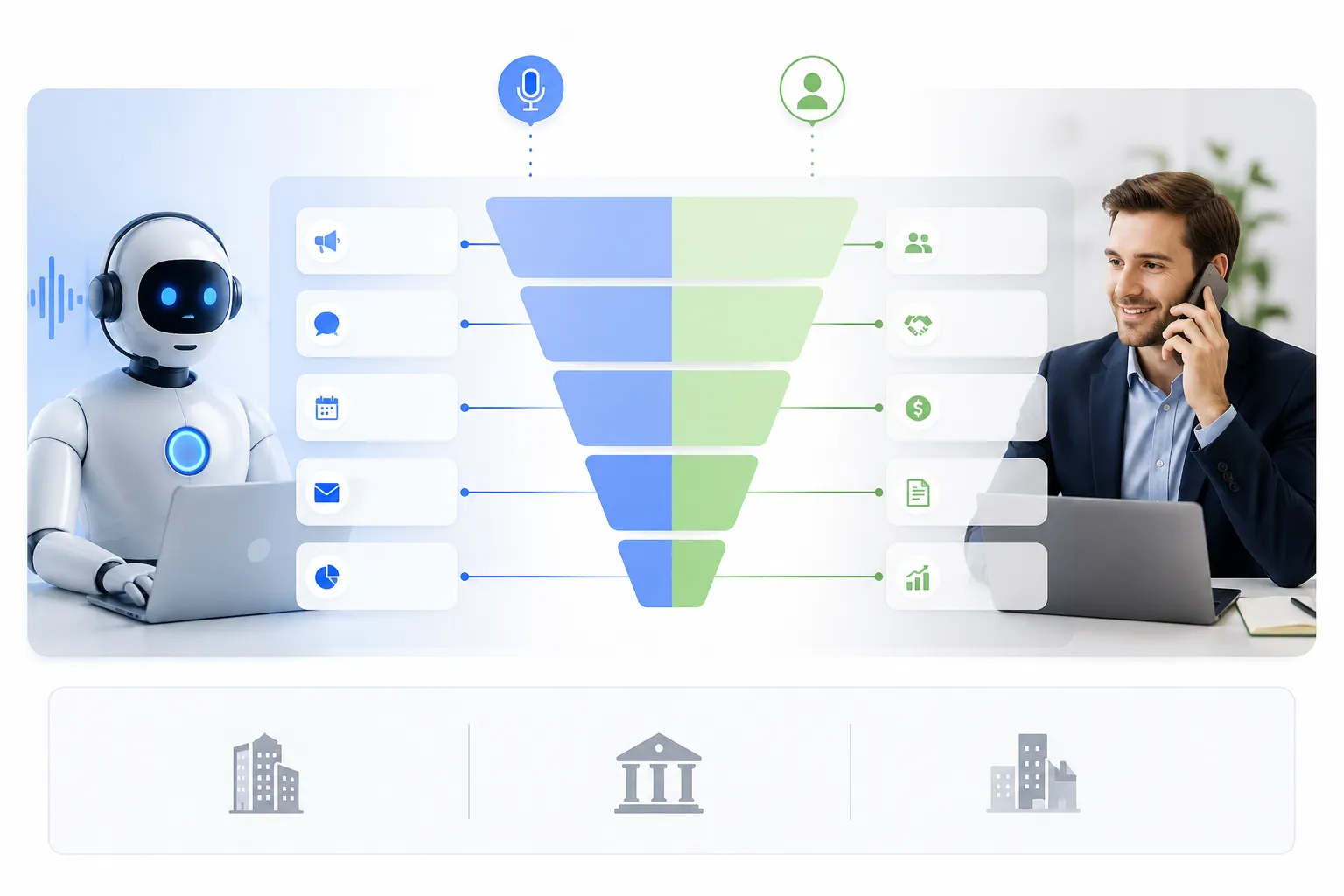
Voice AI agent and a human salesperson side by side with the parts of the funnel each handles labelled
What voice AI agents actually are (plain English)
An AI voice agent is software that can hold a natural, real-time spoken conversation over the phone or web. Under the hood, most agents run a chained pipeline. Speech-to-text (STT) converts the caller's audio into text. A large language model (LLM) decides what to say. Text-to-speech (TTS) speaks the response back. Layered on top are turn detection (deciding when the caller has finished speaking), interruption handling (barge-in), and tool use (booking a meeting, updating a CRM, looking up an order).
This is fundamentally different from the two things people confuse it with:
Old-school IVR ("Press 1 for sales") relies on rigid touch-tone menus and pre-programmed prompts.
Basic chatbots are text-only and often script-bound.
Modern voice agents understand natural language, hold multi-turn conversations, and take actions mid-call. The engineering bar is latency. Agents that respond in roughly 400 to 800 milliseconds feel conversational. Delays above 1.5 seconds feel like the old phone menus. A newer "speech-to-speech" architecture (OpenAI's Realtime API, Google Gemini Live) collapses the STT-LLM-TTS chain into a single model for lower latency.
Real, current platforms in 2026:
Developer and orchestration platforms: Vapi, Retell AI, Bland AI, LiveKit (open-source framework), and Synthflow (no-code).
Voice and model layer: ElevenLabs (now ElevenLabs Agents), Deepgram, Cartesia, and AssemblyAI.
Model-native speech-to-speech: OpenAI Realtime API, Google Gemini Live, and Azure.
Enterprise contact-centre platforms: PolyAI, Cognigy, and Replicant.
Hyperscalers: Amazon (Connect + Lex), Google (Dialogflow CX + Gemini), and Microsoft (Azure).
One verification note: Air AI, frequently cited in 2023 and 2024 as a "sales-replacing" voice agent, effectively collapsed. The FTC announced in March 2026 that Air AI and its owners would be banned from marketing business opportunities and hit with an $18M judgment (largely suspended due to inability to pay) over deceptive earnings claims. It is a useful cautionary tale about hype, not a current recommendation. We cover the same "verify before you adopt" discipline in our audit-ready AI agents guide.
Why now: the 2026 context
Several things converged to make voice AI viable for sales in 2025 and 2026:
Better LLMs that can reason and follow nuanced instructions. We covered the most recent flagships in our Claude Fable 5 business guide and Claude Opus 4.8 piece.
Near-human-quality TTS. ElevenLabs is the most-cited example. Per Reuters and ElevenLabs (February 4, 2026), it raised a $500M Series D at an $11B valuation, a round that "more than triples the company's $3.3 billion valuation from January 2025, when ElevenLabs raised $180 million," bringing total funding to $781M across five rounds. The company "generated over $330 million in annual recurring revenue in 2025."
Lower latency. Production stacks can now reach sub-500ms with components like Deepgram STT and fast TTS engines.
Cheaper inference and maturing platforms that let teams ship in weeks rather than months.
Market-size numbers should be treated as estimates that vary significantly by analyst:
Grand View Research estimated the AI voice agents market at $2.54B in 2025, growing to $3.51B in 2026, with a 39% CAGR to $35.24B by 2033.
Conversational AI market estimates for 2025 range from roughly $12.82B (one analyst) to $14.79B (Fortune Business Insights) to $17.05B (MarketsandMarkets) to $19.21B (Precedence Research), with growth forecasts to $41B to $155B over the next decade.
Several blog and vendor sources cite a "voice AI market hitting $47.5B by 2034" figure attributed to Market.us. Treat these as vendor-repeated estimates.
Adoption among sales teams is well-documented by Salesforce's State of Sales (7th edition, September 2025), based on a survey of more than 4,000 sales professionals. 54% of sellers say they have used AI agents and nearly 9 in 10 plan to by 2027. 94% of sales leaders with agents call them essential for meeting business demands. The report's time-allocation chart shows reps spend 40% of their week selling and 60% not selling (22% meeting with customers, 18% prospecting, 16% manual data entry, and the remainder on other tasks). That non-selling drag is the core rationale for automating top-of-funnel work.
What voice agents actually do well in sales
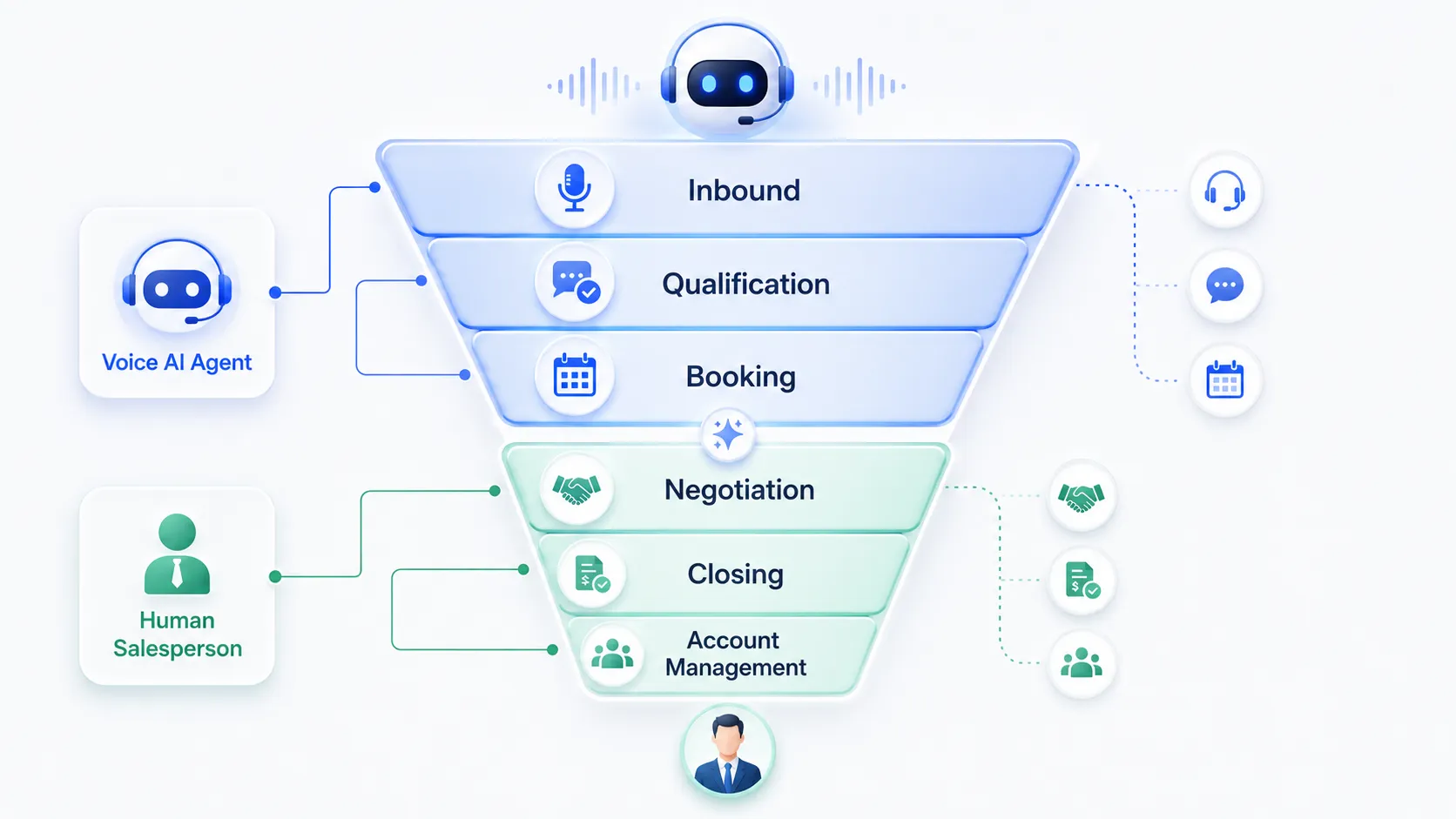
Funnel diagram with voice agent icons at top of funnel (inbound, qualification, booking) and human icons at the bottom (negotiation, closing, account management)
Speed-to-lead (the strongest case)
The classic research is the Lead Response Management study, published in Harvard Business Review (2011) by James Oldroyd and colleagues, which examined 2,241 US companies and roughly 100,000 leads. The core finding: firms responding within 5 minutes were about 100x more likely to connect and 21x more likely to qualify a lead than those waiting 30 minutes. Responding within an hour made firms about 7x more likely to qualify than waiting just one hour longer, and 60x more likely than waiting 24 hours or more.
The problem is execution. A 2026 Blazeo benchmark of 573 businesses found 74% miss the five-minute window entirely. A voice agent can call an inbound lead within seconds, 24/7, which is precisely where humans fail. The same speed-to-lead instinct sits behind the landing-page playbook in our landing page design tips guide: the click is expensive, the gap to first contact decides whether it pays off.
Outbound lead qualification and SDR-style calling at scale
Voice agents run qualification scripts (BANT and similar) across hundreds of contacts per hour, scoring leads and routing qualified ones to humans.
Appointment setting and booking demos
Agents integrate with calendars to book, reschedule, and confirm appointments. They also cut no-shows with reminder calls.
Inbound call answering, routing, and FAQ handling
Never miss a call, around the clock. Agents ingest help-centre content and answer common questions, transferring to a human (with full context) when needed.
Follow-ups and re-engaging cold leads
Agents can work dormant CRM lists that human reps never have time to touch.
Consistency, no fatigue, multilingual, high volume
Agents handle concurrent calls and many languages without burnout.
Cost
This is the clearest quantitative advantage. Verified 2026 platform pricing:
Vapi: about $0.05/min orchestration fee with bring-your-own components; all-in roughly $0.13 to $0.31/min.
Retell AI: about $0.07 to $0.08/min for the voice engine, pay-as-you-go.
Bland AI: all-inclusive per-minute pricing (moved to plan-based tiers in December 2025).
ElevenLabs Agents: about $0.08 to $0.24/min depending on voice tier.
Compare that to a human SDR. A fully loaded in-house SDR costs roughly $110,000 to $160,000 per year once you include benefits, tools, management, ramp, and turnover (median base around $60K and OTE around $85K per RepVue, June 2026). Turnover is a structural drag. The Bridge Group's 9th SDR report (406 B2B companies) found median annual SDR turnover of 32% (12% involuntary plus 20% voluntary), average tenure of about 2.2 years, and a 5.3-month ramp. Vendors frequently cite "$0.40 per AI call versus $7 to $12 per human call," but treat that as a vendor framing rather than an independent benchmark.
Case studies, flagged by credibility
Independent and peer-reviewed (strongest evidence): "Generative AI at Work" by Brynjolfsson, Li, and Raymond (NBER 2023; published in the Quarterly Journal of Economics, 2025). Studying more than 5,000 customer support agents, AI assistance increased issues resolved per hour by 14% on average (revised to 15% in the final peer-reviewed version), with a 34% gain for novice workers. Important caveat: this was a text-chat assist tool, not a voice sales agent, so it is suggestive rather than directly transferable.
Vendor-commissioned (credible firm): A 2025 Forrester Total Economic Impact study commissioned by PolyAI (released July 29, 2025) modelled a composite organisation and found 391% three-year ROI, about $10.2M in agent labour savings over three years, and a payback period under six months. Forrester explicitly does not endorse PolyAI, and the model is a hypothetical composite built from four customer interviews. A widely repeated "331% ROI" figure actually belongs to a separate Forrester study of Google Contact Center AI, not PolyAI.
Vendor case study, independently corroborated: Pine Park Health reported a 38% increase in scheduling NPS using Retell AI, with the result corroborated by trade publication Healthcare IT News.
Vendor self-reported: A CloudTalk field experiment claimed its AI voice agent answered 100% of inbound calls, completed 96% of conversations without human intervention, and generated 70-plus sales-qualified leads. Treat as marketing, not audited data.
What voice agents don't do well (the honest "not replacing" part)
Complex, high-value, consultative, enterprise B2B selling and closing.
Building genuine relationships, trust, and rapport, and reading emotional nuance.
Handling complex objections, negotiation, and bespoke deals.
Creative problem solving, deep domain expertise, and strategic accounts.
Going off-script and showing true empathy. No-code platforms in particular tend to default to scripted lines when callers go off-script.
There is also a real, measurable consumer-preference problem:
Twilio's "Inside the Conversational AI Revolution" report (November 13, 2025; 4,800 consumers and 457 business leaders across 15 countries) found that "69% of consumers prefer interacting with real people, but 63% believe an AI agent is better at responding faster, and 72% would pick an AI agent over a human agent if the issue was guaranteed to be solved" faster. Preference for humans is real but conditional on performance.
The same report found a perception gap: 90% of business leaders think customers are satisfied with their conversational AI, but only 59% of consumers are.
A Pegasystems survey conducted by YouGov of 4,748 UK and US adults (fieldwork November 4 to 13, 2025) found that "over three-quarters of consumers say only dealing with a human 'always' or 'often' leads to better outcomes," with 77% expressing that view and only 2% saying they want to interact exclusively with generative AI chatbots. 64% were "not very" or "not at all" confident in how businesses use generative AI.
Consumers are bad at detecting AI. Twilio found 90% failed to correctly identify AI-generated voice clips despite 72% claiming they could. This is exactly why disclosure matters.
Poor experiences carry brand risk. Twilio documented failure patterns including repetitive loops, comprehension issues, and weak AI-to-human handoffs, with only 15% of consumers reporting a smooth handoff.
The augmentation framing (the core thesis)
The realistic 2026 picture is augmentation and role-shifting, not wholesale replacement. The data converges here:
Gartner (press release of November 18, 2025, "Predicts 2026: Leading Sales in the Age of AI Contradictions") forecasts that by 2028 AI agents will outnumber human sellers tenfold, yet fewer than 40% of sellers will report that AI agents improved their productivity. As VP Analyst Melissa Hilbert put it: "AI agents are everywhere, but there's a value ceiling. Beyond a certain point, more AI does not mean more productivity. Layering additional prompts and tools onto already complex workflows risks overwhelming sellers and accelerating burnout."
Gartner also predicts a hybrid CRM model becomes the industry standard. AI handles routine tasks while humans handle complex, emotionally charged interactions.
McKinsey estimates gen AI could add $0.8 trillion to $1.2 trillion in productivity across sales and marketing, and frames the near-term reality as automating research, drafting, and follow-up (roughly 10 to 15% efficiency gains today) rather than autonomous selling.
Salesforce frames agents as freeing reps from the majority of their week currently spent on non-selling work.
The SDR and BDR role shifts accordingly. Less manual cold dialling and list-working, more handling of AI-qualified, warm conversations, and more time closing. The same "design the workflow before you scale the agents" discipline shows up in our AI agents in mobile apps 2026 guide.
Use cases mapped to the funnel
Top of funnel (voice agents win): inbound lead capture 24/7, speed-to-lead callbacks within seconds, outbound qualification at scale, and FAQ answering.
Middle of funnel (mostly voice agents, with handoff): appointment and demo booking, reminders to cut no-shows, nurturing and re-engaging cold leads, and post-event follow-up.
Bottom of funnel (humans take over): discovery for complex deals, demos, negotiation, closing, and ongoing account management and relationship building.
This map is the practical core of the "augmentation, not replacement" framing. The same job-to-be-done split that we apply to the build side in our WordPress vs custom build guide applies here. Pick the lightest tool that does the job, not the most impressive one.
Risks, ethics, and regulation
This is essential for an honest read.
FCC and TCPA. On February 8, 2024, the FCC issued a Declaratory Ruling that AI-generated voices are "artificial" under the Telephone Consumer Protection Act. The practical effect: AI voice calls require the prior express consent of the called party (prior express written consent for marketing), plus identification and opt-out for telemarketing. Statutory damages run $500 to $1,500 per call with no aggregate cap. The FCC explicitly said the statute does not allow a carve-out for technologies that purport to provide the equivalent of a live agent.
Proposed federal disclosure rule. An August 2024 FCC Notice of Proposed Rulemaking proposed defining "AI-generated calls" and requiring disclosure at the start of such calls. As of mid-2026 it is not finalised, and the current FCC has signalled a lighter regulatory posture.
State laws. California's bot-disclosure law (SB 1001, in force since 2019) plus a wave of 2025 chatbot laws in Utah, Maine, New York, and others now require AI disclosure in various contexts. Texas SB 140 requires disclosure within the first 30 seconds of a call. California's SB 243 (effective January 1, 2026) adds disclosure requirements and a private right of action for companion chatbots. This is a fast-moving patchwork.
Enforcement reality. State attorneys general and class-action plaintiffs are using the existing TCPA framework now, and 2025 to 2026 settlements reportedly ran in the $5M to $20M range. Bought lists rarely carry transferable consent.
Deepfake and voice cloning. The FCC ruling was spurred partly by the fake Biden robocall in the 2024 New Hampshire primary, which was traced to audio made with ElevenLabs technology.
Reputational risk. Doing it badly (robotic, looping, no human escape hatch) damages the brand and, as Twilio's data shows, leaves most customers without a smooth path to a person.
How businesses should approach it (practical playbook)
Start narrow with high-volume, low-complexity use cases: inbound FAQ, after-hours capture, speed-to-lead callbacks, and qualification.
Validate the script with your human team first. The pattern that works is a manual process that converts, then systematise it, then automate it. Automating a broken process just amplifies the problems. The same logic from our SaaS validation playbook applies.
Keep humans in the loop with a clean, context-rich handoff to a person. Smooth handoff is where most deployments fail.
Disclose AI use clearly and early. It is both a trust builder and, increasingly, a legal requirement.
Get consent right for outbound (TCPA). Treat "AI cold calling" as warm outreach to consented leads, not unconsented dialling.
Integrate with your CRM and calendar so the agent can actually act and log results.
Measure the right metric: cost per held or qualified meeting, not just per-minute price or raw calls answered.
Monitor and iterate. Review your worst-call transcripts weekly and ship small fixes to prompts, guardrails, and escalation rules.
Choose the right build path: no-code (Synthflow) for fast pilots, orchestration platforms (Vapi or Retell) for flexibility, and full custom builds (LiveKit plus best-of-breed components) for regulated or high-volume needs.
This is the natural place where an agency fits: scoping the right narrow use case, choosing the stack, engineering low-latency real-time audio, designing conversation flows, wiring CRM and calendar tool use, building compliant consent and disclosure, and setting up monitoring so the agent improves over time. The procurement discipline we walk through in our web app design contract questions guide applies here too.
The future outlook (balanced)
Over the next few years, expect more capable agents (better speech-to-speech, better tool use), broader adoption, and continued role evolution for salespeople (less cold calling, more closing and strategy). The weight of evidence still suggests humans remain central to complex, high-value, relationship-driven sales.
Treat aggressive projections (Gartner's "90% of B2B buying AI-intermediated by 2028" and "$15 trillion in agent-driven B2B purchases") as projections, not facts. Note Gartner's own warning that more than 40% of agentic AI projects may be cancelled by the end of 2027 due to cost, unclear value, or inadequate risk controls.
How Brandrums recommends approaching voice AI in sales
Step 1: if you do nothing else, fix speed-to-lead first. Deploy a voice agent (or a hybrid) to call every inbound lead within 60 seconds, 24/7. This is the single highest-ROI, lowest-risk starting point given the five-minute-rule evidence. Benchmark: are you currently contacting inbound leads in under 5 minutes? If not, this is your fastest win.
Step 2: automate qualification and booking next, routing only qualified, warm prospects to human closers. Threshold to expand: when your agent reliably qualifies and books with a transfer and handoff that customers rate well.
Step 3: keep humans on complex, high-value closing and key accounts. Do not point a voice agent at enterprise negotiation or relationship management. Threshold to reconsider: only if independent (not vendor) data shows AI matching human close rates on complex deals, which does not exist today.
Step 4: build compliance in from day one: consent capture for outbound, clear AI disclosure at call start, opt-out, and CRM logging. This is non-negotiable given the TCPA exposure of $500 to $1,500 per call.
Step 5: measure cost per held qualified meeting plus customer-satisfaction and handoff quality, not vanity metrics. Kill or redesign any flow where customers loop or escalate angrily.
Step 6: pilot small, monitor weekly, iterate. If satisfaction or handoff quality lags, slow down rather than scale.
The full-funnel build of this lives across our website development, web application development, app design and development, SaaS development, and digital marketing retainers.
Key takeaways
Voice AI agents are not replacing salespeople in 2026. They are automating top-of-funnel volume (inbound, qualification, booking, FAQ) while humans close complex deals.
The strongest case is speed-to-lead: under 5 minutes makes you about 100x more likely to connect, and 74% of businesses still miss that window (Blazeo, 2026).
Consumers still prefer humans (Twilio 69%, Pegasystems 77%) but conditionally: they will pick AI if it solves the issue faster. Smooth handoff is where most deployments fail.
Regulation is real. Since the FCC's February 2024 ruling, AI voice calls require prior express consent under TCPA. State laws add disclosure requirements. Statutory damages run $500 to $1,500 per call.
Pick the lightest tool that does the job: no-code (Synthflow) for pilots, orchestration platforms (Vapi or Retell) for flexibility, custom (LiveKit) for regulated or high-volume work.
FAQ
Will voice AI agents replace SDRs entirely?
No, but the role shifts. Voice agents take over the manual cold-dial and list-working volume. Human SDRs spend more time on AI-qualified warm conversations and the parts of the funnel that need judgment, rapport, and creative objection handling. Gartner expects AI agents to outnumber human sellers tenfold by 2028 while fewer than 40% of sellers will say productivity actually improved, which captures the augmentation reality.
What is the single highest-ROI use case for voice AI in sales?
Speed-to-lead. The Lead Response Management research found responding within 5 minutes makes you about 100x more likely to connect and 21x more likely to qualify a lead versus 30 minutes. Blazeo's 2026 benchmark of 573 businesses found 74% miss the five-minute window entirely. A voice agent fills the gap 24/7.
How much does a voice AI agent actually cost?
Per-minute pricing in 2026 sits between about $0.05 and $0.31 depending on the platform and component mix. Vapi runs about $0.05 orchestration with BYO components (all-in $0.13 to $0.31). Retell AI is about $0.07 to $0.08 for the voice engine. ElevenLabs Agents are about $0.08 to $0.24 depending on voice tier. Compare that to a fully loaded SDR at roughly $110,000 to $160,000 a year, and the unit economics are obvious. The honest caveat: vendor headline rates are typically 2x to 6x lower than true all-in cost once LLM, STT, TTS, and telephony are added.
Is it legal to make AI sales calls?
It depends on the type of call and the jurisdiction, and the bar is high. The FCC's February 2024 Declaratory Ruling classifies AI-generated voices as "artificial" under TCPA, requiring prior express consent for AI voice calls (prior express written consent for marketing). State laws (California SB 1001, SB 243, Texas SB 140, and others) add disclosure requirements. Statutory damages are $500 to $1,500 per call. Treat AI outbound as warm outreach to consented leads, not unconsented dialling.
Do customers actually like talking to AI agents?
Conditionally. Twilio (November 2025, 4,800 consumers) found 69% prefer real people, but 72% would pick AI if the issue is guaranteed to be solved faster. Pegasystems / YouGov (November 2025, 4,748 adults) found 77% say dealing with a human "always" or "often" leads to better outcomes. The pattern: customers will tolerate AI when it works smoothly and the handoff to a human is clean. Only 15% of customers in Twilio's data reported a smooth handoff. That is where most deployments fail.
Which platform should I start with?
Pick by build profile. Synthflow if you want a no-code pilot in days. Vapi or Retell AI if you have engineers and want orchestration flexibility. LiveKit if you need full custom control and the lowest latency. PolyAI, Cognigy, or Replicant if you are a large contact centre with compliance and integration depth. Hyperscaler stacks (Amazon Connect + Lex, Google Dialogflow CX + Gemini, Microsoft Azure) if you are already standardised on a cloud.
How do I avoid the Air AI trap?
Validate before you scale. The FTC banned Air AI's founders from marketing business opportunities and entered an $18M judgment in March 2026 over deceptive earnings claims. The honest pattern is the opposite of "set it and forget it": start narrow, validate against real metrics (cost per held qualified meeting, customer satisfaction, handoff quality), monitor weekly, and slow down if numbers slip.
Does it actually pay off?
On the right use cases, yes. The Brynjolfsson, Li, Raymond NBER 2023 / QJE 2025 study of 5,000-plus customer support agents (text chat, not voice) found a 14% lift in issues resolved per hour, 34% for novice workers. PolyAI's Forrester TEI claims 391% three-year ROI for a composite organisation. These are encouraging but not directly transferable to your sales motion. The honest answer: pilot, measure cost per held qualified meeting, and keep what works.
Ready to scope a voice AI pilot without overpromising?
Most teams either over-buy voice AI on day one and burn money on flows their customers hate, or stay out and keep missing inbound leads. We help clients scope a narrow, high-ROI starting point (almost always speed-to-lead or after-hours capture), pick the right stack, engineer the conversation and CRM tool use, get compliance right, and instrument the pilot honestly so the data decides whether to scale. Same discipline we apply through digital marketing, website development, and app design and development retainers. Tell us your funnel and inbound volume and we will recommend a pilot. Or check our pricing options if you are scoping engineering support alongside the platform spend.