TL;DR
Online branding services build and manage your business identity across every digital channel (website, social, visual identity, voice, content). In 2026 they range from roughly $20 for a DIY logo tool to $250,000-plus for a global agency, with most small and medium businesses landing in the $2,000 to $30,000 range for a real brand identity package.
The most-cited statistics (consistent branding lifting revenue 23 to 33 percent; a signature colour boosting recognition by up to 80 percent) come from real sources but carry caveats. The revenue figures are self-reported vendor survey estimates, and the 80 percent colour stat is widely misattributed. Use them as directional rather than gospel.
The biggest predictor of value is not price but whether the provider does strategy before design, delivers brand guidelines, and understands digital. Offshore full-service agencies like Brandrums can deliver agency-level work at competitive rates because of regional cost differences.
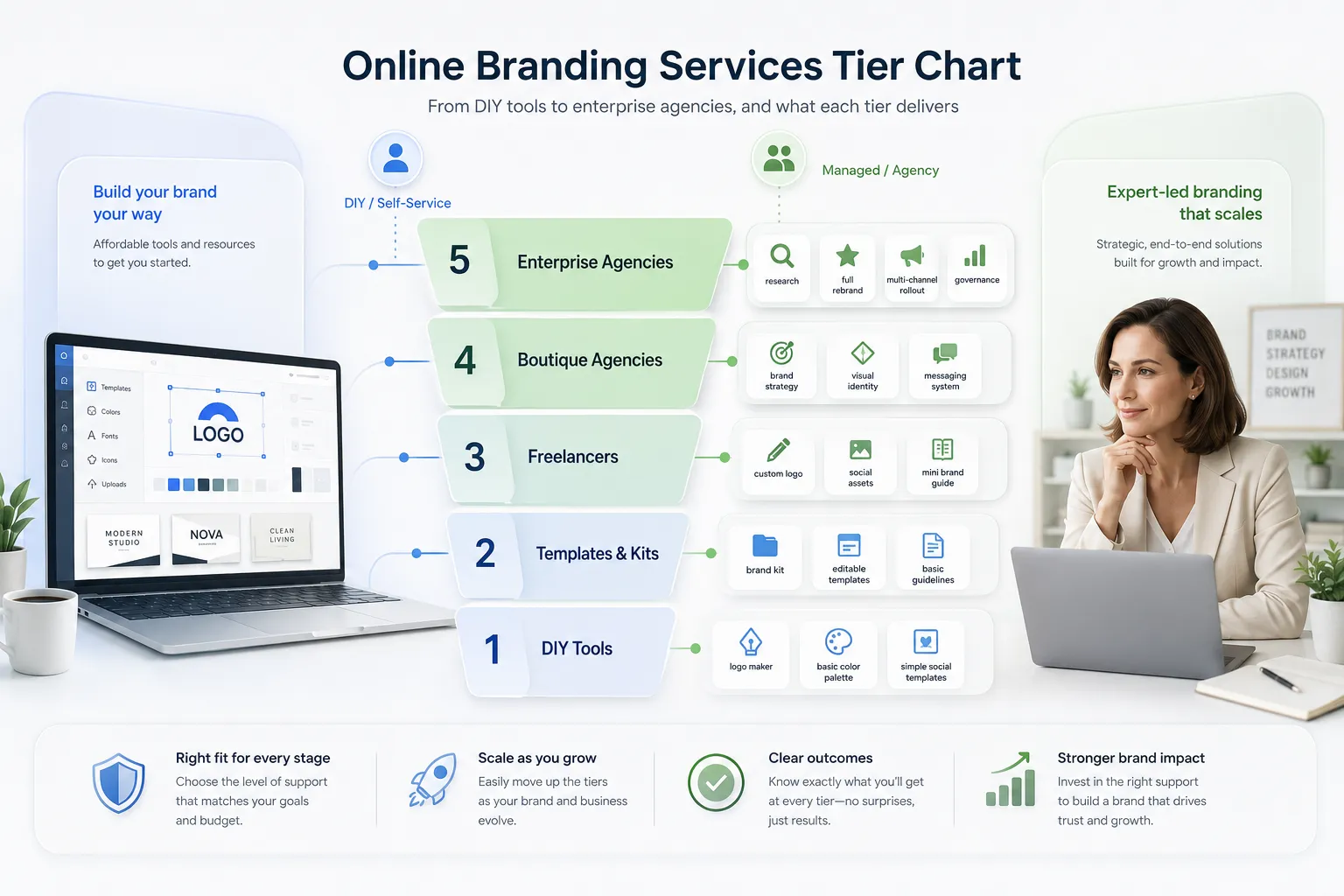
Online branding services tier chart from DIY tools through enterprise agencies with what each tier delivers
What online branding actually is (plain English)
There is a common confusion worth clearing up first:
Branding is the total identity, perception, and experience of your business. What people think and feel when they encounter you.
A logo is just one visual asset within that identity.
Marketing is how you promote the brand once it exists.
Online branding (or digital branding) is the practice of building and managing that identity specifically across digital channels: your website, social media profiles, content, visual identity (logo, colours, type), and brand voice. It is about showing up consistently and recognisably everywhere a customer meets you online. Our branding service covers exactly this surface, with logo design handled as a focused product within it.
Why it matters. Branding drives differentiation, trust, recognition, customer loyalty, perceived value, and the ability to charge premium prices. Several widely circulated statistics support this, though buyers should understand their real sourcing:
"Consistent branding increases revenue by 23 to 33 percent." This comes from Lucidpress (now Marq) "State of Brand Consistency" reports. The 23 percent figure is from the 2016 edition (produced with Demand Metric). The 33 percent figure is from the 2019 edition. Per Lucidpress's December 2, 2019 release via PR Newswire, "the latest State of Brand Consistency Report found consistent branding can increase revenue by 33%, a 10% increase over the 2016 report," based on a survey of "over 200 organizations" (later editions cite 400-plus brand-management experts). Caveat: these are self-reported survey estimates from a vendor that sells brand-consistency software, with a relatively small and somewhat contested sample. Treat as directional.
"A signature colour can boost brand recognition by up to 80 percent." The "up to 80 percent" figure is most commonly traced to a Loyola University (Maryland) colour study cited via Energy PR. Per Omnibound's Brand Consistency Statistics 2026 roundup (last updated June 2026), it is "widely cited but predates 2020." The original research was actually about colour aiding reading and information processing versus monochrome, not brand recognition specifically. A separate Reboot Online consumer survey produced a similar 80 percent headline, but that number reflects how many people recognised Starbucks by its green alone, not a universal law. Use cautiously.
The trust data is more solid. Per the 2019 Edelman Trust Barometer Special Report "In Brands We Trust?" (16,000 people across 8 countries), "a major consideration for brand purchase is now 'I must be able to trust the brand to do what is right,' at 81 percent," a deal-breaker trailing only quality (85 percent), convenience (84 percent), and value (84 percent). And per Capital One Shopping Research's Branding Statistics 2024, "87% of consumers will pay more for products from a trusted brand."
The honest read on the data: branding clearly pays off, but the eye-catching headline numbers are softer than they look. Build the case on the trust data first, treat the revenue and colour stats as directional.
What's included in online branding services
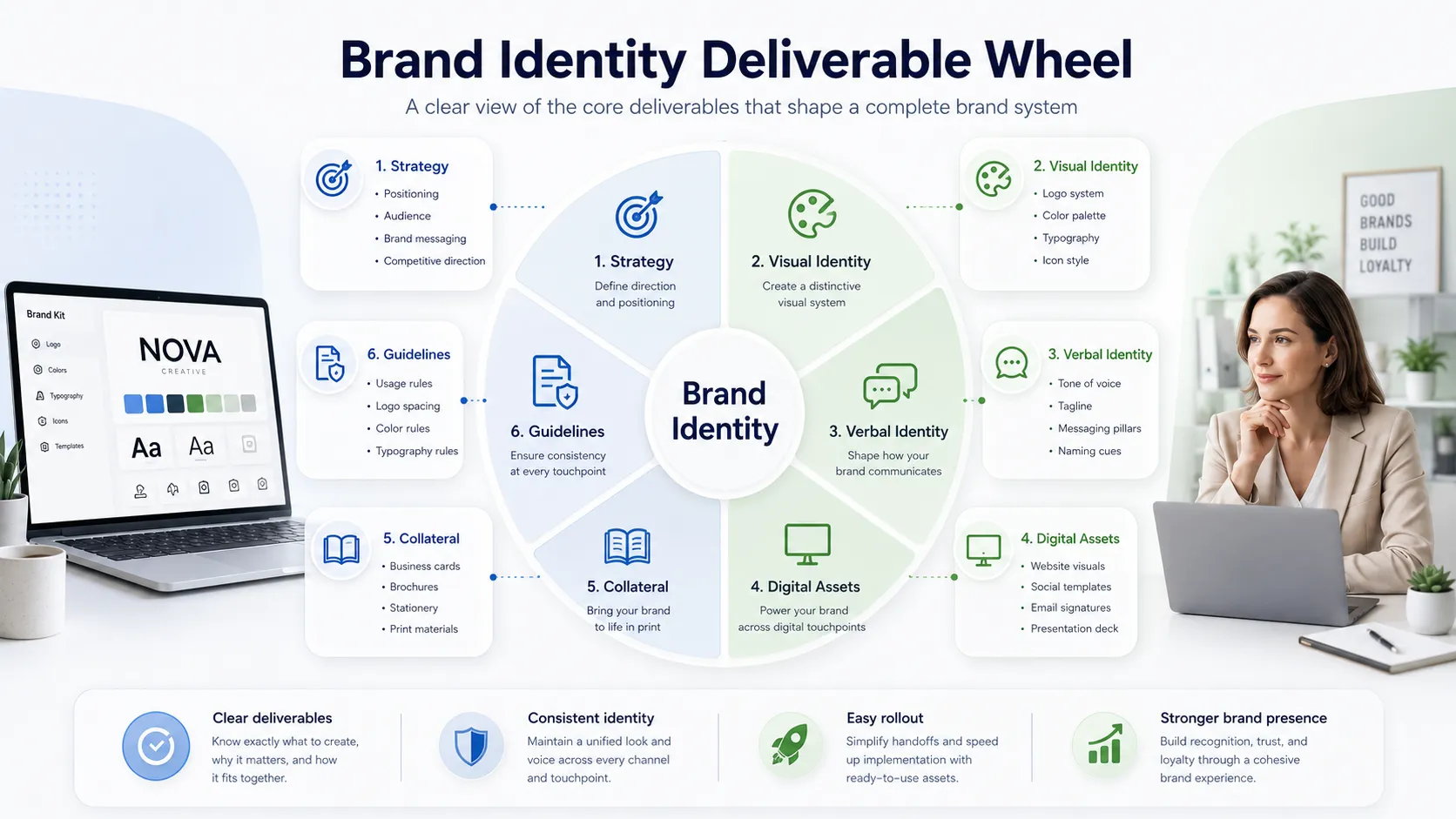
Brand identity deliverable wheel showing strategy, visual identity, verbal identity, digital assets, collateral, and guidelines
Services group into one-time foundational work and ongoing management.
Brand strategy and discovery (one-time): market and competitor research, target audience definition, brand positioning, mission, vision and values, messaging framework, unique value proposition, brand voice and personality.
Visual identity (one-time): primary logo plus variations, colour palette, typography, imagery and photography style, iconography, and the brand guidelines or style guide that ties it together.
Verbal identity (one-time): brand name (naming), tagline or slogan, core messaging, tone of voice, copywriting. Our creative copywriting service plugs in here.
Digital presence and assets (one-time, with refreshes): website design and branding, social media profile branding (banners, templates), email signatures, digital ad templates, presentation and pitch deck templates, favicon, app icon. Our web design and website development services handle the website surface; the social side runs through social media marketing.
Content and social branding (often ongoing): social media content templates, content strategy, branded graphics. Motion lives in video animation.
Brand collateral (one-time): business cards, letterhead, branded marketing materials such as brochures and flyers.
Brand guidelines document (one-time): the deliverable that governs consistency across teams and vendors. If a provider does not include this, they are not really selling you a brand.
Ongoing brand management (recurring): maintaining consistency, brand audits, refreshes, and social media management. The same kind of ongoing surface we run through digital marketing retainers.
Types of online branding services and engagement models
Full brand identity packages: strategy plus visual and verbal identity plus guidelines.
Logo-only or visual identity packages: cheaper, design-focused, light on strategy.
Brand strategy consulting: positioning, messaging, naming, often workshop-based.
Rebranding or brand refresh: updating or overhauling an existing brand.
Ongoing brand management or retainers: monthly support for consistency and social.
DIY tools vs freelancers vs agencies: the spectrum from self-serve software to full-service teams.
The right shape depends on stage. Pre-revenue founders should not buy a $25,000 brand identity package the same week they are still validating the idea, a discipline we cover in our SaaS validation playbook. Once selling is happening, the cost of a weak brand starts showing up in landing-page conversion and ad-spend efficiency, which we unpack in our landing page design tips guide.
What online branding costs in 2026
All figures below are estimates that vary by scope, provider, and location. Offshore agencies (including teams based in Pakistan, where Brandrums operates) typically price below US and UK agencies for comparable work because of regional cost differences. For a related US-cost band on the build side, see our USA custom development cost guide.
Logo design
DIY and AI tools and Fiverr gigs can be tens of dollars. Freelancers commonly $300 to $3,000. Agencies $5,000 and up. Top-tier custom work can exceed $50,000.
DIY tools
Per Looka's official pricing page (2026): Basic Logo $20 (one-time PNG). Premium Logo $65 (one-time, vector files plus full ownership). Brand Kit subscription $96 a year (300-plus assets). Brand Kit Web subscription $129 a year (adds an AI-generated website).
Freelancers and marketplaces
Per 99designs' published contest tiers: logo contests run Bronze $299, Silver $499, Gold $899, Platinum $1,299 (the hand-picked Platinum tier is listed up to $1,499 in South's 2026 review). Logo plus brand identity packs run Bronze $599, Silver $899, Gold $1,699, Platinum $2,499.
Full brand identity packages
Small and mid agencies and senior freelancers commonly $5,000 to $25,000. Comprehensive branding with strategy, messaging, and extensive assets $20,000 to $100,000-plus. Enterprise and global agencies $100,000 to $250,000-plus.
Brand strategy consulting
Brand strategists charge roughly $50 to $300 an hour (freelancers) and $150 to $500 an hour (agencies). Project-based strategy commonly starts around $2,000 and runs to $25,000-plus.
Rebranding
Small business refresh in the low tens of thousands. Comprehensive rebrands $20,000 to $100,000. Large and global rebrands $250,000 to seven figures.
Ongoing branding and social retainers
Small business $500 to $2,500 a month. Mid-market $2,000 to $5,000. Enterprise $5,000 to $25,000-plus.
Price-tier table
Tier | Typical cost | What you get |
|---|---|---|
DIY tools | $20 to $130 | AI or template logo, basic brand kit, social templates. No strategy. Can look generic. |
Freelancer / marketplace | $300 to $3,000 | Custom logo, basic visual identity, limited strategy. |
Small / mid agency | $5,000 to $25,000 | Strategy, full visual and verbal identity, brand guidelines, collateral. |
Premium / enterprise agency | $25,000 to $250,000-plus | Deep research, positioning, naming, full systems, rollout, global scale. |
Factors that affect cost
Scope of deliverables. Provider size, reputation, and location. Depth of strategy versus design only. Number of revisions. Timeline (rush fees). One-time versus ongoing. The size and complexity of the business.
How to choose an online branding partner
Look for:
A strategy-first process, not just pretty logos.
A clear methodology with named phases.
A portfolio with real outcomes, not just visuals.
Reviews and testimonials.
Clear deliverables.
Strong communication.
Genuine understanding of digital.
Value versus price.
Red flags:
Suspiciously cheap pricing.
No strategy or discovery phase.
No defined process.
No brand guidelines deliverable.
Promises of a full brand identity in a few weeks.
Vague pricing.
An agency that agrees with everything and asks no hard questions.
No post-delivery support.
The same procurement discipline we walk through in our web app design contract questions guide applies here. Get the scope, the deliverables, the revision count, the timeline, and the rights assignment written down before money moves.
The ROI and value case
Branding is an investment, not a cost. A strong, consistent brand compounds over time in recognition, trust, conversions, pricing power, and loyalty. A weak or inconsistent brand quietly costs sales and forces higher marketing spend. The trust data above supports the case directly: when 81 percent of consumers say they must trust a brand before buying (Edelman, 2019) and 87 percent say they will pay more for trusted brands (Capital One Shopping, 2024), recognition and trust translate into pricing power and repeat business.
The same recognition compounding shows up downstream on conversion: our landing page design tips guide covers the click-to-form economics, and our voice AI agents in sales guide covers the funnel handoff. Both work harder when the brand they sit inside is already trusted.
What the branding process looks like
A typical agency engagement runs: discovery, research, strategy, identity design (visual and verbal), brand guidelines, rollout and implementation, then ongoing management. A mid-market engagement commonly takes about 8 to 16 weeks depending on scope. The mid-funnel handoff to delivery (website, social, content) is where most brand projects either compound or leak, so build it into the scope from the start. Our web app redesign checklist covers the parallel discipline on the product side.
Common mistakes to avoid
Inconsistent branding across channels.
Choosing the cheapest option when you have started selling.
Skipping strategy.
Having no brand guidelines.
Copying competitors.
Neglecting digital channels.
Failing to maintain or refresh the brand as the business grows.
How Brandrums recommends approaching online branding
Step 1: decide what you actually need before shopping. A quick logo, a full identity, or ongoing management. This determines your tier and budget. Buying a $25,000 identity package before you have validated the offering is the most expensive mistake we see.
Step 2: match the tier to the stage. If you are pre-revenue or testing an idea, a DIY tool ($20 to $130) or a freelancer ($300 to $3,000) is fine. Once you are selling, pitching, or scaling, invest in a real identity package with strategy and guidelines ($5,000-plus). Benchmark to upgrade: when inconsistent or amateur branding is visibly costing you leads, conversions, or the ability to raise prices, move up a tier.
Step 3: shortlist on strategy depth and process, not just portfolio looks. Ask directly who leads strategy versus design and require brand guidelines as a deliverable. Walk away from anyone who skips discovery or promises a full identity in a few weeks.
Step 4: phase the investment if budget is tight. Strategy first, then visuals, then collateral. Many advisors suggest allocating a meaningful share of marketing spend to branding, but a focused phased plan beats a sprawling all-at-once package.
Step 5: pick a partner that owns the digital handoff too. A brand that lives only in a PDF is half a brand. The work needs to land on the website, the social profiles, the landing pages, and the email templates. We run this end to end through branding, logo design, web design, website development, creative copywriting, social media marketing, video animation, and digital marketing retainers, so the brand lands where it actually shows up.
Key takeaways
Online branding is the identity, the consistency, and the digital surface it lives on. Logo is one piece. Strategy and guidelines are what separate a real brand from a polished file.
2026 cost bands: DIY $20 to $130. Freelancer $300 to $3,000. Small or mid agency $5,000 to $25,000. Premium or enterprise $25,000 to $250,000-plus. Ongoing retainers $500 to $25,000-plus a month.
The most-cited stats are softer than they look. 23-33% from Lucidpress is vendor self-report. 80% colour is widely misattributed. Edelman 81% trust and Capital One Shopping 87% pay-more are the more solid evidence.
Strategy-first process and brand guidelines as a hard deliverable are the two non-negotiables. Skip them and you do not have a brand, you have a logo.
Pick the tier that matches your stage, phase the spend if budget is tight, and make sure the partner owns the digital handoff to website, social, and content.
FAQ
What is online branding?
The practice of building and managing your business identity across digital channels: website, social, visual identity, brand voice, and content. It is the consistent way your business shows up everywhere a customer meets you online.
What is the difference between branding, marketing, and a logo?
Branding is the total identity. A logo is one visual asset inside it. Marketing is how you promote the brand once it exists. All three matter, and confusing them is the source of most overspending.
How much should I spend on branding in 2026?
Match the tier to the stage. DIY tools $20 to $130 for testing. Freelancer or marketplace $300 to $3,000 for early stage. Full identity package $5,000 to $25,000 once you are selling. $25,000 to $250,000-plus for enterprise. Phase the investment if budget is tight: strategy first, then visuals, then collateral.
Is the 23 to 33% consistent branding revenue lift real?
It is a real figure from real Lucidpress / Marq reports (2016 and 2019), but it is self-reported survey data from a vendor that sells brand-consistency software, with a relatively small sample. Treat it as directional, not as peer-reviewed fact. The Edelman trust data and Capital One Shopping pay-more data are stronger evidence for the value of branding.
Do I really need brand guidelines?
Yes. Brand guidelines are the document that makes the brand survive contact with multiple teams, freelancers, and vendors. If a provider does not include them as a deliverable, what you are buying is a logo plus some files, not a brand. Walk away.
Are offshore branding agencies any good?
The good ones produce work indistinguishable from US and UK agencies at materially lower cost. The bad ones produce templated work. The filter is the same as for any agency: strategy-first process, clear methodology, real outcomes in the portfolio, and brand guidelines as a deliverable. We cover the team-cost lens for related work in our Malta developer hiring guide.
How long does a brand identity project take?
About 8 to 16 weeks for a mid-market full-identity engagement (discovery, research, strategy, identity design, brand guidelines, rollout). Anyone who promises a full identity in a few weeks is selling a template.
Should I rebrand?
Rebrand when the current brand is actively blocking growth, not because it feels stale. Signs to rebrand: the brand no longer matches the product, the audience, or the price point you want to charge. Signs not to rebrand: you are bored. Smaller refreshes (visual tune-ups, messaging updates) are usually the right answer before a full rebrand.
Ready to build a brand that does the converting for you?
Most teams either underinvest in branding and leak conversion at every touchpoint, or overinvest before the offer is even validated. We help clients pick the right tier, run strategy before design, and land the brand on the actual digital surface so the website, social, landing pages, and email all earn the spend. Same discipline we apply through branding, logo design, web design, website development, creative copywriting, and digital marketing retainers. Tell us your stage and budget and we will recommend the right tier. Or check our pricing options if you are scoping engineering and design support together.