Key takeaways
SaaS CRMs (HubSpot, Salesforce, Pipedrive, Zoho) win on speed and polish. Custom builds win on fit, ownership, and long-term unit economics.
Under 30 seats with a standard pipeline, buying SaaS is cheaper for the first 3 years.
Custom starts beating SaaS on cost between 40 and 80 active users, sooner with deep integrations or strict data residency.
The real question is not "build or buy", it is "what does our sales process look like, and which option fits without ten workarounds?"
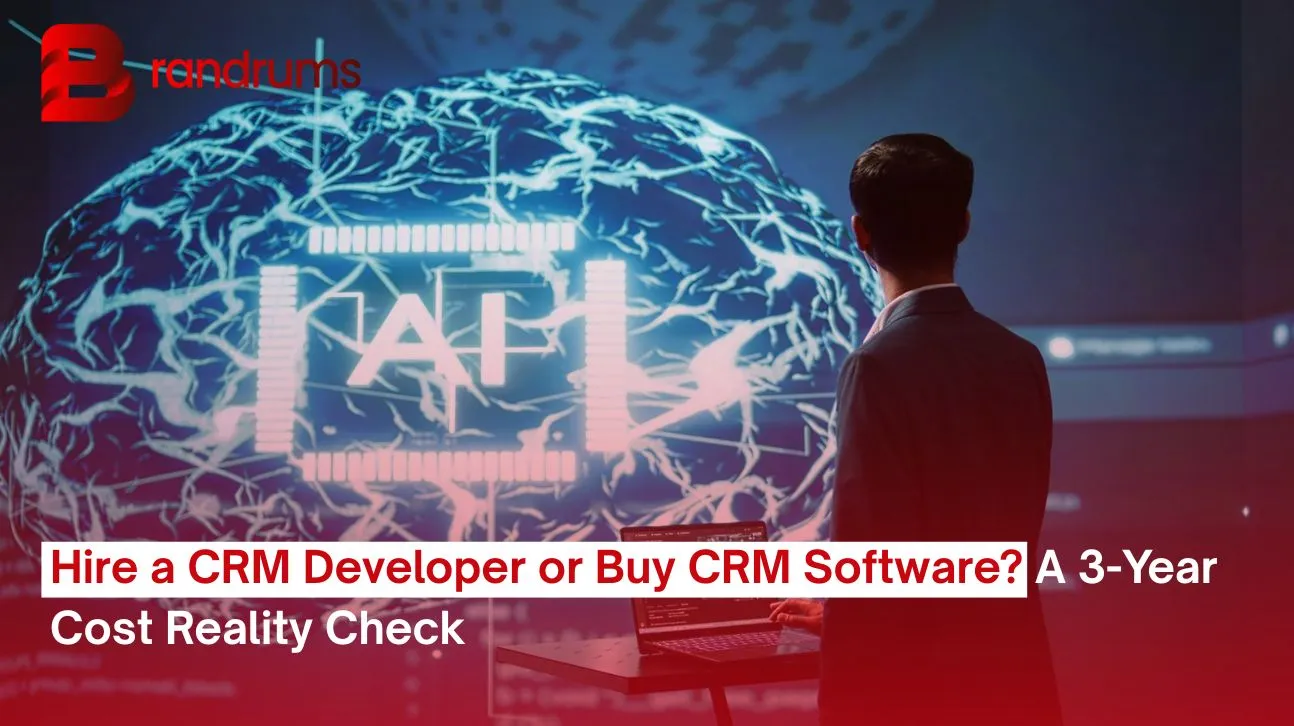
Every CRM conversation ends with the same question: "Should we just build our own?" One side wants Salesforce or HubSpot. The other wants to hire a CRM developer and build something that fits. Both are usually half right.
The CRM market is on track to hit roughly $126 billion in 2026, and 91 percent of companies with more than 11 employees already use one, per DemandSage. The interesting part: the cheaper option on paper is often the more expensive one in practice.
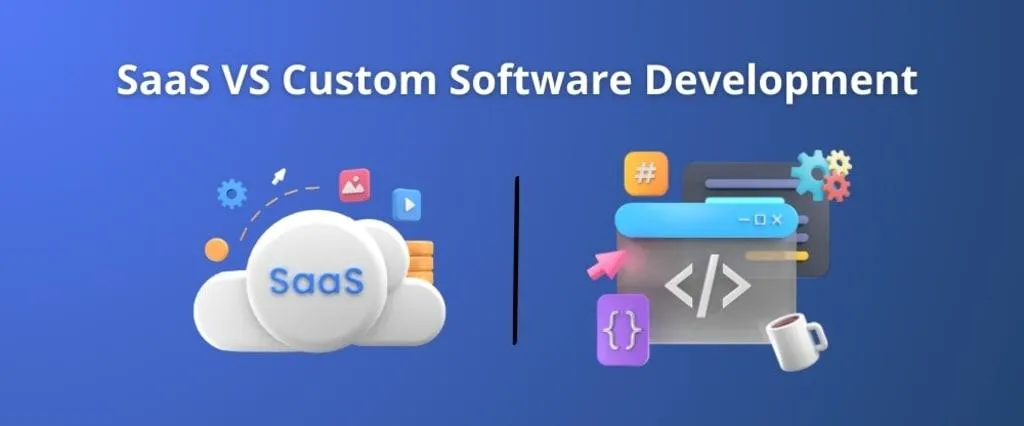
Founder weighing a stack of SaaS CRM logos against a custom
What you get with off-the-shelf CRM software
Ready-made CRMs are the default for a reason. Sign up, import contacts, connect a mailbox, working pipeline before lunch:
HubSpot: easy onboarding, strong marketing tools, freemium that grows.
Salesforce: large ecosystem, deep enterprise features, extensible via AppExchange.
Pipedrive: opinionated pipeline UX, friendly for small sales teams.
Zoho CRM: low entry price, broad suite, good for cost-sensitive SMBs.
Microsoft Dynamics 365: enterprise tilt, strong inside Microsoft 365.
You are paying for product maturity. These platforms have shipped for two decades and their roadmaps move faster than any internal team can match, which is why we usually recommend SaaS first in our B2B software guide for small businesses. The trade-off is fit. If your sales process is unusual (multi-sided marketplace, regulated workflow, dealer network with split commissions), you will spend your life on workarounds.
What "hire a CRM developer" means in 2026
Three shapes, three cost profiles:
In-house developer. US mid-level engineers earn $90k to $120k base, seniors $130k+. Fully loaded, plan on $180k to $220k per developer per year, and you usually need more than one.
Freelancer. Good for a small build or focused integration. Cheap upfront, but risky if they disappear mid-project.
Agency or product partner. A specialist team scopes, ships in phases, and stays on for maintenance. More than a freelancer, less than a full in-house team, with designers, backend, frontend, QA, and DevOps under one roof. This is the model behind our CRM development service and how most teams approach custom SaaS development.
Whichever route, custom is not "set and forget". You keep paying for updates, security patches, new integrations, and feature work.
The 3-year cost comparison nobody runs cleanly
Most teams compare sticker price to sticker price. The fair comparison is total cost of ownership over a few years, hidden fees and human time included. A 25-seat B2B team with one mid-complex integration. For other scopes, our pricing page shows how build cost flexes by feature tier.
Cost line | HubSpot Pro | Salesforce | Pipedrive Power | Zoho Enterprise | Custom CRM |
|---|---|---|---|---|---|
Per-user / month | ~$90 | ~$175 base | ~$64 | ~$40 | n/a |
Year 1 license (25 seats) | ~$27,000 | ~$52,500 | ~$19,200 | ~$12,000 | $0 |
Onboarding | ~$1,500 | $15k to $60k | Light | Light | In build |
Build cost | $0 | $0 | $0 | $0 | $80k to $250k |
Year 2-3 licenses | ~$54,000 | ~$105,000+ | ~$38,400 | ~$24,000 | $0 |
Maintenance / year | Bundled | Bundled | Bundled | Bundled | $20k to $50k |
3-year total | ~$82.5k | ~$172.5k+ | ~$57.6k | ~$36k | ~$140k to $400k |
Pricing from Salesflare's 2026 CRM comparison and Costbench's Pipedrive breakdown. At 25 seats, Zoho or Pipedrive beats a custom build for 3 years. HubSpot Pro sits in the same range as a small custom CRM but you get a finished product on day one. Salesforce gets expensive once you add Einstein, CPQ, and an implementation partner; the $175 list often becomes $300+ effective. Custom rarely wins year one. Break-even with mid-tier SaaS shows up between years 3 and 5.
3
When buying CRM software is the right call
Buying is the right move more often than founders admit. Pick SaaS when most of these are true:
Sales process looks like a normal pipeline: lead, qualify, demo, propose, close.
Under 30 to 40 seats, growing in single digits per quarter.
You need to be live in weeks, not months.
Integrations are mainstream: Gmail, Slack, Stripe, QuickBooks, Calendly.
You want a vendor on the hook for uptime, security, and compliance.
HubSpot suits SMB B2B with marketing in the mix. Pipedrive fits sales-led teams that hate clutter. Zoho is the value play. Salesforce makes sense once you have multiple business units or revenue ops complexity that justifies the price tag. Many teams run HubSpot or Pipedrive for two to three years, then move the painful parts into a custom layer. That matches our MVP vs full product strategy guide: buy the boring parts, build the parts that differentiate you.
When hiring a CRM developer beats off-the-shelf software
Custom becomes the better bet when the sales process refuses to fit a pipeline diagram. Signals:
Multi-sided model (suppliers, agents, end customers) with different views and economics.
Workflows the SaaS cannot model without ten custom objects and a Zapier graveyard.
50+ users with licensing as a six-figure line item.
Strict data residency or audit requirements (fintech, healthcare, legal).
CRM must drive operational systems: dispatch, billing, inventory, lab orders, claims.
Competitive advantage in owning lead-scoring or pricing logic.
The underrated reason is integration depth. SaaS marketplaces are huge, but "integration" often means a one-way sync of a few fields. If ops is exporting CSVs every Monday, the tool does not live inside your business. A custom CRM can share a data model with your ERP, POS system, billing engine, and data warehouse, which is why mid-market companies pair CRM work with enterprise app development.
The sales process test
A quick gut check, in the same shape as our case management software guide for law firms.
Signal | Lean SaaS | Lean custom CRM |
|---|---|---|
Pipeline stages | 5 to 8 standard | Branching, multiple parallel pipelines |
Roles | SDR, AE, manager | Brokers, distributors, partners, ops |
Pricing | List price + discounts | Custom quoting, tiered margins |
Integrations | Email, Stripe, Slack | ERP, POS, dispatch, custom APIs |
Compliance | SOC 2 | HIPAA, PCI, GDPR residency, audit logs |
Reporting | Dashboards | Custom data models, BI warehouse |
Mostly left: do not build, spend on better SaaS configuration and a sales ops hire. Mostly right: workarounds will cost more than the build.
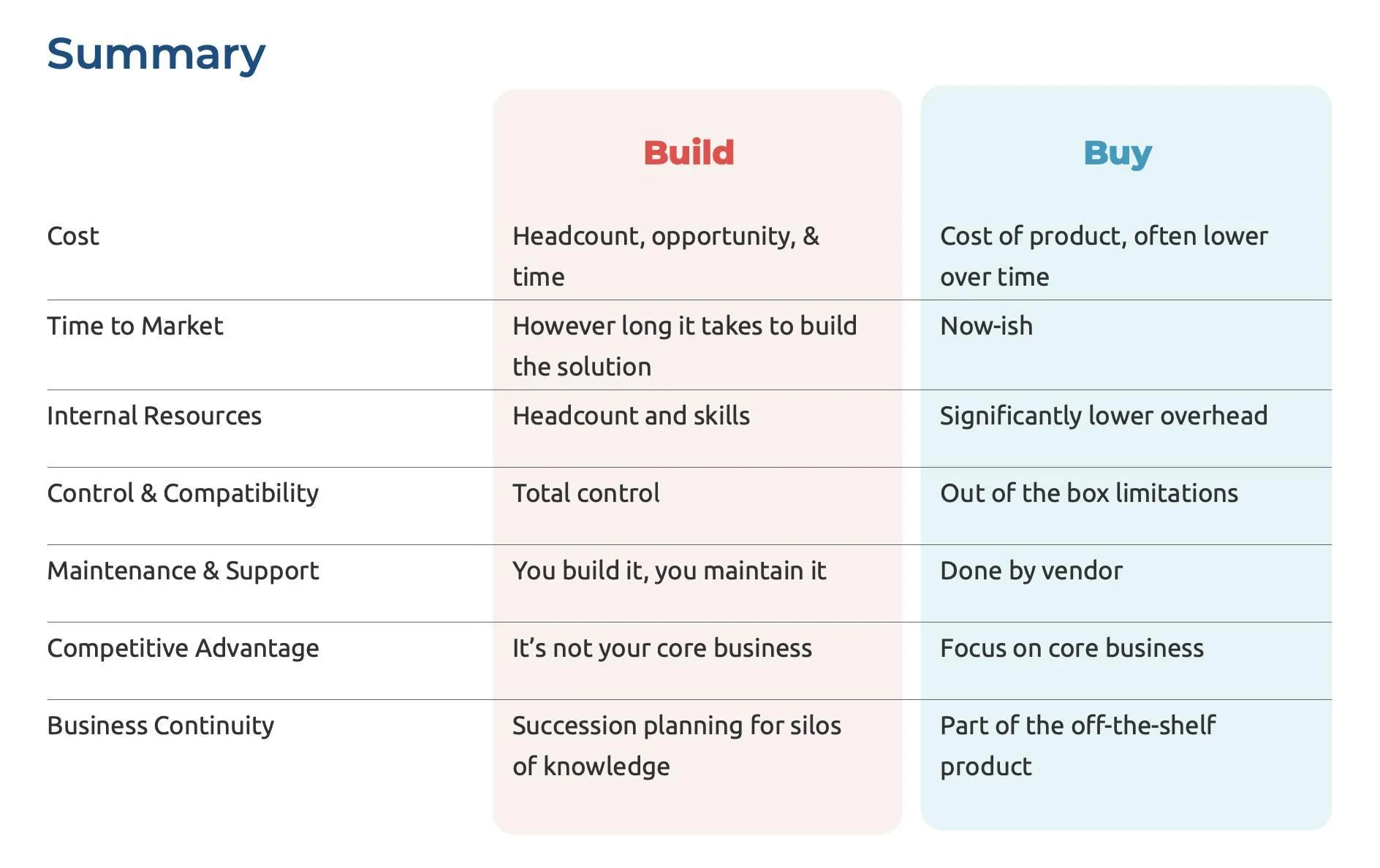
Decision matrix mapping sales process complexity to build vs buy CRM recommendation
Ownership and lock-in
Buying SaaS means renting a relationship. The vendor owns the schema, the AI models, the upgrade cycle, and the price list. Fine until they raise prices, deprecate a feature, or sunset an edition. Salesforce, HubSpot, and the rest have all done it. Migration off a CRM with two years of data, automations, and email history is a serious project, not a weekend export.
Building means owning the code, schema, data, and roadmap. You ship features without waiting on a vendor, and you host where customers require. You also own the bugs, on-call, and the hiring problem. For regulated industries, IP-heavy products, and vertical SaaS whose CRM is partly the product, ownership is the whole point. If your CRM feeds a customer-facing portal or an audit-ready AI workflow, you almost always want to own the data layer.
The hybrid pattern most teams use
Teams that look like they made a clean build-or-buy decision usually did neither. They run a SaaS CRM as the system of record and build a thin custom layer on top for the parts that matter:
HubSpot as the CRM, with a custom quoting and pricing engine bolted on via API.
Salesforce as the source of truth, with a custom partner portal for brokers and dealers.
Pipedrive for sales, plus a custom ops dashboard joining CRM data with inventory and dispatch.
Usually the cheapest path. Polished SaaS for the boring parts (contacts, deals, email, mobile, reporting) and you only build the 20 percent that is genuinely yours. Teams running this pattern often pair the custom layer with a web application or a mobile app for field reps.
Timelines and red flags
Timeline matters because revenue does not wait. Typical ranges from our delivery work, including engagements paired with staff augmentation:
SaaS rollout: 2 to 8 weeks, longer with legacy migration.
Hybrid (SaaS + custom layer): 6 to 16 weeks.
Full custom CRM: 4 to 9 months to an adopted MVP, then ongoing work.
Most build-versus-buy mistakes show up as quiet symptoms. The same warning signs appear in billing software custom vs off-the-shelf.
Red flags for buying SaaS
You pay for two CRM-adjacent tools because the main one cannot do the job.
Admins spend a day a week maintaining custom fields and workflows.
License fees will pass $250k per year in 24 months.
Reporting lives in spreadsheets because the platform cannot model your data.
Red flags for building custom
No in-house technical leadership and no plan to hire.
Sales has not agreed on the current process, let alone a future one.
Motivation is "we don't like Salesforce" rather than a specific functional gap.
Less than 12 months of runway and no urgent pain.
The most expensive mistake is building because you dislike the SaaS UX, not because the SaaS cannot model the process. UX you can fix with configuration. Modelling problems you cannot.
How Brandrums helps you pick the right CRM
Most clients come to us leaning one way. Our job is to pressure-test that lean against the sales process, headcount plan, and integration surface. Sometimes the answer is "keep HubSpot, fix the configuration, build a quoting engine on top". Sometimes "buy Salesforce now, migrate in 24 months". When custom is the call, our CRM development team handles discovery, data modelling, UX, backend, integrations, QA, and rollout, then stays on for ongoing work. We pair it with web development and digital marketing when the CRM plugs into a wider customer experience. See delivery in the Tamreeni case study.
Key takeaways
Sub-30-seat teams with a standard pipeline: HubSpot, Pipedrive, or Zoho beats building on every metric except long-term ownership.
Salesforce is rarely the cheapest, but often the most defensible enterprise pick.
Custom CRM usually pays back between years 3 and 5, sooner with heavy licensing or an unusual process.
Hybrid (SaaS plus a thin custom layer) is the cheapest way to get the best of both.
The decision is reversible. Start with what fits today, plan migration before you are forced into it.
FAQ
Is it cheaper to buy CRM software or build a custom one?
In years 1 to 3, buying SaaS is almost always cheaper. A 25-seat HubSpot or Pipedrive setup runs $40k to $90k over 3 years; a custom CRM costs $80k to $250k to build plus maintenance. Custom usually wins on total cost between years 3 and 5 as headcount and license fees grow.
When should I hire a CRM developer instead of using HubSpot or Salesforce?
When your process does not fit a standard pipeline, you have strict data ownership needs, you are at 50+ users with rising license fees, or the CRM must drive operational systems like dispatch, billing, or inventory. If the motivation is "we don't like the UX", fix the configuration first.
What does it cost to build a custom CRM in 2026?
An MVP CRM with core pipeline, contacts, basic automation, and one or two integrations runs $80k to $150k with an agency. A larger build with custom roles, quoting, reporting, mobile apps, and multiple integrations sits in $150k to $350k. Plan 15 to 25 percent of build cost per year for maintenance.
Can I start with SaaS and migrate to custom later?
Yes, and most successful teams do exactly that. Run HubSpot, Pipedrive, or Zoho for 1 to 3 years, document the parts the SaaS cannot model, then build a custom layer or full replacement. Data collected during the SaaS phase makes the custom build cheaper and more accurate.
Are SaaS CRMs better for integrations?
For mainstream tools (Gmail, Slack, Stripe, QuickBooks, Calendly), yes. SaaS marketplaces have thousands of connectors. For ERP, POS, internal systems, or anything regulated, custom almost always wins because it shares a data model instead of syncing fields one way.
How do I know if my sales process is too complex for off-the-shelf CRM?
Watch for: more than two custom objects per workflow, admins maintaining the system a day a week, reporting living in spreadsheets, and overlapping SaaS tools. Two or three of those together usually mean a custom build pays back faster than another year of workarounds.
Ready to choose the right CRM path?
The answer comes from your sales process, headcount plan, and integration surface, not a feature comparison page. Contact our team to scope a CRM build or audit, or check our pricing options to see how a custom CRM fits your budget.
Tags
About the Author

Daniel Brooks
Daniel covers web development, artificial intelligence, product design, and the technology decisions that help modern businesses grow.