Key takeaways
The single most-cited reason startups fail is building something nobody needs. CB Insights' classic post-mortem analysis found 42% died because there was no market need.
Validation costs little more than your time over a few weeks. Building a SaaS MVP costs $25,000 to $150,000 over 3 to 6 months. The math is obvious.
Real validation means commitment, not compliments. People pay deposits, sign LOIs, or hand over a credit card. They do not just nod and say "great idea."
The pre-build playbook is concrete: define your customer, run Mom Test interviews, size the market, study competitors, check search demand, run a smoke-test page, then pre-sell.
You are ready to build when there is evidence of a painful problem, a reachable market, and people who put something at stake. That is the moment to scope a lean MVP, not a moment earlier.

Founder reviewing customer interview notes alongside a smoke
Why this matters more than your idea
CB Insights' classic analysis of over 100 startup post-mortems found that "no market need" was the number one cause of failure at 42%, ahead of "ran out of cash" at 29% and "not the right team" at 23%. In a March 2026 revision using a different dataset (431 VC-backed startups that shut down since 2023), CB Insights reframed the top causes as "ran out of capital" (the proximate end of most stories) with poor product-market fit at 43%, bad timing at 29%, and unsustainable unit economics at 19%. Different studies, different methodologies, same lesson: most startups do not die from bad code. They die from building something the market did not want.
Building a SaaS MVP usually runs $25,000 to $150,000 over 3 to 6 months. We cover the ranges in detail in our mobile app cost guide and the USA app development pricing piece. Spending that before confirming demand is the expensive mistake. Validation is the disciplined process of disproving that risk before you write code.
One more datapoint that sharpens the point. Pendo's 2019 Feature Adoption Report, based on anonymised data from 615 customer accounts, found 80% of features in the average software product are rarely or never used. An older Standish Group study put the figure at 64%. Both are vendor research, so attribute with caveats, but the direction is consistent: teams build more than customers use.
What validation actually means
In plain English, validating a SaaS idea means confirming a real, urgent problem exists and that real people will pay to solve it, before you write a line of code. Three distinct things to validate, and conflating them is the classic early mistake:
Problem validation: Does the problem exist, and is it painful enough that people are already trying to solve it (spending time, money, or effort on workarounds)?
Market validation: Is the group of people with that problem big enough, reachable enough, and willing to pay enough to build a business around?
Solution validation: Does your specific approach resonate, and would people choose it over what they do today?
A useful mental model: distinguish vitamins (nice-to-haves that make something slightly better) from aspirins (painkillers for problems people will pay to fix). People reliably pay for aspirins. Most founders jump straight to solution validation and skip problem validation. That is the root error.
The frameworks worth knowing
Five sources do almost all the work. The rest of the validation literature is commentary on these:
The Mom Test by Rob Fitzpatrick. A short, practical handbook on customer interviews. Three rules: talk about their life, not your idea; ask about specifics in the past, not hypotheticals about the future; talk less and listen more. The name comes from the idea that good questions are ones even your mom cannot lie to you about.
The Lean Startup by Eric Ries. The build-measure-learn feedback loop. Validated learning as the unit of startup progress. The MVP is the version of a product that lets you complete one full turn of that loop with the least effort.
Y Combinator. Talk to users and build what they want, then iterate. Eric Migicovsky's YC talk echoes The Mom Test. Paul Graham's "make something people want" is the destination.
Value Proposition Canvas by Alex Osterwalder. A one-page tool mapping customer jobs, pains, and gains on one side, and your products, pain relievers, and gain creators on the other. When the two sides match, you have problem-solution fit.
Jobs-to-be-Done by Clayton Christensen. Customers hire a product to make progress on a job in their life. The milkshake study in HBR is the canonical reference.
The same shape repeats across all of them: get out of the building, learn from real customer behaviour, earn evidence before committing engineering resources.
The step-by-step validation playbook
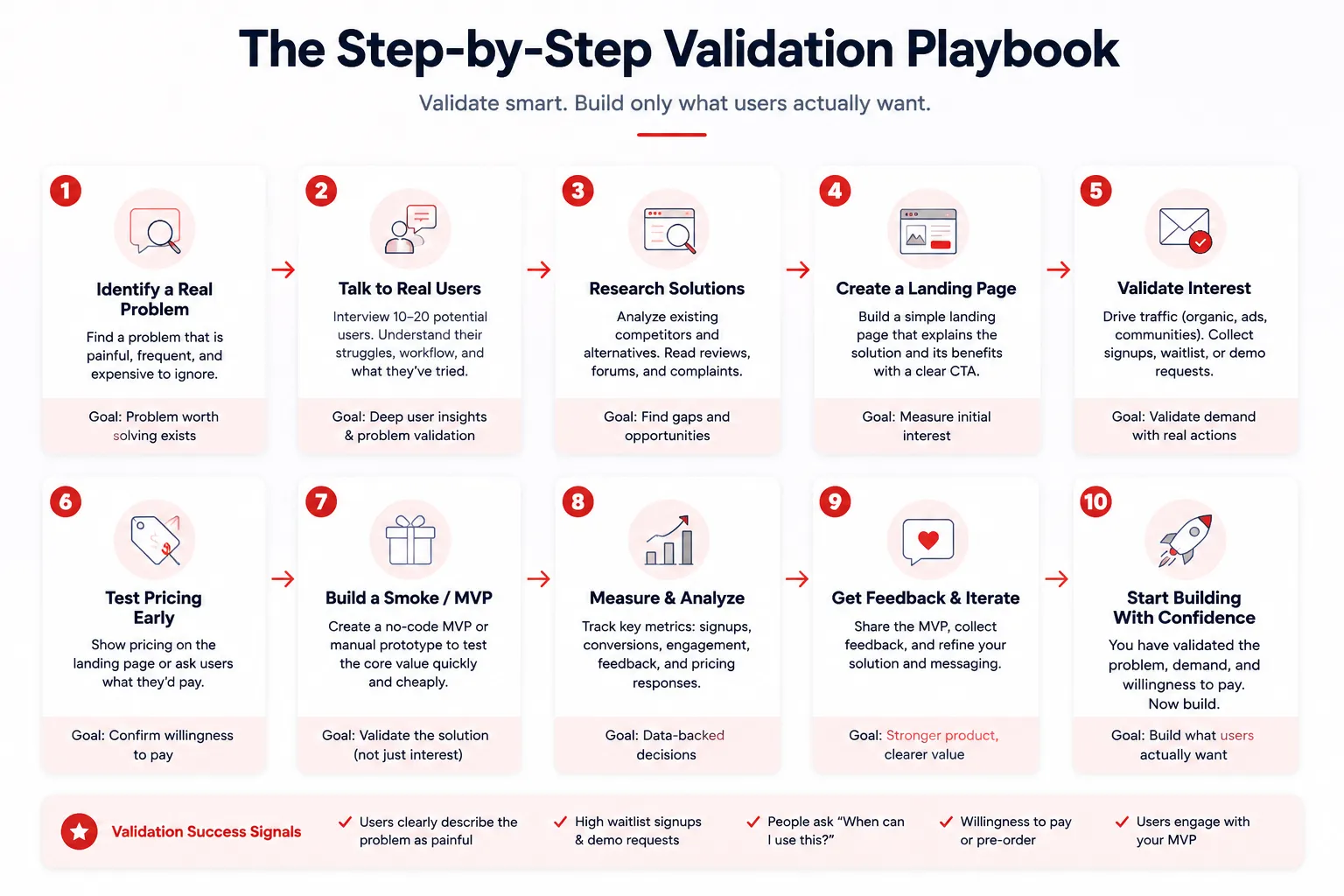
Diagram of the four
Step 1: Define the problem and your ideal customer profile
Write a one-sentence risky-assumption statement: "We believe that [specific target customer] will pay [price] for [solution] because of [problem]." Get specific about who suffers most from the problem. Some founders call this the "initial victim profile," the narrow group feeling the most acute pain, before broadening to a general ICP.
Step 2: Run customer discovery interviews (the Mom Test way)
Aim for 15 to 25 conversations with people who actually have the problem and have no social reason to be nice to you. Nielsen Norman Group research suggests 15 to 20 interviews surface the majority of core user needs, with diminishing returns beyond about 25 unless you enter a new segment. Practical rules:
Ask about their life and past behaviour: "Tell me about the last time this problem cost you time or money," not "Would you use a tool that does X?"
Avoid leading questions. "Wouldn't it be great if..." is a sales pitch, not research.
Talk less, listen more. Aim for the customer doing most of the talking.
Dig for whether they have already looked for or paid for a solution. If they have not, they may not buy yours.
Step 3: Market sizing (TAM, SAM, SOM)
Estimate Total Addressable Market, Serviceable Available Market, and Serviceable Obtainable Market. Use top-down (industry reports) and bottom-up (number of target customers times realistic annual revenue per customer) and cross-check them. As a rough investor benchmark, venture-scale opportunities are often described as TAM over $1B, SAM over $100M, SOM over $10M, with early SOM typically 1% to 5% of SAM. Avoid the "we'll capture 1% of a huge market" hand-wave. Investors read it as a red flag.
Step 4: Competitor analysis (competition is a good sign)
Existing competitors are evidence that demand exists, money is being spent, and a market has been validated for you. "No competitors" usually means no market, not a green field. Study how rivals price, position, and what their customers complain about (mine G2 reviews, app store reviews, and Reddit threads for the gaps). For a sharper view of how this plays out across SaaS categories, see our notes on B2B software solutions for small business. The same instinct shows up in our build-vs-buy work for verticals like law firm case management and custom CRM.
Step 5: Keyword and search-demand research
Use Google Keyword Planner (free with a Google Ads account) for monthly search volumes and Google Trends (free) to see whether interest is rising, seasonal, or fading. A "Breakout" term in Trends signals search volume up over 5,000%. A real example: Buffer's founder saw that "schedule Instagram post" had high volume with low SEO difficulty and used that as one early validation signal.
Step 6: The smoke-test landing page
Build one page that describes the product as if it exists, drive traffic to it, and measure whether real people take a committing action (enter an email, click a pricing plan, attempt to pre-order). The classic case is Buffer. Joel Gascoigne built a two-page site (page one explained Buffer, page two collected emails) before writing code. He then added a pricing page in the middle to test willingness to pay. Visitors picked a plan before leaving an email. Per Buffer's own blog "Idea to Paying Customers in 7 Weeks," Joel had his first paying customer within four days of launch.
The key, per Gascoigne, is that a landing page is only useful if it is built for validated learning. Real actions and real conversations, not just a "coming soon" email grab. For practical considerations on scoping these early pages, our web app design contract guide covers what to ask before any engineering commitment.
Step 7: The Dropbox-style demo video
Drew Houston could not easily show file-sync working, so he made an explainer video demonstrating the product. Two videos, not one. The first was a screencast posted to Hacker News on April 5, 2007 as part of Dropbox's Y Combinator application, with a waitlist form at the bottom. The second, more polished demo (with insider jokes for the tech crowd) was posted to Digg and Hacker News in late 2007 or early 2008 and is the one tied to the famous spike. Eric Ries recounts in The Lean Startup that the video drove hundreds of thousands of people to the site and the beta waiting list went from 5,000 people to 75,000 people overnight. Houston measured demand and urgency before committing full engineering resources.
Step 8: Pre-selling, LOIs, and crowdfunding
The strongest validation is someone putting something at stake before the product exists.
Pre-orders and deposits: Ask for a refundable deposit or a discounted lifetime / early-bird price. People will lie to you until you ask for their credit card.
Letters of intent: Common in B2B. A non-binding signed commitment to buy at $X when you launch. Useful as a signal, weak as proof. The gold standard is money actually changing hands.
Crowdfunding (Kickstarter, Indiegogo): Functions as pre-sale validation. One commonly-cited datapoint is that campaigns substantially exceeding their goal have far higher completion rates than those barely hitting minimum.
Step 9: Audience, waitlist, and communities
Grow a waitlist with a referral loop (refer friends to move up the line). A low referral rate is itself a signal of weak word-of-mouth. Hang out where your target users already are: Reddit (r/SaaS, r/startups, r/Entrepreneur and niche subs), Indie Hackers, LinkedIn, niche Slack and Discord groups, Product Hunt ("Coming Soon" pages), and Hacker News ("Show HN"). Listen for buying-signal language: "I'd pay for," "looking for a tool that," "the current tool sucks because." This is the same instinct that drives us when scoping website development work for early-stage founders.
Step 10: No-code prototypes and wizard-of-oz MVPs
Deliver the value manually before automating.
Concierge MVP: Manually provide the service to a small group who know a human is doing the work. Airbnb's founders personally hosted and managed early bookings.
Wizard-of-Oz MVP: The user thinks the product is automated, but humans run it behind the scenes. The classic example is Zappos. Founder Nick Swinmurn photographed shoes at local stores, posted them online, and bought and shipped them manually when orders came in. He validated that people would buy shoes online before building any inventory or logistics system. (Zappos was later acquired by Amazon.)
No-code tools: Figma (clickable prototypes), Bubble, Glide, Softr, and Adalo let non-technical founders build something testable without engineering. For the kinds of patterns these tools surface, see our guide to real web application examples.
Step 11: Small paid ad tests
Run a small Google Ads or Meta Ads budget to a smoke-test landing page to measure real demand at real cost. This tells you cost-per-click and cost-per-lead, and whether strangers (not friends) will click and convert. For budgeting context, WordStream by LocaliQ's 2026 Google Ads benchmarks put the average cost-per-click at $5.42 and average cost-per-lead at $66.69 across 13,474 US campaigns from April 2025 to March 2026. Wide variation by niche. Meta cost-per-lead typically runs lower than Google in most verticals.
Step 12: A/B test pricing and willingness to pay
Use a pricing page in your smoke test (as Buffer did) to see which plan people click. Or run the "dry wallet" experiment where users select a paid plan before learning the product is not built yet. The signal you want is people reaching for their wallet, not nodding along.
What validated actually looks like
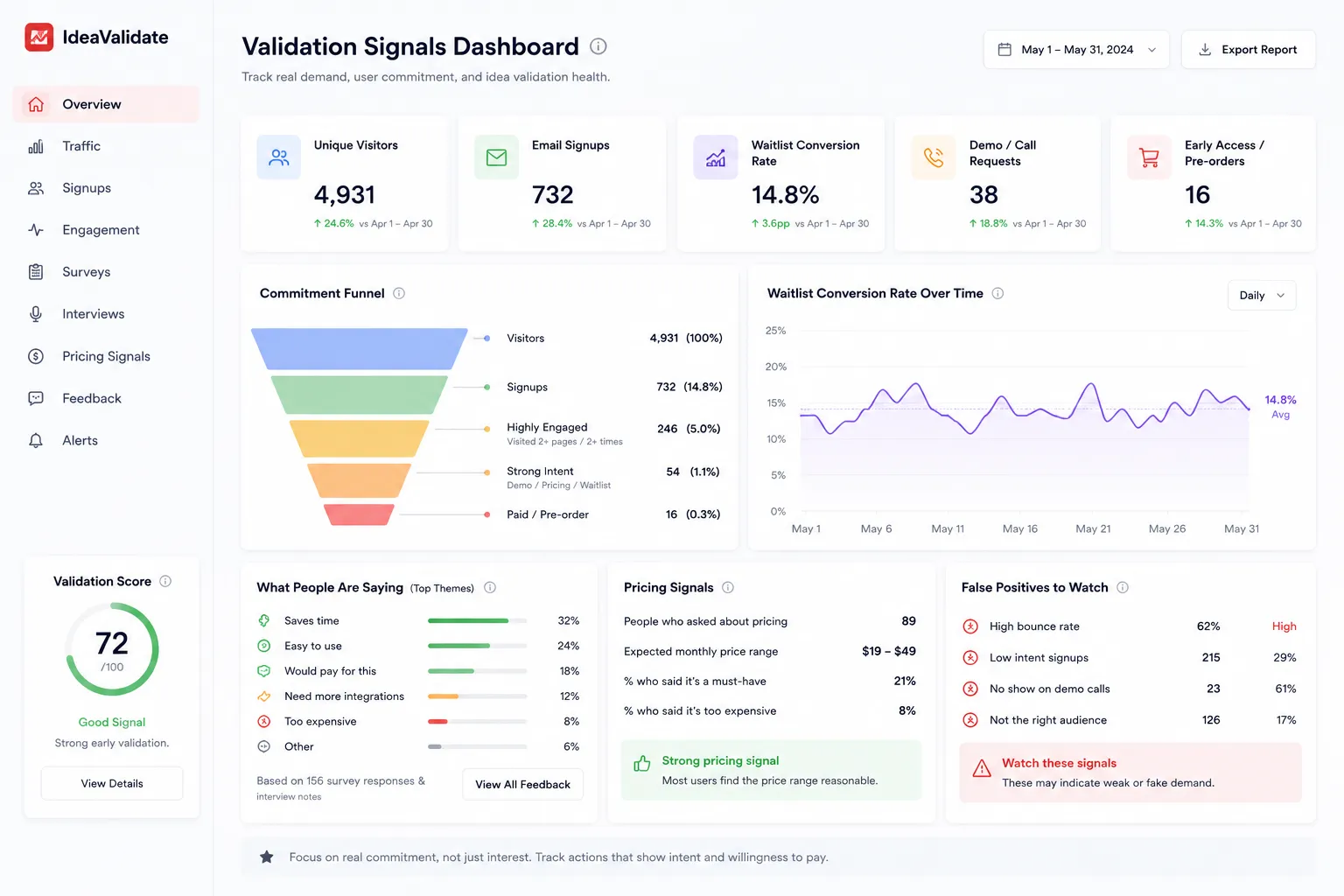
Dashboard of validation signals including commitment metrics waitlist conversion and false
Real signals (commitment):
People take a committing action: hand over an email on a low-friction waitlist, click a paid plan, leave a deposit, or pre-pay.
In interviews, they describe an active, painful problem and current spending on workarounds, and they ask "when can I buy this?" rather than "cool idea."
B2B: a decision-maker with budget signs an LOI, commits to a paid pilot, or actually pays.
Repeat engagement and word-of-mouth referrals.
Directional benchmarks (rules of thumb, not laws):
Smoke-test landing pages: a common practitioner heuristic is that 10%+ conversion on a low-friction email or waitlist CTA is a strong validation signal. For context, cross-industry median landing-page conversion is about 2.35% (WordStream), email opt-in pages average around 10.76% (GetResponse), and SaaS landing pages run a median around 3.8% (Unbounce). The biggest variable is the commitment level of the action. An email opt-in converts far higher than a pre-order.
Product-market fit (post-launch): the Sean Ellis test asks "How would you feel if you could no longer use this product?" If 40%+ of engaged users say "very disappointed," that is the standard PMF signal. Needs roughly 30+ (ideally 100+) responses to be meaningful.
False signals to ignore:
"That's a great idea." Interest is cheap. Commitment is the test.
Social media likes, landing-page visits with no conversions, or large email lists where nobody tried to pay.
Praise from friends, family, and your co-founder. Per Y Combinator, feedback from friends and family has essentially no predictive value. It is contaminated by relationship dynamics.
"I'd buy it if it had feature X." Usually a polite deferral. If the core problem is painful enough, people buy without X.
Tools that pay for themselves
Pricing changes often. Many tools have genuine free tiers suitable for validation.
Surveys and interviews: Google Forms (free), Tally (free, unlimited responses), Typeform (limited free, paid from ~$29/mo), Calendly for booking interviews (free tier), Otter.ai or Fathom for transcription (free tiers).
Landing pages and waitlists: Carrd (free; Pro from $9 to $19/year, the cheapest serious option), Framer (free tier), Webflow (free Starter, site plans from ~$14/mo), Unbounce (paid, ~$74+/mo, strong A/B testing), Kit/ConvertKit for email capture (free up to 10,000 subscribers). Dedicated waitlist tools include Getwaitlist (~$15/mo), LaunchList, Prefinery, and Viral Loops (referral campaigns, from ~$49/mo).
No-code prototypes: Figma (free Starter), Bubble (free tier), Glide (free tier), Softr (free tier; Airtable-based), Adalo (free plan; native mobile), plus AI app builders Lovable and Bolt (free tiers, Pro ~$25/mo).
Analytics: Google Analytics 4 (free), Microsoft Clarity (free heatmaps and session recordings, unlimited; note weaker privacy controls), Hotjar (free Basic), PostHog (generous free tier; product analytics, replays, feature flags).
Ad testing: Google Ads, Meta Ads, Reddit Ads (niche communities), LinkedIn Ads (B2B targeting by job title).
Keyword and search demand: Google Keyword Planner (free), Google Trends (free), AnswerThePublic (limited free), Ahrefs (paid, ~$99+/mo), Semrush (paid, ~$139+/mo).
The mistakes that kill validation
Confirmation bias. Seeking evidence that supports the idea and dismissing the rest. Real validation tries to disprove the idea. Set kill criteria before you start (for example: "if we do not get 10 pre-orders by [date], we stop").
Leading questions. "Would you use a tool that saves you 5 hours a week?" tells the person the answer you want.
Friends and family. They will be supportive, not honest. Interview strangers in your target market.
Mistaking interest for intent. Compliments and "I'd use that" are not commitments. Force a real action: email, intro, deposit, payment.
Validating the solution before the problem. Falling in love with your build and skipping problem validation entirely.
Ignoring willingness to pay. Never testing whether anyone will actually open their wallet.
Cherry-picking enthusiasts. Building for the three who loved it while ignoring the 17 who were lukewarm. Weight negative feedback heavily.
Wrong audience. Talking to people who are easy to reach rather than representative.
Analysis paralysis. Validation can become procrastination. Time-box it (two to four weeks). Once the problem is real, the solution resonates, and demand signals are positive, it is time to build.
Validating while building. Writing code and validating simultaneously creates confirmation bias because you are already committed.
When you are ready to build
You have validated enough when you can honestly check these boxes:
Evidence of a real, painful, recurring problem (not a vitamin) from multiple strangers in your target market.
A market that is large enough and reachable (defensible TAM/SAM/SOM grounded in real data).
Demonstrated demand with commitment: a converting smoke test, a waitlist with real engagement, pre-orders, deposits, signed LOIs, or best of all, money in hand.
A clear "why now": what changed in the last 24 months that makes this viable today.
That is the moment to scope a lean MVP. The smallest version that solves the core problem for your initial customer profile and lets you complete one full build-measure-learn loop. Resist feature creep. Buffer launched with a single feature (scheduling), deliberately leaving out things that felt essential. Our MVP vs full product framework walks through how to make that scope call cleanly.
Validation evidence also doubles as fundraising traction. At pre-seed, investors look for exactly these market-validation signals: waitlist, free users, LOIs, early revenue. For non-technical or solo founders, the validated-and-ready stage is where a development partner earns its keep. They translate proven demand into a well-scoped, well-built MVP quickly rather than burning months and budget discovering what to build. The sequence that works is: validate first, scope tight, then build with a team that can ship. The same logic is why our founder playbook for designing a startup app opens with discovery, not design.
A four-week validation plan
Week 1 (problem and customer, ~$0). Write your risky-assumption sentence and ICP. Run 15 to 25 Mom Test interviews with strangers who have the problem. Search Reddit, Indie Hackers, and niche communities for people venting about this exact pain. Stop or reframe the problem if you cannot find people actively trying to solve it.
Week 1 to 2 (market and demand desk research, ~$0). Size TAM/SAM/SOM with top-down and bottom-up methods. Check Google Keyword Planner and Google Trends. Map competitors and mine their reviews for gaps. Green light: rising or steady search volume and a few growing competitors. Yellow to red: no competitors and no search volume.
Week 2 to 3 (smoke test, ~$50 to $300). Build a Carrd or Framer landing page with a clear value proposition and one committing CTA. Drive a small paid-ad budget to it. Add Microsoft Clarity (free) to watch behaviour. Aim for ~10%+ on a low-friction email CTA from targeted traffic. Persistently under ~2% to 3% from on-target traffic is a warning.
Week 3 to 4 (commitment, ~$0). Add a pricing page and test willingness to pay. For B2B, pursue paid pilots or deposits over unpaid LOIs. Set a go/no-go threshold in advance: a meaningful number of real commitments (deposits, pre-orders, paid pilots, or a high-converting waitlist with referral pull).
Decision. If the evidence clears your pre-set thresholds, scope a lean MVP around the single core job and start building. This is where hiring a development team is justified. If it does not, pivot the problem, the audience, or the solution, then re-run the cheapest relevant test. Killing a bad idea in four weeks is a win, not a failure.
How Brandrums helps founders ship the right thing
Most validation work is the founder's job. Strangers in your target market, not an agency, give you the answers. But the bridge from validated demand to a built product is where outside help earns its keep. Brandrums comes in at that handoff: we scope a lean MVP around the single core job your validation surfaced, build it with the right stack for your scale, and ship it through the same delivery discipline we cover in our mobile app deployment strategy guide. You can see how we approach scoping in our project portfolio, and our work across fintech, healthcare, ecommerce, and legal shows how the same validation-first sequence holds across verticals.
Key takeaways
Most failed startups died building something nobody needed (42% per CB Insights). Validation is the disciplined attempt to disprove that risk before writing code.
Validate three things separately: the problem, the market, and the solution. Most founders skip problem validation. That is the root error.
Five frameworks do almost all the work: The Mom Test, The Lean Startup, YC's talk-to-users guidance, Value Proposition Canvas, and Jobs-to-be-Done.
The playbook is concrete: define ICP, interview, size market, study competitors, check search demand, run a smoke-test page, pre-sell. Time-box it to four weeks.
Real validation means commitment (money, deposit, signed LOI), not compliments. Build only when the evidence clears thresholds you set in advance.
FAQ
How long should validating a SaaS idea take?
Time-box it to two to four weeks. Validation can become procrastination if you let it run open-ended. Set kill criteria (specific commitment thresholds and dates) before you start. Once the problem is real, the solution resonates, and demand signals are positive, it is time to build.
How many customer interviews do I need?
Aim for 15 to 25. Nielsen Norman Group research suggests 15 to 20 interviews surface the majority of core user needs, with diminishing returns beyond about 25 unless you enter a new segment. Quality matters more than count: talk to strangers in your target market, not friends.
What is the difference between problem validation and solution validation?
Problem validation asks whether a real, painful, recurring problem exists and whether people are already trying to solve it. Solution validation asks whether your specific approach would resonate. Most founders jump straight to solution validation. That is the root error. Validate the problem first, then the market, then the solution.
Is a landing page enough to validate an idea?
No, but it is a strong early signal when designed for commitment. A landing page with an email opt-in measures interest; a landing page with a pricing page that asks visitors to pick a plan or pre-order measures intent. Buffer's pricing-page test is the canonical example. Use the smoke test alongside interviews and pre-sales, not instead of them.
How much should I spend on validation?
Most validation work costs little more than time over a few weeks. A typical breakdown: $0 for interviews, market sizing, and competitor research. $50 to $300 for a smoke-test landing page and a small ad budget. The contrast is the point: validation costs a few hundred dollars; building an unvalidated SaaS MVP costs $25,000 to $150,000.
When is it time to bring in a development team?
When you have evidence of a painful, recurring problem from multiple strangers, a defensible market, and people who put something at stake (deposits, pre-orders, paid pilots, signed LOIs). That is the moment to scope a lean MVP around the single core job and bring in a partner who can build it cleanly. Our mobile application and website development teams scope these MVPs around the validated demand, not around feature wishlists.
Ready to scope the right MVP after validation?
The teams that ship products customers actually pay for share one thing: they earned evidence before they wrote code. Tell us what your validation surfaced and we will scope the leanest MVP that proves it in production. Or review our pricing options if you are evaluating engineering support for the build phase.
Tags
About the Author
Richard Brown
Related Posts
Best POS System for Restaurants in 2026: Toast, Square, Lightspeed, Clover or Custom Build?
Best Law Firm Billing Software in 2026: Clio, TimeSolv, Bill4Time, LeanLaw or a Custom Build?