Key takeaways
For most independent restaurants, off-the-shelf POS (Toast, Square, Lightspeed, Clover) is the right call in 2026; the real cost is processing fees, not software.
Toast leads full-service, Square wins on simplicity and price, Lightspeed suits multi-location, Clover is strong for quick service.
Custom POS becomes economical around 15 to 25 locations, with payback driven by processing fee savings and delivery integration control.
Menu complexity and third-party delivery volume (DoorDash, Uber Eats, Grubhub) are bigger build triggers than headcount.
A realistic custom restaurant POS lands at $60k to $250k for v1 plus 15 to 20% annual maintenance, versus $250k+ over three years for enterprise SaaS at the same scale.
Picking the best POS system for a restaurant in 2026 is less about sales-page features and more about which decisions you can live with for three years. Toast, Square, Lightspeed and Clover all work, with sharp edges that show up after the two year contract and proprietary hardware lock in. This guide compares the four on 2026 pricing, then lays out the triggers that justify a custom POS build instead.
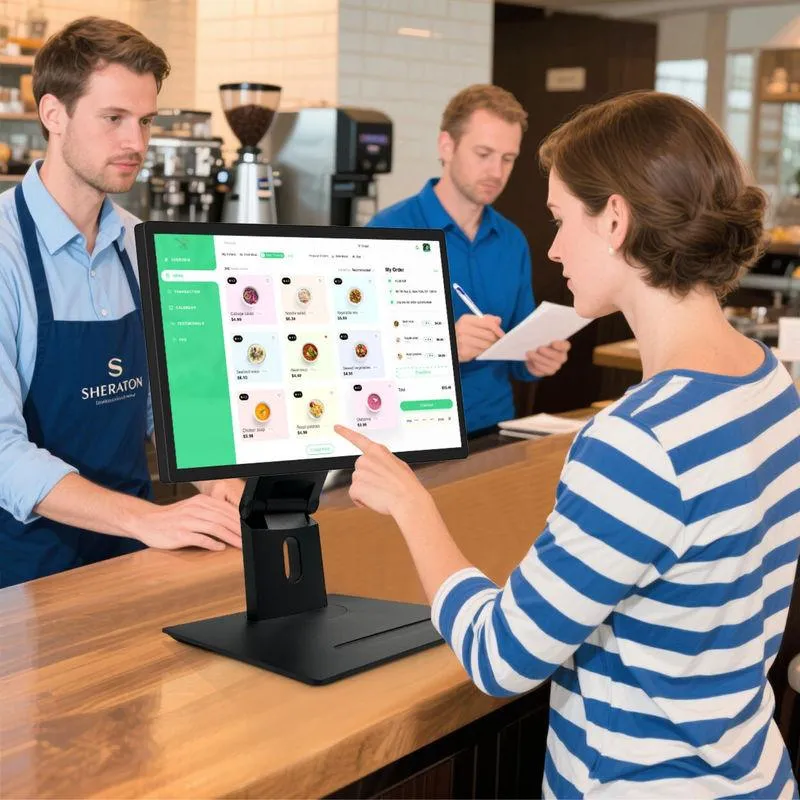
Restaurant counter with a tablet POS displaying a comparison of Toast, Square, Lightspeed and Clover dashboards, hero image at top of article
The 2026 restaurant POS landscape
Four platforms dominate North American restaurant POS in 2026: Toast (full-service and growing chains), Square (cafes, food trucks, single-site independents), Lightspeed (multi-location and upscale), and Clover (quick service). All four are cloud-first, push integrated payments, and lock you into proprietary hardware. The differences live in processing rates, kitchen display routing, multi-location reporting, and whether delivery integrations are first-class or duct-taped. In our work with restaurant and hospitality clients the pattern repeats: the platform that wins for one concept is the wrong call for the sister brand across the street.
Toast: built for full-service, expensive once you scale
Toast is the default for sit-down restaurants in 2026. Server handhelds, coursing, table management and tip pooling are first-class. Starter Kit is technically $0, Point of Sale sits at $69 per location, Build Your Own opens at $110 before add-ons (each $50 to $165 per month per 2026 Toast pricing breakdowns).
Processing is the number that matters: 2.49% plus 15 cents in-person on the paid tier, 3.09% plus 15 cents on free, 3.50% plus 15 cents online. A restaurant doing $50k per month in card volume often pays $1,500 to $2,500 all-in. Terminals start around $799, contracts run two years with $1,000 to $5,000 termination fees. If you plan to grow into a chain and care about custom mobile ordering experiences, the long-term math gets uncomfortable.
Square for Restaurants: cheapest entry, weakest at scale
Square is the right answer for a single-location cafe, food truck or counter-service concept that needs to be live this weekend. Free is $0 with 2.6% plus 10 cents in-person, Plus is $60, Premium negotiates rates as low as 2.4% plus 10 cents. Hardware is friendly: Square Terminal around $299, a Stand kit under $200, an iPad register at the price of an iPad.
Where Square stops working is operational depth. Coursing, complex modifiers, prep station routing and ingredient-level inventory exist but feel bolted on next to Toast or Lightspeed. With more than 80 SKUs and serious modifier logic, or more than three sites with shared inventory, you will hit the ceiling inside a year. Founders shipping a companion app should check our 2026 food delivery app development cost breakdown before committing to Square's online ordering.
Lightspeed Restaurant: the multi-location workhorse
Lightspeed targets the operator who has outgrown Square but does not want to rebuild on Toast. Plans run $69 per location for Essentials up to $399 for Premium with advanced analytics and API access. Lightspeed Payments runs 2.6% plus 10 cents in person and 2.6% plus 30 cents online.
Wins: floor plan management across sites, deep inventory with recipe costing, an open API, reporting that holds at 5 to 30 locations. Gaps: a steeper learning curve, hardware costs that climb fast with kitchen displays and kiosks, and a US support footprint that lags Toast. For upscale and hotel groups running parallel ecommerce or retail operations, Lightspeed is often the cleanest off-the-shelf answer.
Clover: strong on quick service, contract terms to watch
Clover is the workhorse for counter-service, fast casual and quick service. Quick Service runs $135 to $245, Full Service opens at $179, all on 36 month hardware financing. In-person processing is a flat 2.3% plus 10 cents across tiers per NerdWallet's 2026 Clover vs Square comparison, the most attractive rate of the four.
The catches: hardware is locked to Clover (no easy processor switch without scrapping terminals), the app marketplace is uneven, and 36 month financing loads software cost into hardware. Clover works best for owner-operators who want predictable monthly payments, not for groups planning aggressive expansion. For a sister-industry view, see our case management software analysis for law firms.
Side
Side by side: the 2026 numbers that decide it
The picture only emerges when you put base software, processing, hardware and multi-location depth in the same table. Use this as a starting point, not a quote.
Platform | Entry monthly (per location) | In-person processing | Hardware floor | Best fit | Multi-location ceiling |
|---|---|---|---|---|---|
Toast | $0 to $69 | 2.49% + 15c (paid tier) | $799+ proprietary | Full-service, casual dining | Strong to 50+ locations |
Square for Restaurants | $0 to $60 | 2.4% to 2.6% + 10c | $0 (BYO iPad) to $299 | Cafes, food trucks, single site | Workable to 3 to 5 locations |
Lightspeed Restaurant | $69 to $399 | 2.6% + 10c (Payments) | $500+ flexible | Upscale, hotel groups, chains | Strong to 30+ locations |
Clover | $135 to $245 | 2.3% + 10c (flat) | Bundled, 36 month finance | Quick service, counter only | Workable to 10 locations |
Three observations. Headline software fees matter least; processing dominates total cost above $30k monthly card sales. Clover has the best rate but locks you in hardest. None publish enterprise pricing publicly, so anyone at 10+ locations is negotiating, not picking a plan. The cost model in our hire a CRM developer vs buy CRM software analysis applies line-for-line to POS.
A decision framework: chain size, menu complexity, delivery mix
The off-the-shelf vs custom POS question is a budget exercise driven by three variables you can measure today.
Variable 1: number of locations
Under 5 locations, off-the-shelf almost always wins. Between 5 and 15, the math gets close. Above 15 to 25, custom pays back inside 24 months through processing renegotiation and the loss of per-location software fees. Industry data on custom POS for franchises in 2026 puts a 20-location custom build at $60k to $90k versus $150k to $300k for an enterprise SaaS three year commitment.
Variable 2: menu and operational complexity
More than 150 SKUs with three-plus modifier layers? Four or more prep stations with different timing logic? A central commissary or shared inventory across sites? Yes to two or more, off-the-shelf will hurt. A custom web application on top of a payments processor often beats a forced-fit SaaS here.
Variable 3: delivery and third-party integration mix
If DoorDash, Uber Eats and Grubhub make up more than 30% of revenue, your POS choice is mostly a delivery integration choice. Toast and Lightspeed have first-party integrations; Square and Clover rely on middleware like Otter or Chowly at $50 to $100 per month per location. Above 30% delivery share, latency and menu sync errors become a revenue drag. A custom integration layer means you control the API contracts and ship menu changes in minutes.
What custom restaurant POS costs in 2026
The million-dollar enterprise project myth is dead. Modern stacks (React Native or Flutter on the terminal, Node or Go on the backend, Stripe Connect or Adyen for payments) collapse the build cost. Realistic ranges:
$60k to $120k: single-concept chain (5 to 15 locations) with table management, kitchen displays, basic inventory and one delivery integration.
$120k to $250k: multi-concept group (15 to 40 locations) with shared inventory, loyalty, analytics and three or more delivery integrations.
$250k+: franchise operator or virtual brand platform with white-label tenant support, central commissary, open API for franchisee tools.
Plan for 15 to 20% of build cost per year in maintenance. Hardware stays off-the-shelf (Elo, Star Micronics, Verifone). The framing in our custom vs off-the-shelf law firm billing software piece applies: own the workflow that defines your business, rent the rest.
Hidden costs nobody quotes you for
Whether you buy or build, these line items get missed in the original quote and show up in month three, especially if rollout coincides with a marketing launch or rebrand.
Hardware refresh every 4 to 5 years at $1,500 to $4,000 per location.
Network resilience: a second internet line and 4G failover at $80 to $150 per location per month.
Processing renegotiation: above $500k annual card volume per site, you can shave 20 to 40 basis points by moving to Stripe, Adyen or a regional acquirer.
Staff training: 4 to 12 hours per server plus the productivity dip during cutover.
Integration drift: delivery, accounting and loyalty apps ship breaking changes 2 to 4 times per year. Without an owned layer, the vendor bills for the fix.
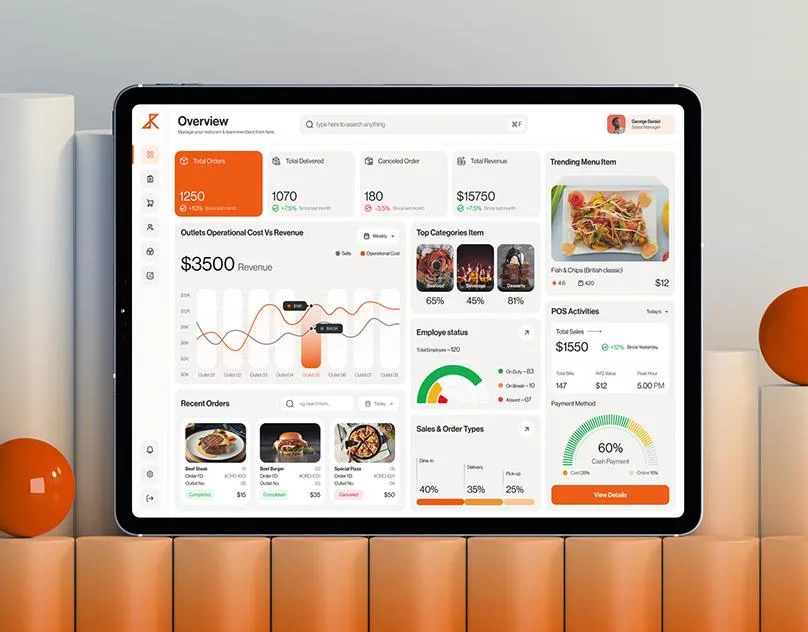
Restaurant operations dashboard showing real
Migration: switch without losing a weekend
Switches go badly when operators cut over on a Monday morning. Safer pattern: run both systems in parallel for 7 to 14 days on one quiet shift per day with a pilot location. Export everything from the legacy POS before signing cancellation, because vendors slow-walk exports once you have left. Rebuild reports before cutover, then roll the rest in waves of two to four sites per week. Keep the old hardware on a shelf for 90 days as a Friday-rush fallback. Our web app redesign checklist doubles as a sister document for the operations dashboard side.
So which POS is the right call in 2026?
One to three full-service restaurants where server workflow matters more than price: Toast. A single cafe, food truck or counter spot live this weekend: Square. Five to thirty upscale or multi-brand sites needing deep inventory and API access: Lightspeed. Quick service with high volume and a need for the lowest processing rate: Clover, hardware lock-in accepted. Cross 15 locations, run a complex menu, or pull more than 30% of revenue through delivery: model a custom build, because the three year math usually wins. The development partner you choose matters more than the platform once volume scales.
Key takeaways
Toast wins full-service, Square wins simplicity, Lightspeed wins multi-location, Clover wins quick service.
Processing fees, not software fees, dominate total cost above $30k monthly card volume.
Custom POS pays back at 15 to 25 locations or when delivery is over 30% of revenue.
Realistic custom build: $60k to $250k for v1, plus 15 to 20% annual maintenance.
Migrate in waves with a 90 day fallback, never cut over a whole group on a Monday.
FAQ
Which POS has the lowest total cost for a single restaurant?
For a single-site independent doing under $30k per month in card volume, Square for Restaurants on Free or Plus usually has the lowest three year cost, especially with a BYO iPad. Above $50k per month or with more than two terminals, Toast or Clover can pull ahead thanks to lower processing rates.
When does a custom POS make financial sense?
Break-even is usually between 15 and 25 locations, earlier with very high card volume per site or heavy delivery exposure. A 20-location custom build at $60k to $90k plus maintenance typically beats an enterprise SaaS commitment of $150k to $300k over three years, and the gap widens with negotiated processing rates.
Can I migrate POS systems without losing menu and customer data?
Yes, if you do the export work before you cancel. Major platforms support CSV exports of menu, modifiers, customers and sales history, but once your account is in cancellation, exports slow and support thins. Plan a 30 day overlap, export in week one, rebuild reports in week two, pilot one location in weeks three and four.
How much do delivery integrations affect POS choice?
Heavily. Toast and Lightspeed have first-party DoorDash and Uber Eats integrations that handle menu sync, tax routing and order injection cleanly. Square and Clover rely on middleware like Otter or Chowly at $50 to $100 per location per month, which adds latency. Above 30% delivery share, integration quality outweighs other POS features.
What hardware should I buy if I might switch POS later?
Avoid Clover and Toast hardware because both are tied to their software. iPad-based setups (Square, Lightspeed, custom builds) preserve flexibility. Star Micronics printers, Elo touchscreens and Verifone terminals are the most portable choices across platforms.
Choosing between off-the-shelf POS and a custom build? Our team builds restaurant operating systems across restaurant and hospitality and on-demand brands, from single-site ordering apps to franchise platforms. Book a free scoping call or review transparent development and platform pricing before you sign your next two year POS contract.
Tags
About the Author

Daniel Brooks
Daniel covers web development, artificial intelligence, product design, and the technology decisions that help modern businesses grow.