TL;DR
A custom DAM makes sense when your workflows, integrations, asset types, scale, or data-sovereignty needs outgrow off-the-shelf SaaS, and when recurring per-seat or per-storage fees start to rival the cost of owning the software outright. For standard needs, buy. For differentiated needs, build (or take a hybrid path on open-source or headless APIs).
The DAM market is real and growing fast. Estimates cluster around USD 6 to 8 billion in 2025 to 2026 with double-digit CAGRs (roughly 14% to 18% depending on the research firm), driven by content explosion and AI. SaaS DAM pricing is overwhelmingly quote-based and can run from a few thousand to well over USD 100,000 per year.
A custom DAM MVP is realistically a 3 to 6 month build. Full enterprise builds run 9 to 18 months. Cost is dominated by scope (AI, video, integrations) and team location. Offshore engineering rates give an experienced agency partner a meaningful cost advantage over North American shops.
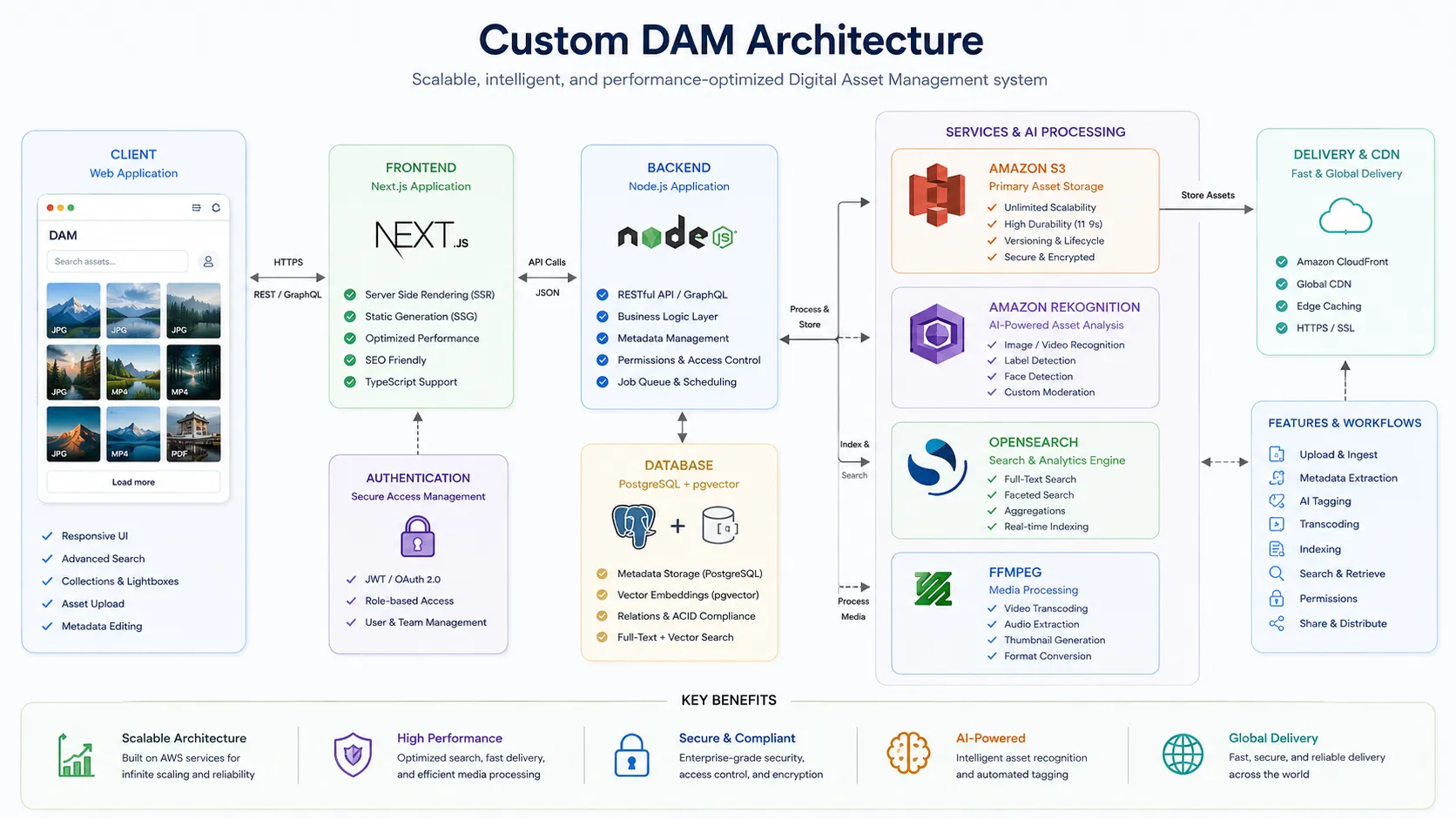
Custom DAM architecture diagram showing Next.js front end, Node backend, S3, OpenSearch, pgvector, FFmpeg, and Rekognition
What a DAM actually is (plain English)
A Digital Asset Management system is a centralised platform to store, organise, manage, retrieve, and distribute digital assets along with their metadata. Assets include images, video, audio, documents, logos, brand assets, design files, and increasingly 3D models. The core idea is a single source of truth for digital content.
Key concepts:
Assets: the binary files themselves (JPEG, MP4, AI, PSD, PDF, GLB, and so on).
Metadata: descriptive data about each asset (keywords, usage rights, license expiry, version tags, EXIF and IPTC camera and location data).
Taxonomy: the controlled vocabulary and hierarchy used to classify assets so they are findable.
Version control: tracking revisions so teams always use the latest approved file and can revert when needed.
Rights management: tracking usage rights, licenses, and expirations to avoid legal exposure.
How it differs from adjacent tools:
vs cloud storage (Google Drive, Dropbox): cloud storage handles basic file hosting, folders, and share links. A DAM adds rich metadata, AI search, version control, granular permissions, rights management, workflows, brand governance, and deep integrations.
vs CMS: a CMS (for example WordPress) manages and publishes website content such as pages and blogs. A DAM manages the media files. The two often integrate, with the DAM storing assets and the CMS publishing them. We unpack the build-vs-CMS angle in our WordPress vs custom build guide.
vs PIM: a PIM manages structured, relational product data (SKUs, specs, pricing). A DAM manages unstructured binary media. They are complementary and frequently integrated.
Who uses it: marketing and brand teams, e-commerce and retail, media and publishing, creative agencies, manufacturing and CPG, and enterprises generally. Media and entertainment is the largest end-user segment. Per Mordor Intelligence, media and entertainment held 32.12% share of the DAM market in 2025, while healthcare and life sciences are the fastest-growing vertical at a 15.51% CAGR to 2031. For the brand-asset side of the use case, our online branding services 2026 guide covers what those assets are and why consistency at scale needs a system, not a shared drive.
Why DAM matters (the business case)
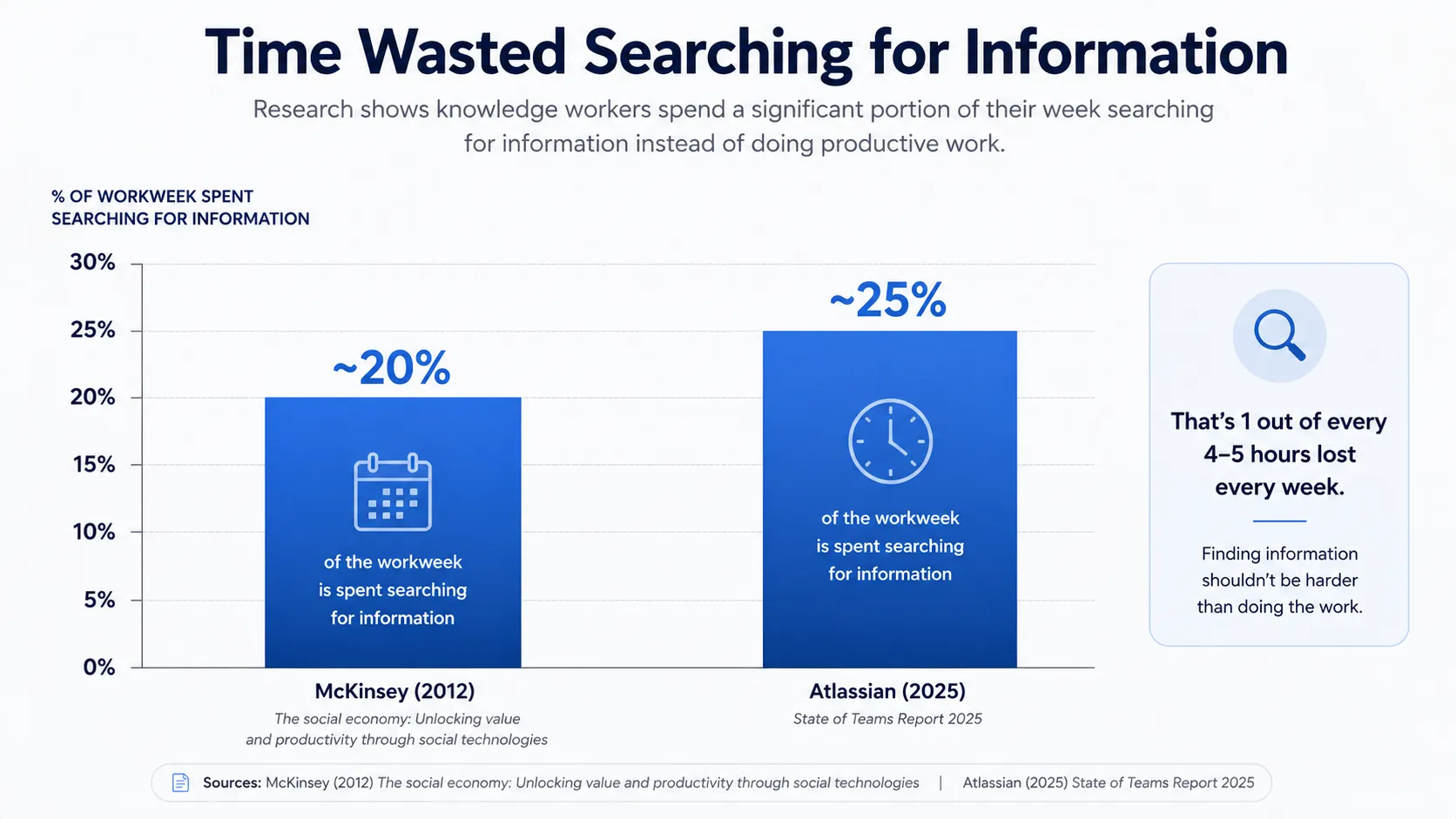
Bar chart of time wasted searching for information citing McKinsey 2012 ~20% and Atlassian 2025 ~25% of workweek
Problems a DAM solves: scattered assets across drives and inboxes, wasted time searching, version confusion, brand inconsistency, duplicate work, rights and licensing risk, and slow content workflows.
Time wasted searching (sourced carefully). The most-cited stat ("employees spend 1.8 hours per day, 9.3 hours per week, searching and gathering information") is attributed to McKinsey. The original primary source is the McKinsey Global Institute report "The Social Economy: Unlocking value and productivity through social technologies" (July 2012), which states the average interaction worker spends "nearly 20 percent" of the workweek looking for internal information, and that a searchable record could cut search time by as much as 35%. The 20% figure blends IDC and McKinsey analysis. The defensible version of the stat is the roughly 20% / one-day-per-week figure, presented as dated. For a current corroborating data point, the Atlassian State of Teams 2025 report (200 Fortune 1000 executives and 12,000 knowledge workers) found that "executives and teams alike spend a quarter of the workweek searching for information," totalling 2.4 billion hours wasted searching each year within the Fortune 500.
Asset re-creation waste. In a survey of 3,400 creatives and marketers, 51% reported wasting money producing and recreating assets that go unused because people do not know they exist or cannot find them (Bynder, "The Top Six Ways DAM Delivers ROI"). Separately, Bynder's "What Is Digital Asset Management?" guide attributes a related figure to Gartner: marketing teams spend up to 30% of their time on non-value-adding tasks like file hunting and manual asset management. Both are vendor-published and should be attributed as such.
Market size (flag as estimates that vary widely). Different research firms publish materially different numbers because they define the market differently:
Mordor Intelligence: USD 6.42B in 2025, USD 7.51B in 2026, reaching USD 14.42B by 2031 (13.94% CAGR, 2026 to 2031). North America held a 36.27% share in 2025. Asia-Pacific is set to grow at a 14.84% CAGR.
MarketsandMarkets: USD 6.23B in 2025 to USD 14.51B by 2031 (15.4% CAGR). The AI-powered DAM segment is projected to grow fastest at 17.5%.
Fortune Business Insights: USD 5.36B in 2025, USD 6.29B in 2026, to USD 19.36B by 2034 (15.10% CAGR).
Grand View, Straits Research, IMARC, and others land in similar ranges with CAGRs of roughly 13% to 18%.
IDC's software-only forecast is more conservative: a 9.8% CAGR from 2023 to 2028 (IDC Worldwide Digital Asset Management Software Forecast, 2025 to 2028).
ROI evidence. A Forrester Total Economic Impact study commissioned by DAM vendor Wedia (2024) found that a composite organisation realised 434% ROI over three years with a payback period of under 6 months. As with all vendor-commissioned TEI studies, this models a best-case composite of interviewed customers, so treat it as directional, not an industry average.
Custom vs off-the-shelf (build vs buy)
Real off-the-shelf and SaaS DAM products (verified current): Bynder, Brandfolder (by Smartsheet), Canto, Adobe Experience Manager Assets (AEM), Acquia DAM (formerly Widen), MediaValet, Cloudinary, Frontify, Aprimo, Filecamp, and others. AEM Assets now ships in Prime and Ultimate tiers with Adobe Firefly generative AI and "agentic" features. Bynder announced generative AI built on Amazon Bedrock.
SaaS DAM pricing model. Overwhelmingly quote-based, scaling by number of users, storage volume, feature modules, and contract term. Published or reported data points:
Bynder: reportedly starts around USD 450/month at entry level. Third-party contract benchmarks (SpendHound) show SMB averages around USD 33,663/year and enterprise averages around USD 124,668/year. Professional services (implementation and migration) commonly add 15 to 30% of first-year contract value, and third-party data shows renewals escalating roughly 22 to 23% year over year in some segments.
Canto and Bynder package estimates of roughly USD 15,000 to USD 20,000/year per one comparison (Tagbox), with Bynder roughly USD 2,000/TB/year storage and USD 500/user/year as a rough heuristic.
Cloudinary: publishes tiers (Free, Plus at USD 89/month, Advanced at USD 224/month, custom Enterprise) using a usage-credit model (1 credit equals 1,000 transformations or 1 GB storage or 1 GB bandwidth).
Acquia DAM: reportedly starts around USD 49/user/month.
Industry commentary notes enterprise DAM implementations often require an investment of at least USD 50,000 plus roughly 6 months to implement, with setup and migration adding USD 30,000 to USD 50,000.
When to buy off-the-shelf: standard needs, fast time-to-value, lower upfront cost, vendor-managed hosting, security, and updates, and a mature feature set out of the box.
When to build custom: unique workflows; specific integrations into your stack; full control and ownership; avoiding per-seat or per-asset licensing fees that escalate; data sovereignty and regulatory needs; avoiding vendor lock-in; scale economics (when SaaS fees rival ownership costs); and special asset types (such as 3D or CAD) or bespoke AI.
Honest trade-offs. Custom means higher upfront cost and time, and you own maintenance. Off-the-shelf is faster but carries recurring fees, less flexibility, and potential lock-in. Raw file export is usually possible, but custom tags, workflow states, and usage analytics often do not export cleanly, which is itself a lock-in risk. The same scope-vs-sticker logic from our WordPress vs custom build guide and the validation discipline in our SaaS validation playbook apply directly.
Hybrid option. Build on an open-source DAM (Pimcore, which bundles DAM with PIM, CMS, and MDM under GPLv3 with a free Community Edition; ResourceSpace under a BSD license; Razuna; Phraseanet) or on headless DAM and media APIs (Cloudinary). This gives ownership and customisation while reusing proven foundations.
Core features of a custom DAM
Ingestion and upload: bulk upload, drag-and-drop, watch folders, API ingestion, multipart upload for large files.
Storage: cloud object storage (AWS S3 or compatible).
Metadata management: custom schemas, auto-extraction of EXIF and IPTC.
Tagging and taxonomy: manual plus AI auto-tagging.
Search and filtering: full-text, faceted, AI / visual, and semantic search.
Organisation: folders, collections, albums, hierarchies.
Version control and asset history.
Preview and rendering: thumbnails, video preview, document preview, transcoding.
Image and video processing: resizing, format conversion, transformations, on-the-fly CDN delivery.
Access control and permissions: roles, user groups, granular asset and folder-level permissions.
Rights and licensing management: usage rights, expirations, copyright, watermarking.
Workflow and collaboration: approvals, comments, annotations, status.
Sharing and distribution: share links, portals, embeds, brand portals.
Integrations: CMS, PIM, e-commerce, Adobe Creative Cloud, social, marketing tools via API and webhooks.
Analytics and reporting: asset usage, downloads, popular assets.
AI features: auto-tagging, content recognition, smart cropping, visual and semantic search, background removal, generative features.
Brand management and brand portal.
Audit logs and security.
Technical architecture and tech stack
High-level architecture: front end, backend and API, metadata database, object storage, search engine, CDN, an async processing and transcoding pipeline, and AI services.
Storage. AWS S3 handles objects up to 5 TB (50 TB via the multipart API). Best practice is multipart upload for files 100 MB or larger, often via presigned URLs and S3 Transfer Acceleration, which AWS shows can cut upload time by up to 61%. The AWS-side primitives we walk through in our AWS for non-technical founders guide map cleanly here.
Database. PostgreSQL or MongoDB for metadata. Elasticsearch, OpenSearch, or Algolia for fast faceted and full-text search (OpenSearch is the Apache-2.0 AWS fork of Elasticsearch). A documented real-world migration to OpenSearch cut metadata search from about 60 seconds to about 4 seconds.
Vector database. For AI semantic and visual search, store embeddings in a vector store. pgvector (a Postgres extension) keeps vectors alongside relational data, minimising architecture complexity. Alternatives include Pinecone, Milvus, Weaviate, FAISS, and Chroma.
Media processing. Sharp for images. FFmpeg or AWS Elemental MediaConvert for video transcoding and thumbnail / poster-frame generation. Async processing via queues (Redis or SQS) and orchestration (Lambda plus Step Functions). MediaConvert bills by duration of output video, and frame capture is free.
CDN. CloudFront for delivery and edge caching, with on-the-fly image transformation.
AI / ML. Vision AI for auto-tagging and content recognition (Amazon Rekognition is priced at USD 0.001 per image for the first 1 million images per month, dropping to USD 0.0008 for the next 9 million and USD 0.0006 thereafter, per the official AWS pricing page; or open CLIP models). Embeddings for semantic search. Smart cropping. Generative features. CLIP generates 512-dimension multimodal embeddings enabling text-to-image and image-to-image search. The agent-governance discipline we cover in our audit-ready AI agents guide applies to AI tagging: keep humans in the loop on the labels that drive search.
One viable stack (alternatives exist): React / Next.js front end; Node.js (Express or NestJS) backend; PostgreSQL (with pgvector) and / or MongoDB; Elasticsearch or OpenSearch; S3; Redis for caching and queues; CloudFront; FFmpeg and Sharp; Rekognition or self-hosted CLIP. This is the MERN, Next.js, AWS, and AI / RAG stack we ship through our web application development, SaaS development, and enterprise app development services. The Next.js deployment shape is in our Next.js on AWS guide.
Scalability, security, and performance. Server-side encryption (SSE-S3 or SSE-KMS by default on S3), SSO and MFA, granular permissions, audit logs, lifecycle rules to clean up incomplete multipart uploads, and horizontal scaling of the search and processing tiers.
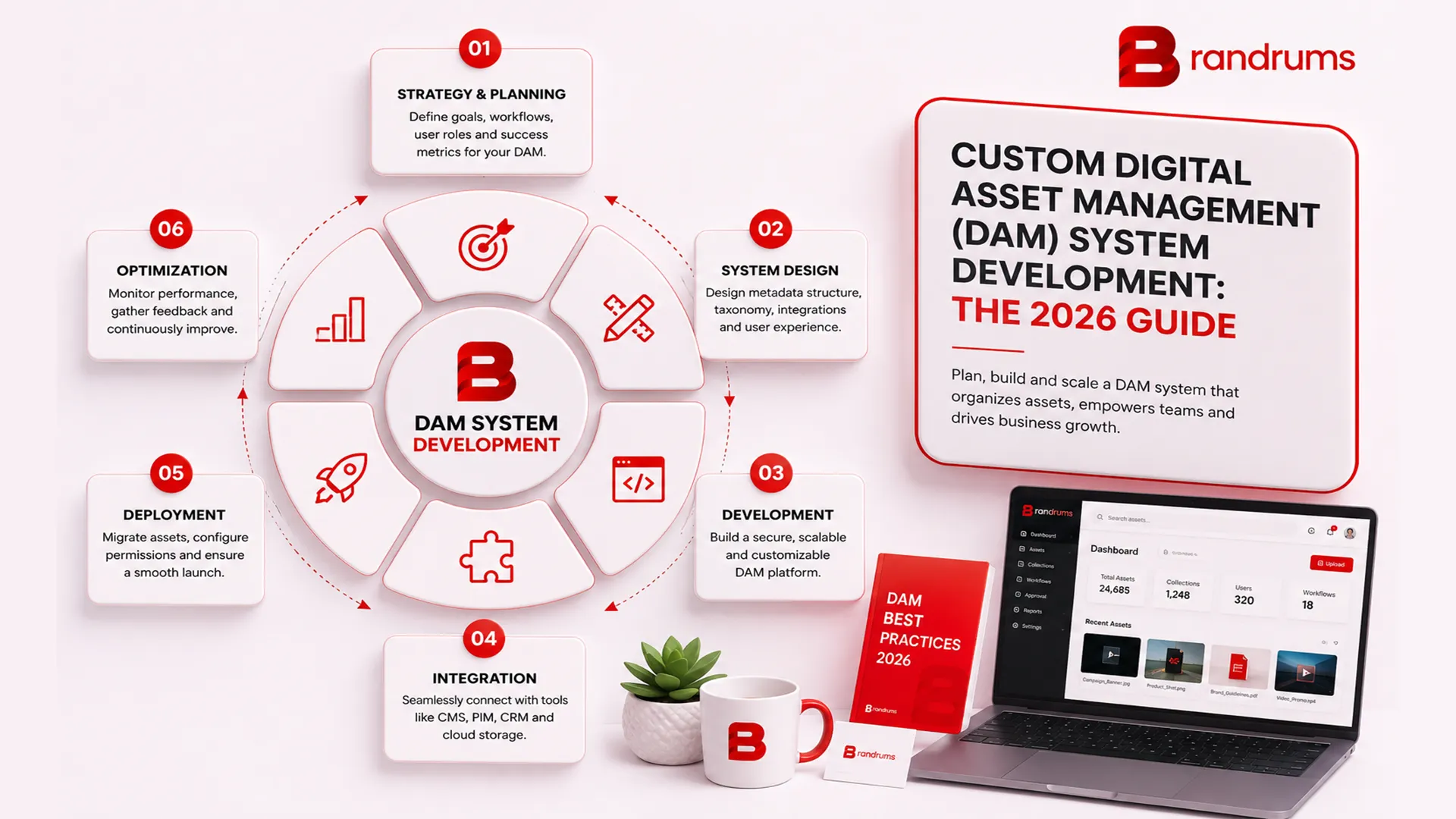
The development process (phased)
Discovery and requirements.
Define taxonomy and metadata schema (often the most underestimated effort. Governance can consume 15 to 25% of program budgets in enterprise deployments).
UX / UI design.
Architecture design.
MVP feature scoping (start narrow: ingestion, storage, metadata, search, permissions).
Iterative development.
Integrations.
Testing, including with realistic asset volumes.
Migration of existing assets (cleaning and mapping metadata often dwarfs software configuration).
Deployment.
Training and change management (this drives adoption).
Ongoing maintenance (typically 15 to 25% of build cost per year).
The procurement and scope discipline that protects this process lives in our web app design contract questions guide, and the launch-side review checklist is in our web app redesign checklist.
Cost and timeline (estimates, clearly flagged)
These are engineering estimates, not quotes. Actual figures depend on scope.
General custom software benchmarks (2025 to 2026). Most custom software projects fall in the USD 75,000 to USD 250,000 range. Simple apps from roughly USD 15,000 to USD 80,000. Complex enterprise systems exceeding USD 300,000 to USD 2M-plus. AI / ML integration commonly adds USD 20,000 to USD 150,000. Annual maintenance runs roughly 15 to 25% (some sources say up to 50 to 60%) of build cost.
DAM-specific estimate. At least one development-vendor breakdown puts basic DAM solutions at USD 40,000 to USD 70,000 and enterprise-grade platforms above USD 250,000.
Reasoned ranges for a custom DAM:
MVP (core ingestion, storage, metadata, faceted search, permissions, basic preview): roughly 3 to 6 months.
Full enterprise build (AI tagging and semantic search, video transcoding pipeline, multiple integrations, brand portals, analytics, SSO, and governance): roughly 9 to 18 months.
Cost drivers: feature scope, AI features, integrations, scale, design complexity, and team and location.
Offshore and agency rate differences: US developers commonly run USD 50 to USD 250-plus an hour. South Asia, India, and Pakistan regions can run roughly USD 20 to USD 80 an hour. Geographic arbitrage can save 40 to 70% versus North American shops without sacrificing quality if the partner is strong. The team-cost lens is in our Malta developer hiring guide and the US-market band is in our USA custom development cost guide.
TCO vs SaaS. Compare a one-time build plus roughly 15 to 25% per year maintenance against years of SaaS subscriptions. If an enterprise SaaS DAM runs around USD 124,668 a year (the Bynder enterprise benchmark) and escalates more than 20% per renewal, a custom build can reach cost parity within a few years for large deployments, while eliminating per-seat caps and lock-in. Smaller teams usually find SaaS cheaper in total cost of ownership.
Challenges and best practices
Large files and storage costs. Use object storage with lifecycle tiering. Use multipart upload. Clean up incomplete uploads automatically.
Search performance at scale. Use a dedicated search engine (Elasticsearch or OpenSearch), map keyword (not text) fields for facets, and normalise values during ingestion.
Metadata consistency and taxonomy. Invest early in schema and governance. Normalise values. Use controlled vocabularies.
User adoption. Prioritise UX, training, and change management.
Migration of legacy assets. Budget heavily for cleaning and mapping. This often dwarfs configuration work.
Security and access control. Encryption, SSO and MFA, granular permissions, audit logs.
Scalability. Async processing, queues, horizontal scaling of search and media tiers.
AI tagging accuracy. Combine AI with human review. Retrain or customise models (for example, Rekognition Custom Labels) for domain-specific tags. Keep a feedback loop. The agent-discipline framing in our AI agents in mobile apps 2026 guide applies here too.
Maintenance. Plan and budget for it from day one.
When a custom DAM is worth it
Custom DAM development makes the most sense for organisations that:
Manage very large or rapidly growing asset libraries where per-seat or per-storage SaaS fees escalate.
Have unique workflows or asset types (3D, CAD, proprietary formats) that SaaS handles poorly.
Need deep, bespoke integrations into an existing stack.
Have data-sovereignty or regulatory requirements.
Want to own their roadmap and avoid lock-in.
Want differentiated AI (semantic and visual search, custom tagging models, RAG over assets).
Organisations with standard needs, small teams, or limited technical resources are usually better served by SaaS or a hybrid open-source approach. For those that fall on the build side, the right partner matters: a team fluent in the MERN, Next.js, AWS, and AI stack that underpins a modern DAM, and able to deliver at competitive offshore rates, is exactly the profile we cover through web application development, SaaS development, enterprise app development, and website development retainers, from discovery and taxonomy design through architecture, AI integration, migration, and ongoing maintenance. The brand-asset surface that often drives this need is covered in our branding service page.
How Brandrums recommends approaching custom DAM
Step 1: start with a build-vs-buy scorecard. Score your needs on workflow uniqueness, integration depth, asset types, scale economics, data sovereignty, and AI ambition. If most scores are "standard," buy SaaS or adopt open-source. If most are "differentiated," build custom. Threshold to revisit: when annual SaaS cost plus escalation approaches the amortised 3-year cost of ownership, custom becomes financially compelling.
Step 2: if building, scope an MVP first. Ingestion, S3 storage, metadata schema, faceted search, permissions, preview. Ship in 3 to 6 months. Defer AI tagging, video transcoding, and brand portals to phase 2. Benchmark to expand: if MVP adoption and search performance hit targets (for example, sub-second faceted search and more than 60% team adoption), expand.
Step 3: invest in taxonomy and migration up front. Allocate a meaningful share of budget to metadata governance and legacy asset cleanup. Benchmark: enterprise programs that earmark 15 to 25% of budget for governance see faster go-lives and higher adoption.
Step 4: choose a proven stack and a cost-effective partner. A React / Next.js plus Node plus PostgreSQL / pgvector plus OpenSearch plus S3 plus CloudFront plus FFmpeg / Rekognition stack is well-supported. An experienced offshore partner can deliver this at 40 to 70% below North American rates.
Step 5: plan maintenance and AI accuracy loops from day one. Budget roughly 15 to 25% a year for maintenance and build a human-in-the-loop review process for AI tags.
Key takeaways
DAM is a discipline plus a system, not just storage. It centralises assets and metadata, then adds taxonomy, version control, rights, workflow, and distribution.
Market is real (USD 5.4B to 7.7B in 2025, double-digit CAGR) but analysts disagree on the number. Cite the firm and call the figure an estimate.
Build vs buy is the central decision. Buy for standard needs, build for differentiated needs, and consider open-source (Pimcore, ResourceSpace) or headless APIs (Cloudinary) as a legitimate middle path.
A modern custom DAM stack is well-trodden: Next.js + Node + PostgreSQL / pgvector + OpenSearch + S3 + CloudFront + FFmpeg + Rekognition or CLIP.
MVP 3 to 6 months. Enterprise 9 to 18 months. Maintenance roughly 15 to 25% of build cost a year. Geographic arbitrage can save 40 to 70% versus North American shops if the partner is strong.
FAQ
What is a Digital Asset Management system, in one sentence?
A centralised platform to store, organise, manage, retrieve, and distribute digital assets along with their metadata, governance, and rights, so the right asset can be found and used by the right person at the right time.
How is a DAM different from Google Drive or Dropbox?
Cloud storage handles basic file hosting, folders, and share links. A DAM adds rich metadata, AI search, version control, granular permissions, rights management, workflows, brand governance, and integrations. If your team is searching for the same file three times a week or recreating assets that already exist, you have outgrown cloud storage.
How much does a custom DAM cost to build?
An MVP typically lands in the USD 40,000 to USD 70,000 range over 3 to 6 months. A full enterprise build with AI tagging, video pipeline, multiple integrations, brand portals, and analytics runs USD 250,000-plus over 9 to 18 months. Annual maintenance is roughly 15 to 25% of build cost. Offshore engineering can save 40 to 70% versus North American rates if the partner is strong.
Should I build a custom DAM or buy SaaS?
Buy SaaS (Bynder, Brandfolder, Canto, Adobe AEM Assets, Acquia, Cloudinary) if your needs are standard, your team is small, and the per-seat plus per-storage math stays sane. Build custom if you have unique workflows, special asset types, deep integration needs, data-sovereignty requirements, or your annual SaaS cost is starting to look like 3 years of amortised build cost. Open-source (Pimcore, ResourceSpace) is the middle path.
How is the "1.8 hours per day searching" stat actually sourced?
It is a paraphrase. The defensible primary source is the McKinsey Global Institute report "The Social Economy" (July 2012), which states interaction workers spend nearly 20% of the workweek searching for internal information. The 20% figure blends IDC and McKinsey analysis. A current corroborator is the Atlassian State of Teams 2025 report, which found knowledge workers spend about a quarter of the workweek searching for information.
What does a modern DAM tech stack look like?
React / Next.js front end. Node.js (Express or NestJS) backend. PostgreSQL (with pgvector for embeddings) or MongoDB for metadata. OpenSearch or Elasticsearch for faceted and full-text search. S3 for object storage. CloudFront for delivery. FFmpeg or AWS MediaConvert for video. Sharp for images. Amazon Rekognition or open CLIP for vision AI. Redis for caching and queues.
How do I avoid the AI tagging accuracy problem?
Combine AI with human review on a sample of new uploads, retrain or customise models for domain-specific tags (Rekognition Custom Labels supports this), and keep a feedback loop. Treat AI tags as suggested labels, not authoritative ones, until the data shows otherwise.
What is the most underestimated effort in a DAM project?
Taxonomy, metadata schema, and migration. Cleaning and mapping legacy assets often dwarfs the software configuration work. Enterprise programs that earmark 15 to 25% of budget for governance and migration see faster go-lives and materially higher adoption.
Ready to scope a DAM that pays for itself?
Most teams either over-pay for SaaS that does not match their workflow, or build a custom DAM without enough taxonomy and migration discipline to make it stick. We help clients score build vs buy honestly, scope a tight MVP if custom is the answer, and ship the modern Next.js / Node / OpenSearch / S3 / Rekognition stack at offshore rates. Same discipline we apply through web application development, SaaS development, enterprise app development, website development, and digital marketing retainers. Tell us your asset volume and stack and we will recommend the right path. Or check our pricing options if you are scoping engineering support alongside the platform.
Tags
About the Author

Daniel Brooks
Daniel covers web development, artificial intelligence, product design, and the technology decisions that help modern businesses grow.