
Every founder asking a US agency for an app quote has felt the same flicker of panic when the number lands. Six figures for what looks like a few screens and a login. The good news in 2026 is the market has stratified. There is a real middle between the $25,000 freelancer gamble and the $400,000 premium agency engagement. This guide covers what affordable app design and development services in USA actually look like, what each tier delivers, and where the US premium pays you back.
TL;DR
USA MVP builds in 2026 typically land between $60K and $120K for a focused, single-platform app with a real backend.
Mid-market cross-platform builds run $120K to $250K; enterprise compliance-heavy apps start around $250K and climb past $500K.
Offshore and nearshore teams can cut hourly rates by 40 to 70 percent, but communication, IP, and QA overhead eat back some of that savings.
Plan to spend 15 to 25 percent of build cost every year on maintenance, app store fees, monitoring, and OS updates.
The cheapest path to a shipped app is almost always a tightly scoped MVP, not a cheaper hourly rate.
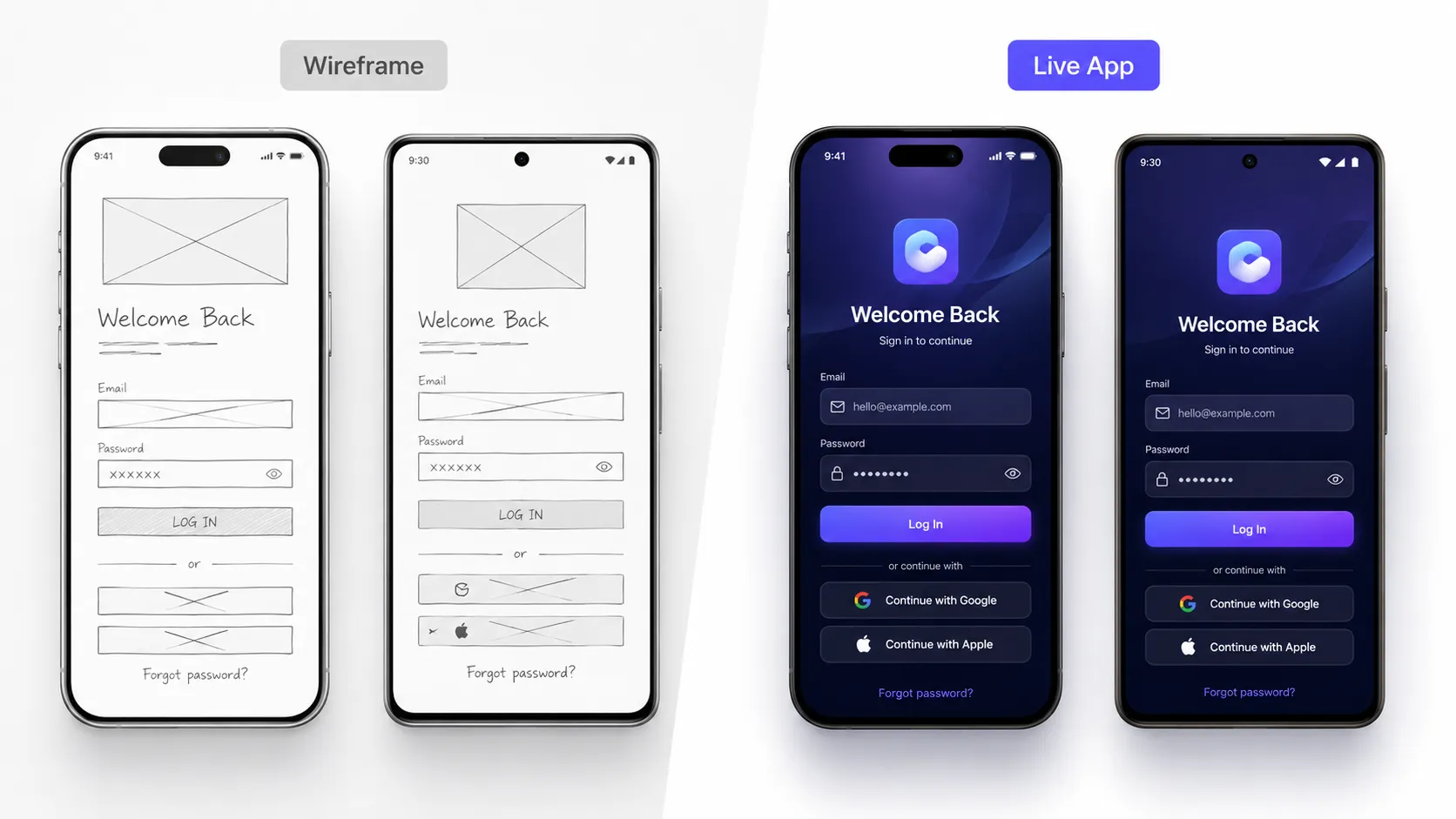
Side by side comparison of a wireframe and a finished mobile app screen on iPhone and Pixel devices, alt: USA app development wireframe to live app comparison 2026 placement note: hero image
What "affordable" actually means in the 2026 US market
Affordable does not mean cheap. In 2026, mid-sized US agencies deliver production iOS and Android apps for less than half what a premium Manhattan or San Francisco shop charges, because they run leaner teams and lean on modern cross-platform tooling. According to TechAhead's 2026 cost guide, most small-to-mid business apps land between $50,000 and $120,000 when scoped carefully, with the industry average for fully custom builds near $171,450.
At Brandrums we treat affordability as cutting scope, not corners. Our mobile application development engagements start with a hard conversation about what the app must do on day one. If you are still validating the idea, see our guide to designing a startup app before signing anything.
USA app development price tiers in 2026
Ranges below come from public 2026 industry reports, not Brandrums quotes. Use them as planning ranges. Every project varies based on integrations, design fidelity, and compliance scope. For our packaged options see the Brandrums pricing page.
Tier | Typical USA Cost (2026) | What You Get | Typical Timeline |
|---|---|---|---|
Lean MVP | $30K to $80K | 3 to 5 core screens, single platform or basic cross-platform, simple auth, one or two integrations | 8 to 14 weeks |
Standard MVP | $60K to $120K | Full MVP feature set, polished UI, push notifications, analytics, admin panel | 3 to 5 months |
Mid-market product | $120K to $250K | Cross-platform, payments, multiple APIs, role-based access, web companion | 5 to 9 months |
Enterprise platform | $250K to $500K+ | Multi-tenant, SOC 2 or HIPAA compliance, advanced analytics, phased rollout | 9 to 18 months |
According to TopDevs' 2026 USA pricing report, the average US senior mobile engineer bills $120 to $250 per hour, which is what drives cost at the enterprise end. For an MVP example, see our Tamreeni case study.
USA vs nearshore vs offshore: the honest comparison
The rate gap is real. DistantJob's 2026 outsourcing breakdown pegs US senior rates at $150 to $300 per hour, Eastern European nearshore at $40 to $75, and far-offshore Asia between $20 and $65 depending on stack and seniority. But hourly rate is only one input to total cost of ownership.
Factor | USA Onshore | LATAM Nearshore | Asia Offshore |
|---|---|---|---|
Senior dev rate (2026) | $150 to $300/hr | $45 to $75/hr | $25 to $65/hr |
Time zone overlap with US | Full | Mostly full | 2 to 4 hours, often async |
Contract and IP enforcement | Straightforward, US courts | Strong in Mexico, Colombia, Brazil | Variable, requires careful contracts |
Best for | Regulated industries, on-site work, complex stakeholder coordination | Product teams wanting overlap plus savings | Long-running maintenance, high-volume QA, mature specs |
Hidden cost drivers | High blended rate | Travel, agency fees | Specification overhead, QA rework, project management surcharge |
A reasonable hybrid is a US-based product lead and designer driving offshore engineering. That keeps strategy close to users while taking rate pressure off the build. Our web design team pairs this way for clients also reading our affordable US website development guide.
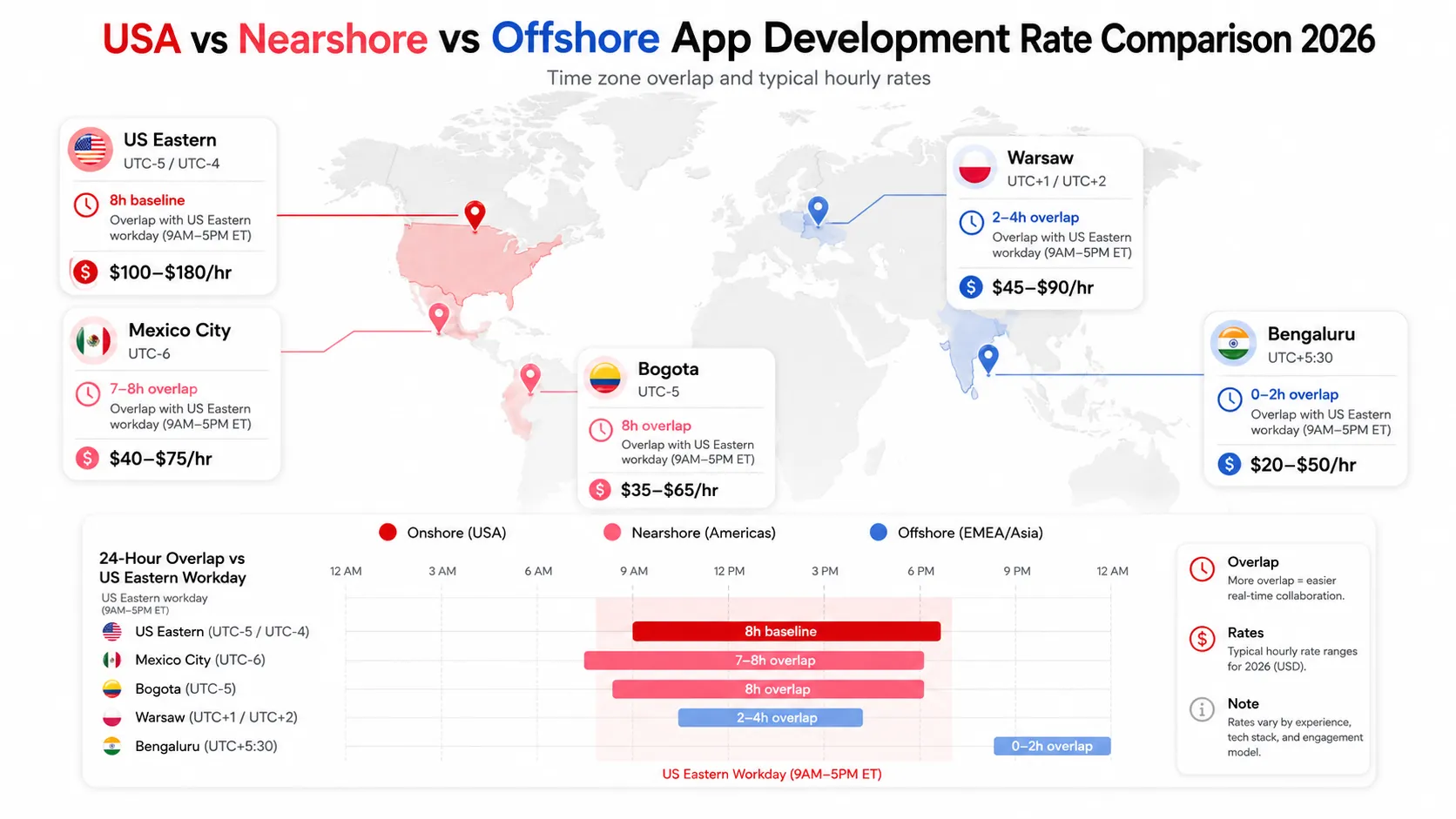
Map graphic showing time zone overlap between US Eastern, Mexico City, Bogota, Warsaw, and Bengaluru with hourly rate ranges, alt: USA vs nearshore vs offshore app development rate comparison 2026 placement note: after comparison table
When the USA premium is worth paying
Paying US rates is the right call when any of the following are true.
You handle regulated data. HIPAA, SOC 2, PCI, and FedRAMP audits are easier with US-based teams that sit in compliance meetings without visa friction. Founders in healthcare and fintech almost always need this.
Your IP is the company. If your algorithm is the moat, US contracts and courts reduce risk in a way offshore agreements rarely match.
You need in-person discovery. Field research with hospital staff, warehouse workers, or dealership employees benefits from a team that can fly out next Tuesday.
You are pitching enterprise buyers. Many Fortune 1000 procurement processes ask where engineering sits.
If none of those fit, a hybrid model usually beats a full US team on price. For staffing patterns, see our notes on hiring a design team.
MVP-first thinking is the real cost lever
The biggest predictor of US app project cost is not the agency you hire. It is the scope you sign. A 14-screen MVP at a $150 blended rate beats an 8-screen MVP at a $90 rate every time, because every screen carries design, build, test, copy, and edge case work behind it.
A useful MVP filter we apply at Brandrums:
Write the one-sentence value promise to the user.
List every screen you think you need.
Cross out any screen that does not serve that one sentence on day one.
For each remaining screen, list three actions a user can take. Anything beyond three becomes a v2 ticket.
Apply that filter and most apps shrink 30 to 50 percent before a Figma file opens. See our portfolio, the Rise Up Kings case study, and our mobile app design cost breakdown.
Cross-platform vs native in 2026
Cross-platform is no longer the budget compromise it was five years ago. React Native and Flutter ship near-native performance for typical product surfaces, and the tooling around state, navigation, and OTA updates has matured. For a founder shipping a CRUD-style product, cross-platform can cut total build cost by 30 to 40 percent versus two parallel native codebases.
Native still wins when you need deep platform APIs (AR, advanced camera, low-level audio) or when your brand bar demands platform-specific UI nuance. We build both and pick based on the feature list. If you are considering AI features, our analysis of Claude Opus 4.8 for business use cases covers when to embed an LLM in a mobile experience.
The hidden costs nobody quotes
The sticker shock comes after launch, not before. According to Appinventiv's 2026 maintenance budget guide, you should plan on 15 to 25 percent of build cost every year just to keep an app running. For complex apps with multiple integrations the number can climb past 35 percent.
Common line items founders forget to budget:
App store fees. RevenueCat's 2026 App Store fee guide covers Apple's 15 percent Small Business rate and 30 percent standard tier. Apple charges $99 per year, Google charges a one-time $25.
Push notifications. Firebase, OneSignal, and similar services scale by monthly active users and message volume.
Analytics and monitoring. Amplitude, Mixpanel, Sentry, and Datadog add up quickly past 10K MAU.
Backend hosting. AWS, GCP, or Vercel costs grow with usage and rarely match the optimistic pitch-deck estimate.
OS updates. Apple and Google ship major OS releases yearly. Plan a maintenance sprint each fall and spring.
Design refreshes. A two-year-old app looks ancient. Budget one visual refresh in the first 24 months, led by a team that owns your brand system and logo design.
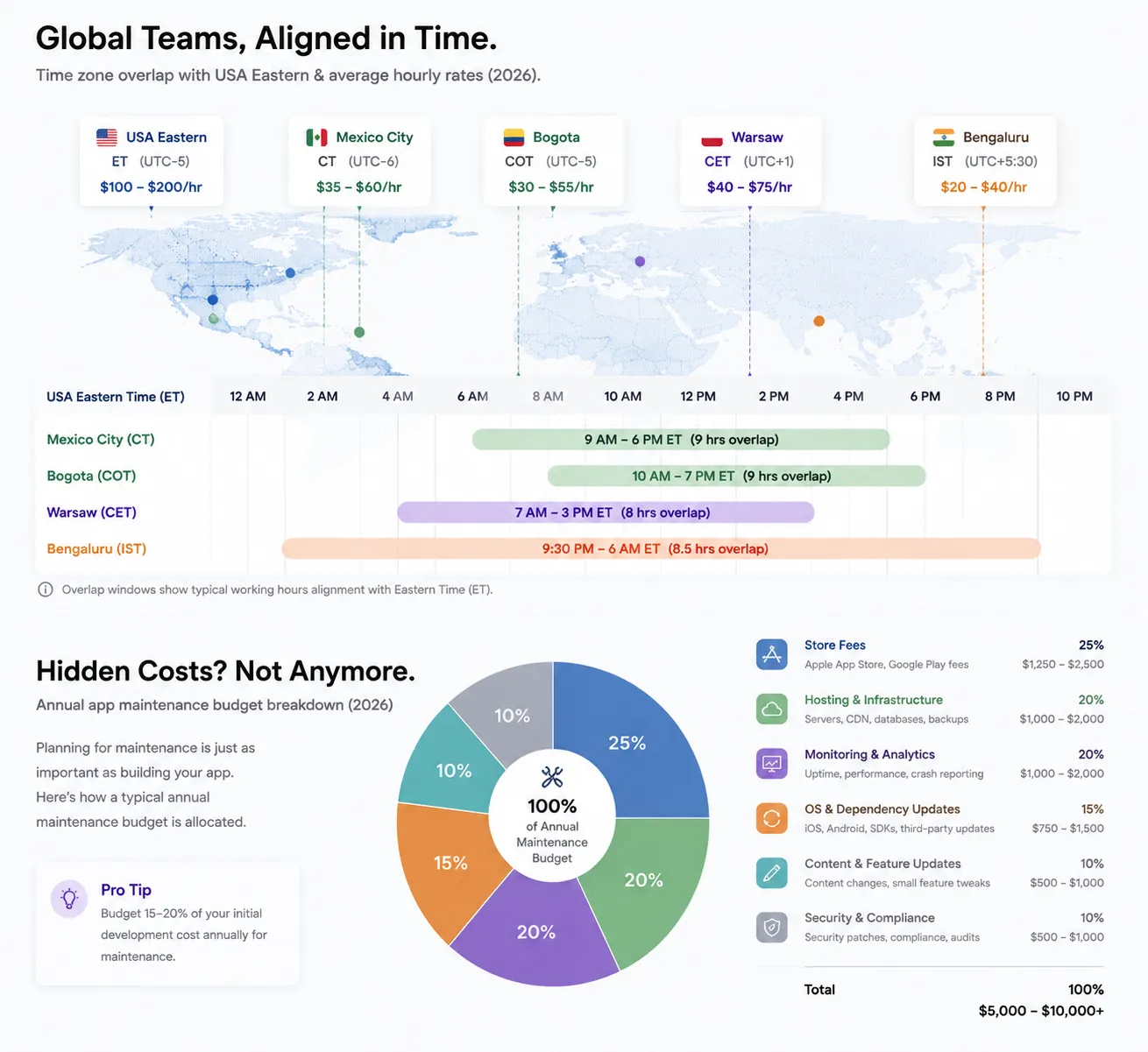
Pie chart breaking down annual app maintenance budget into store fees, hosting, monitoring, OS updates, and content, alt: Mobile app annual maintenance cost breakdown 2026 placement note: inside hidden costs section
Where US founders most often blow the budget
Across the projects we audit, five patterns burn budgets.
Scope creep disguised as "small additions." A new role, tab, or admin screen each look small and collectively double the build.
Choosing the cheapest vendor without checking QA. Cheap teams skip automated tests, so every change after launch costs three times what it should.
Skipping discovery. Two weeks of structured discovery typically saves four to eight weeks of rework.
Underestimating content and onboarding. Empty states, error states, and first-run flows are 20 percent of the work and usually missing from scope.
No analytics from day one. Founders who launch without instrumentation cannot prioritize v2 and rebuild the wrong things.
For founders in regulated or transactional spaces, our work in ecommerce, real estate, and education shows how analytics and compliance get baked in rather than bolted on.
How to evaluate an affordable US app agency
This short checklist separates teams who price low because they are efficient from teams who price low because they cut corners.
Ask for two case studies in your industry with measurable outcomes, like our Hard Shoulder case study.
Ask who actually writes the code. Subcontracting is fine if disclosed.
Ask for the test coverage target. "We test as we go" is not an answer.
Ask how they handle store submissions, rejections, and the first 30 days post-launch.
Get maintenance pricing in writing before signing the build contract.
Confirm they understand related disciplines like digital marketing and social media for launch, plus creative copywriting for in-app content.
To see how Brandrums runs this process, our about page covers team structure, and the full services overview shows how product, design, marketing, and engineering connect.
Key takeaways
Affordable does not mean cheap. It means scoped tightly, staffed correctly, and reviewed honestly.
Realistic 2026 USA price tiers run from $30K lean MVPs to $500K-plus enterprise platforms.
Nearshore and offshore can cut hourly rates 40 to 70 percent, but require discipline on specs and QA.
Pay USA premium when compliance, IP, or in-person discovery demand it.
Plan 15 to 25 percent of build cost for annual maintenance, plus the hidden line items most teams forget.
Scope is the cost lever that matters most. Cut features before you cut quality.
Frequently asked questions
What is the minimum realistic budget for a US app build in 2026?
For an MVP with a polished single-platform experience and a real backend, plan $30,000 to $60,000 at the floor and $60,000 to $120,000 for cross-platform parity, push notifications, analytics, and an admin panel through a partner like Brandrums mobile. Anything cheaper usually means a template app or scope that will not survive real users.
Can I get a quality app built offshore for under $30,000?
Yes, with caveats. A mature offshore team with a tight spec and a strong US-based product lead can deliver under $30,000. Without local leadership the spec drifts, QA suffers, and you spend the savings rebuilding. The cheapest predictable model is hybrid: US strategy and design plus nearshore or offshore engineering.
How much does ongoing app maintenance really cost?
Benchmarks put annual maintenance at 15 to 25 percent of build cost, with complex apps running 30 to 35 percent. For a $100,000 build that means $15,000 to $25,000 per year covering bug fixes, OS updates, hosting, and security patches, plus app store fees, push services, and analytics on top.
Should I go native or cross-platform to save money?
For most product apps in 2026, cross-platform with React Native or Flutter cuts build cost by 30 to 40 percent versus two native codebases, with negligible user-facing tradeoffs. Choose native when you need deep APIs like AR, advanced camera, or low-level audio, or when your brand requires pixel-perfect platform-specific design.
What are the App Store and Play Store fees in 2026?
Apple charges $99 annually and takes 30 percent of in-app revenue, dropping to 15 percent for Small Business Program members under $1M per year and for subscriptions after year one. Google Play charges a $25 one-time fee and takes 15 percent on the first $1M of annual revenue, 30 percent above, with subscription fees dropping further under 2026 settlements.
How do I avoid the most common budget blowups?
Lock scope before the build starts and treat any change as a written change order. Invest in two weeks of structured discovery, instrument analytics from day one, and budget for onboarding, empty states, and OS updates upfront. Pick a partner whose case studies show measurable outcomes, not just pretty screens.
Ready to scope your app the right way?
For a frank conversation about whether your idea fits a $60K MVP, a $200K mid-market build, or something in between, the Brandrums team can sketch scope before you sign. Start with a call via our contact page, browse the pricing page, or see shipped work in projects and the Brandrums blog.
Tags
About the Author

Daniel Brooks
Daniel covers web development, artificial intelligence, product design, and the technology decisions that help modern businesses grow.