Key takeaways
A useful 2026 fitness app MVP costs $25,000 to $60,000. A full platform with wearables, video, AI coaching and community usually lands between $120,000 and $300,000.
Wearable sync (Apple Watch, Garmin, Whoop, Oura) is rarely the line item that breaks the budget. Video infrastructure and live coaching are.
Subscription billing now drives roughly 65% of fitness app revenue, so build the paywall properly the first time.
Annual maintenance is typically 18 to 22% of build cost, and content production for video apps can match or exceed engineering.
Cross-platform builds with Flutter or React Native shave 25 to 40% off the bill versus dual native, with no meaningful UX penalty for most fitness use cases.
The fitness app market keeps expanding in ways that punish lazy budgeting. Statista pegs 2026 revenue at $9.2 billion for fitness apps, with broader digital fitness platforms tracking toward $15 billion at a 13% CAGR. Founders see those numbers and assume the build is cheap because "it's just a workout tracker." It isn't.
Here are the 2026 ranges for design, build, and operations, with the features buyers expect now: wearable sync, on-demand and live video, AI personalisation, and community layers. For the same lens on other verticals, see our mobile app design cost breakdown and the food delivery app cost guide.

Founder reviewing a fitness app pricing spreadsheet on a laptop next to a smartwatch, top of post hero
Cost ranges by app tier in 2026
Most fitness apps land in one of four tiers. The swing factor isn't feature count, it's video production and wearable support, both of which add ongoing operating cost on top of engineering. Our mobile application development team runs a one-week discovery before committing.
Tier | What's in it | Timeline | 2026 cost |
|---|---|---|---|
Lean MVP | Auth, workout library, basic tracking, one platform | 2 to 4 months | $25,000 to $60,000 |
Mid-market | Cross-platform, wearable sync, in-app subscriptions, social feed | 4 to 7 months | $60,000 to $130,000 |
Advanced | On-demand video, AI workout personalisation, live classes, admin CMS | 7 to 12 months | $130,000 to $250,000 |
Platform | B2B corporate wellness, multi-tenant CMS, clinical-grade reporting | 12 to 24 months | $250,000 to $600,000+ |
The MVP number is real but conditional. It assumes discovery is done and scope is hard. If you're still validating, read our take on MVP versus full-product strategy first. Our MVP development workflow ships the first release under 60 days when scope is honest.
Feature pricing that reflects 2026, not 2022
Old cost tables treat "video streaming" as a single $10K line. That hasn't been true for years. Live coaching needs WebRTC, recording, transcoding, and a CDN bill that scales with usage. AI personalisation is now its own discipline, often led by our AI engineering team alongside the core app squad. Below is what individual features cost in 2026.
Feature | 2026 cost | Notes |
|---|---|---|
Auth, profiles, onboarding | $2,500 to $5,000 | Use Auth0 or Clerk to skip a week of work |
Workout library with categories | $4,000 to $9,000 | Content production sold separately |
Custom workout builder | $6,000 to $14,000 | Drag-and-drop UI plus rest timers |
Progress charts and streaks | $5,000 to $10,000 | Volume, PRs, adherence, weekly summaries |
Apple Health and Google Fit sync | $4,000 to $8,000 | Read and write, with permission flows |
Wearable sync (Garmin, Whoop, Oura) | $10,000 to $22,000 | Per vendor SDK, plus background sync |
On-demand video (Mux or Cloudflare Stream) | $14,000 to $30,000 | Player, DRM, offline downloads |
Live video coaching (1-to-many) | $22,000 to $50,000 | WebRTC, chat, recording, presence |
AI workout personalisation | $18,000 to $55,000 | Model selection, eval set, feedback loop |
Computer-vision form check | $30,000 to $90,000 | The hardest feature to ship well |
Social feed and community | $10,000 to $24,000 | Moderation tooling is non-optional |
Gamification (badges, leagues) | $5,000 to $11,000 | Big retention lever for the price |
In-app subscriptions and paywall | $6,000 to $14,000 | RevenueCat saves you weeks here |
Admin dashboard / CMS | $10,000 to $24,000 | Where content teams will live |
Don't build your own video player; Mux and Cloudflare Stream solve that for a predictable monthly bill. Do build paywall logic on RevenueCat, since subscription analytics is where growth lives. Computer-vision form check is the feature founders cut after seeing the price, usually rightly. The AI and ML in modern app development piece covers how to separate signal from hype.
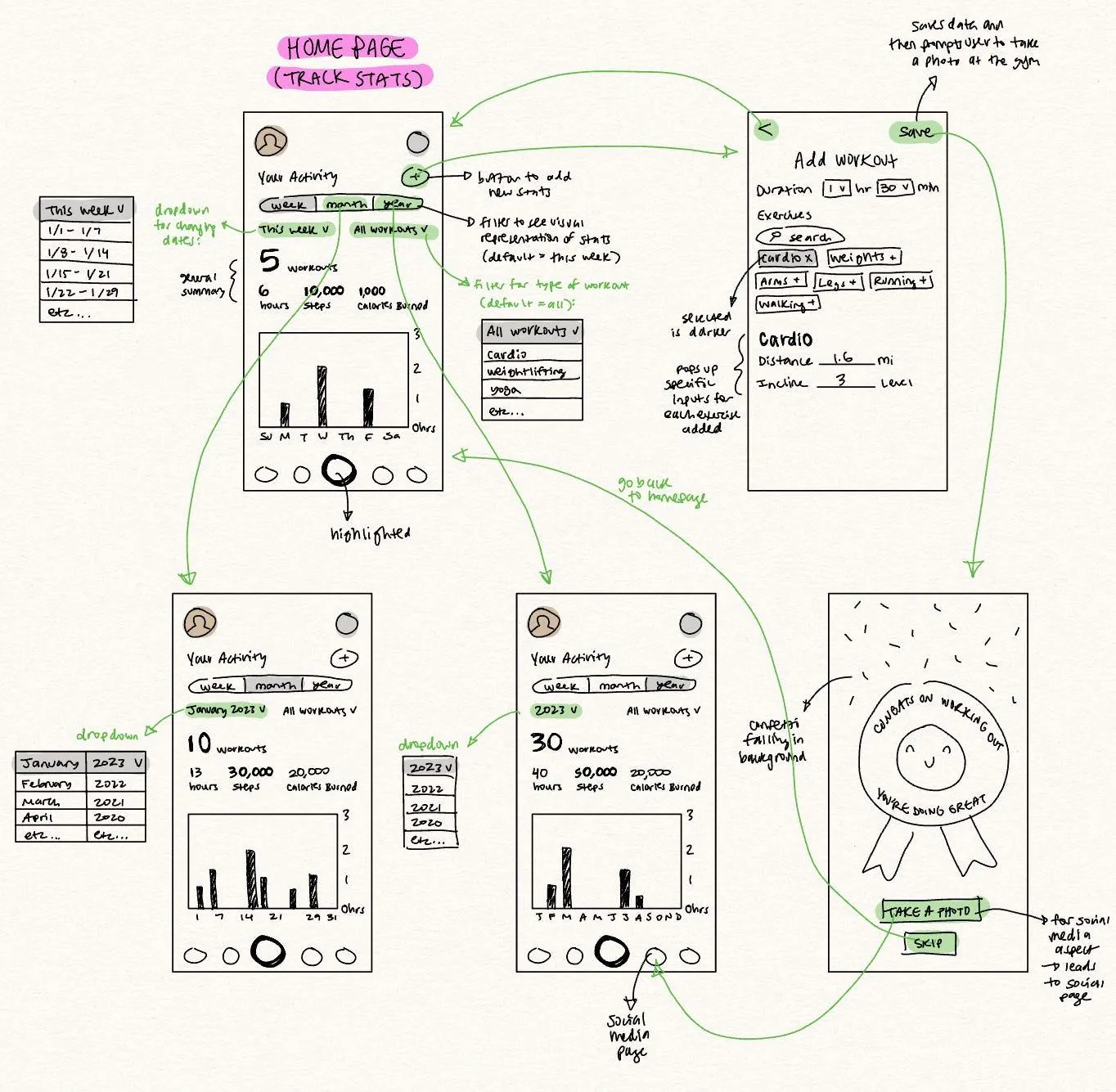
Wireframe sketches of fitness app screens showing workout builder, video player and progress dashboard, between feature pricing and platform sections
Platform choice and what it saves you
Cross-platform with Flutter or React Native is the 2026 default for fitness apps. The gap with native has narrowed enough that even Peloton-style players use it for non-core flows. Native still wins for tight Apple Watch integrations, heavy on-device ML, and offline-first sessions needing precise sensor access. Our cross-platform app development team builds the shell once and drops to native only for the wearable bridge.
Flutter or React Native: $60,000 to $200,000 for a mid-market build.
Dual native (Swift + Kotlin): Add 30 to 45%. Worth it if differentiation lives in the watch.
iOS-first then Android: Common with US wellness brands. Ship in 3 months, pressure-test pricing, then double down.
PWA or web first: Cheapest, but you lose push, HealthKit, and most wearables. Fine for B2B coach portals.
If your differentiation lives on the wrist, look hard at platform-specific roadmaps before locking the stack. Otherwise, cross-platform is the budget default.
Where the money goes during the build
A lot of the bill isn't engineering. Design, content, QA and infrastructure together hit 40 to 50% of a fitness app build. The split below is what we see across recent projects with our design team and engineering pods.
Phase | Share of budget | What you're paying for |
|---|---|---|
Discovery and product strategy | 6 to 10% | User research, scope, tech decisions |
UI/UX and motion design | 12 to 18% | Wireframes, design system, prototypes |
Mobile engineering | 28 to 35% | Screens, navigation, offline behaviour |
Backend and APIs | 22 to 30% | Auth, content, billing, analytics |
Integrations | 6 to 10% | Wearables, payments, push, email |
QA and device testing | 10 to 14% | Real-device runs, accessibility, beta |
Launch and store ops | 3 to 5% | Submission, screenshots, ASO basics |
One common mistake: under-funding QA. Fitness apps run for an hour at a time, in the background, with the screen locked. That's worst-case for battery, sensors, and Bluetooth. Allocate the full 10% or you'll pay later in one-star reviews. Our mobile app deployment strategy guide covers the launch-week checklist.
Where you hire matters more than ever
2026 blended rates for a mid-senior mobile engineer. Offshore quality has kept climbing since 2024, and we put Karachi or Krakow teams alongside US ones on the same delivery. Our note on hiring developers in Malta covers the EU side.
USA and Canada: $110 to $210/hr. Best for regulated, clinical, and enterprise sales work.
Western Europe: $80 to $160/hr. Strong design and product engineering.
Eastern Europe: $40 to $85/hr. Reliable mid-market, EU-friendly contracts.
Latin America: $35 to $75/hr. Best timezone fit for US founders.
South Asia (Pakistan, India): $18 to $45/hr. Where most Brandrums delivery happens. Best value for full-build mobile work.
For long-term squads rather than one-off builds, our staff augmentation model usually beats fixed-bid on total cost of ownership by month nine.
World map highlighting fitness app development rates by region with average hourly pricing, illustrating geographic cost differences
The hidden line items nobody quotes
Most cost articles stop at engineering. The Year One bill is bigger. Here's what we make sure clients model before contract signature.
Video content production: 200 well-produced workouts runs $80,000 to $250,000. Peloton-grade studio is 5 to 10x that.
Cloud and CDN: $500 to $4,000/month at launch for a video-heavy app, scaling with watch time.
Compliance: HIPAA hosting and a third-party audit add $8,000 to $25,000 if you touch protected health data. Even non-clinical apps need a privacy review.
Apple and Google fees: 15% on most subscriptions in 2026. Bake it into LTV math from day one.
User acquisition: Paid CAC sits at $4 to $15 in the US. Budget at least 1x your build cost for Year One growth.
Coach payouts: If trainers are in the loop, the payments engine adds $15,000 to $40,000 on top of consumer billing.
For a sanity check before committing capital, the 2026 mobile launch playbook phases these costs across Year One. The post-mortem on why on-demand apps fail is worth reading before you finalise scope.
Real-world reference points
Founders ask "what would it cost to build something like X?" constantly. Rough 2026 rebuilds with a competent cross-platform team:
MyFitnessPal-style nutrition tracker: $90,000 to $170,000 plus food database investment.
Strava-style activity log with social: $110,000 to $200,000. The social graph beats the GPS for effort.
Nike Training Club-style guided workouts: $80,000 to $160,000 for engineering, 2 to 3x once you add quality video.
Peloton-style live and on-demand classes: $250,000 to $600,000+. Studio production drives the cost, not the app.
Whoop-style wearable companion: $120,000 to $260,000. Most of the bill is data pipeline, charts, and battery work.
Calm-style mindfulness MVP: $40,000 to $90,000 if you license existing audio.
The healthcare industry page covers our compliance posture and tech stack defaults for health and wellness builds.
Ongoing costs after launch
Plan for maintenance at 18 to 22% of build cost per year. That covers iOS and Android upgrades, security patches, analytics, and the small feature stream your data demands. Customer support runs $1,500 to $12,000 a year. For premium subscription apps, refund handling alone can be a quarter-time job by month six.
Useful frame: treat the first 12 months after launch as a second build, funded separately. The teams that win draft a months 4-to-12 roadmap before v1 ships. Our web application and product team sets that roadmap during discovery.
How to cut 30 to 50% without gutting the product
Six savings we apply on almost every fitness engagement.
Buy infrastructure, build product. RevenueCat, Mux, Stream Chat, Algolia, Auth0. Each saves 2 to 6 weeks and costs less than salary.
Cut features, not quality. A 4-feature app that nails onboarding beats a 12-feature app that loses users at step 3.
Go cross-platform. 25 to 40% cheaper, future maintenance roughly halved.
Defer video. Ship illustrated workout steps first, add video in v2 once you know which workouts get used.
Phase the wearables. Apple Watch and Apple Health first. Garmin, Whoop and Oura when paying users ask.
Hire blended. US product lead plus offshore engineering pod is the lowest-risk, lowest-cost combination for most 2026 builds.
If brand isn't locked yet, our branding and logo design teams run in parallel with discovery so identity doesn't lag the product. The logo and app design for branding piece covers that overlap.
Key takeaways
Plan for a $25K to $60K MVP, $60K to $130K mid-market build, or $130K+ for video and AI-heavy platforms.
Wearable integration is rarely the budget killer. Video and live coaching are.
Maintenance and content production together usually equal 30 to 40% of the build cost every year.
Cross-platform with infrastructure SDKs (RevenueCat, Mux, Auth0) is the default that wins on cost and time.
The biggest predictor of total spend is scope discipline, not hourly rate.
FAQ
How much does a fitness app MVP cost in 2026?
A useful MVP (sign-up, workouts, session logging, progress) costs $25,000 to $60,000 with a cross-platform stack and off-the-shelf auth and billing. Anything under $20,000 is a template or a clone that needs a rewrite within a year. The MVP is for learning, not scaling.
What does it cost to add wearable integration?
Apple Health and Google Fit sync runs $4,000 to $8,000 and covers most US users. Garmin, Whoop, Oura, Polar or Fitbit cost $10,000 to $22,000 per vendor depending on data depth and background sync. Launch with Apple Health only and add vendors when paying users ask for them.
Is AI personalisation worth the price?
Sometimes. A workout-recommendation model that adapts to logged sessions adds $18,000 to $55,000 and produces measurable retention gains. Computer-vision form correction adds $30,000 to $90,000 and tends to underdeliver outside a narrow exercise set. Start simple, prove the lift, then invest in deeper AI.
How long does a typical build take?
Lean MVPs ship in 8 to 14 weeks. Mid-market apps with wearables and social take 4 to 7 months. Live video, AI, and a B2B layer runs 9 to 14 months. Timelines slip on late content production, not engineering, so lock the video pipeline early.
What ongoing costs should I plan for?
Budget 18 to 22% of build cost per year for engineering maintenance, plus cloud and CDN bills that scale with usage. Add customer support and a user-acquisition budget that often matches the build cost in Year One. Subscription apps also pay Apple and Google's 15% from day one.
Native or cross-platform?
Cross-platform (Flutter or React Native) for 80% of fitness apps in 2026. Go native only if your differentiation is deep Apple Watch or Wear OS integration, on-device ML, or heavy background sensor work. Cross-platform ships fast, looks native, and cuts three-year maintenance cost roughly in half.
To put a number against a real scope, our team runs fixed-fee discovery and ships a credible roadmap in two weeks. Start at contact us, or see the pricing page for indicative packages across MVP, mid-market and platform tiers.
Tags
About the Author

Daniel Brooks
Daniel covers web development, artificial intelligence, product design, and the technology decisions that help modern businesses grow.