How AI Actually Reduces Costs
"Cut costs with AI" sounds like a slogan until you look at where the money actually leaks out of a business. Most cost reduction from AI is not exotic. It comes from giving people their time back, handling routine work automatically, and making fewer expensive mistakes. Unglamorous, but that is exactly why it works. The headline that gets attention: a majority of AI users, around 66 percent, report saving between $500 and $2,000 a month from their tools, against a typical spend of $50 to $500 a month. That is the gap that makes AI cost reduction worth taking seriously.
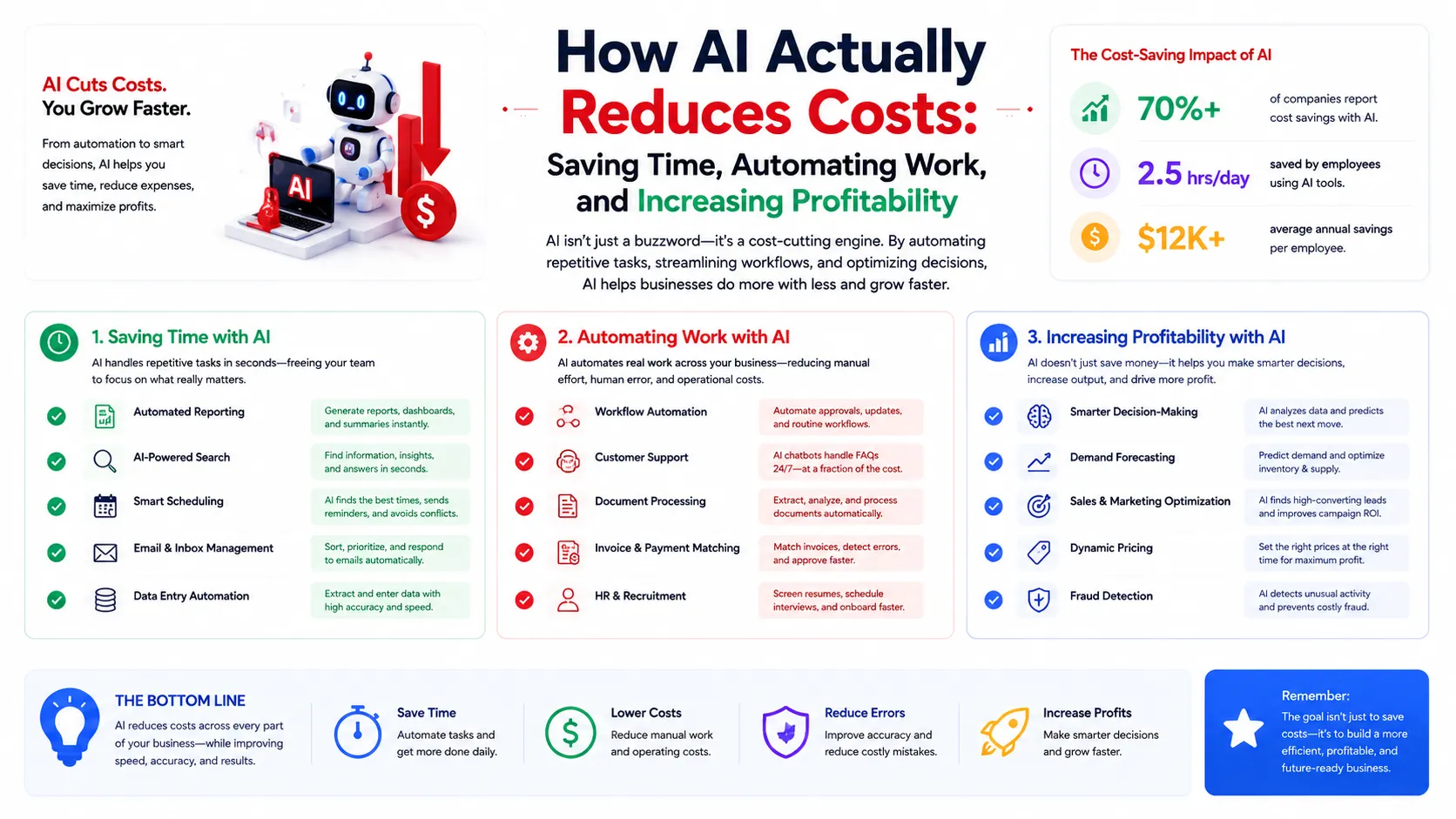
hero image for this blog, top of post, full width
The gap between cost and reported saving is why AI cost reduction gets so much attention. But averages hide the truth, which is that the savings depend heavily on where you point the tools. So let us walk through the specific areas where AI cuts real costs, with honest numbers and the catches that come with each.
Labor on Repetitive Tasks This is the biggest one, and it is not about layoffs. It is about reclaiming the hours your existing team loses to repetitive work. Small business employees save an average of 5.6 hours a week using AI tools, and managers reclaim over 7. Multiply that across a team and you are looking at the equivalent of meaningful added capacity without adding payroll.
The point is not to cut staff. It is that the work your people already do gets done in less time, so they can take on more valuable work instead of drowning in admin. Productivity gains of 25 to 40 percent are common for businesses using AI well. That is capacity you would otherwise have to hire for. How to capture it: identify the repetitive tasks eating your team's week, drafting, summarizing, data entry, sorting, and put AI on those first. The recovered hours are your savings, whether you reinvest them in growth or simply stop paying overtime to keep up.
It helps to put a number on it. Say one employee earning the equivalent of $30 an hour saves five hours a week. That is roughly $600 of recovered capacity a month from a single person, against a tool that might cost $20. Scale that across five people and the monthly figure starts to resemble a part-time salary you no longer need to add. None of this requires cutting anyone. It means the growth you were about to hire for can be absorbed by the team you already have, which is the cheapest kind of expansion there is. The mistake to avoid is treating the saved time as invisible. If those five hours quietly refill with more low-value busywork, you have gained nothing you can measure. The businesses that turn time savings into real cost savings are deliberate about it. They either redirect the hours into revenue-generating work or they genuinely reduce the overtime and contractor spend the busywork used to demand. Saved time only becomes saved money when you decide where it goes.
Customer Support Support is one of the clearest cost-reduction wins available. A large share of customer questions are the same handful repeated endlessly: hours, pricing, shipping, returns, booking. An AI chatbot handles those around the clock so your team only touches the conversations that need a person.
In retail, chatbots already handle the majority of routine inquiries. For a small business, that can mean the difference between needing another support hire and comfortably handling growing volume with the team you have. The savings are real and they compound as you grow, because the chatbot does not need a raise or a second shift. There is a quality angle too, not just a cost one. A customer who gets an instant, accurate answer at 11pm is a happier customer than one who waits until morning for a reply they could have had immediately. So the chatbot is simultaneously cutting your support cost and improving your response times, which tends to reduce the follow-up messages and frustrated escalations that eat even more of your team's time. The trick is scope: point the bot at the genuinely repetitive questions and hand everything nuanced to a human cleanly, so customers never feel trapped in a loop. Done that way, support automation is one of the rare moves that lowers cost and raises satisfaction at the same time.
Marketing and Content Content is expensive when every blog post, email, and social caption is made by hand or outsourced. AI changes the unit economics. One person with an AI assistant can produce what used to take a small team or a costly agency retainer.
A single blog post becomes social posts, an email, and a summary through one content workflow. You are not necessarily firing your agency, but you are getting far more output per dollar, which either lowers your marketing spend or stretches it much further. For a small business with a tight marketing budget, that leverage is the whole game. Mini case study: a local services company was paying a freelancer roughly $1,200 a month to produce four blog posts and the social content around them. They moved to an in-house workflow: a $20 assistant drafts, a staff member who knows the business edits and adds the real expertise, and an automation spins each post into social and email versions. Output went up to six posts a month with more social coverage, and the direct content cost dropped to the price of one subscription plus a few hours of an existing employee's time. The freelancer savings alone covered their entire AI stack many times over.
Errors and Rework Mistakes are a hidden, ugly cost. A wrong number in a quote, a missed detail in a contract, a data-entry error that snowballs. AI tools that check, proofread, and validate catch a lot of these before they become expensive.
This is quieter than the other savings because you rarely see the disaster that did not happen. But fewer errors means less rework, fewer refunds, fewer apology emails, and less time spent untangling messes. Across a year, error reduction is a genuine line of savings, even though it never shows up as a tidy number on an invoice.
Five areas where AI reliably takes cost out of a small business.
Inventory and Waste For any business holding stock, AI demand forecasting cuts costs from both directions. It reduces stockouts that lose you sales and overstock that ties up cash and ends in markdowns. Retailers using AI forecasting consistently report less waste and healthier margins. If you carry inventory, this is one of the highest-return places to apply AI, because every percentage point of waste you remove drops straight to the bottom line.
Find Your Biggest Cost Leaks First
The savings depend entirely on where you apply AI. Brandrums helps businesses pinpoint the costliest, most repetitive work and put AI exactly there.
See Our AI SolutionsTalk to Us
The Honest Math: Cost to Save Money
Here is the part the slogans skip. Saving money with AI costs money first. You will not see net savings in week one, and pretending otherwise sets you up to quit too early.
The tools. $50 to $500 a month for most small businesses.
Setup and training time. The advertised price is often only 20 to 40 percent of the true first-year cost. Budget 10 to 30 hours per tool to learn it.
The productivity dip. Expect two to four weeks of slightly slower output while your team adapts.
None of this kills the case for AI cost reduction. It just means the savings are net positive over months, not days. Structured AI adopters typically reach 3 to 5 times ROI within 12 to 18 months. The businesses that fail are usually the ones that expected instant savings, got impatient during the setup phase, and bailed before the math turned in their favor.
How to Start Cutting Costs the Right Way
The wrong way is to buy a stack of tools and hope costs fall. The right way is targeted and measured.
A cost-reduction sequence that works
Find your most expensive repetitive work. Where does your team's time actually go? Start there.
Apply one tool to that one area. Resist automating everything at once.
Measure the saving in hours or dollars. Within 60 days, name what it gave back.
Reinvest or pocket the savings. Then move to the next costliest area.
Cut any tool you cannot tie to a saving. Idle subscriptions quietly erase your gains.
Done this way, AI cost reduction is not a gamble. It is a series of small, measured bets that each pay back before you place the next one. That discipline is what separates the businesses saving $2,000 a month from the ones wondering where their subscription budget went.
Frequently Asked Questions
How does AI reduce business costs?
AI reduces costs mainly by reclaiming staff time on repetitive tasks (5 to 7 hours per person per week), handling routine customer support with chatbots, producing more marketing content per dollar, cutting errors and rework, and improving inventory forecasting to reduce waste. Around 66 percent of AI users report saving $500 to $2,000 a month.
How much money can AI save a small business?
Most AI users report saving $500 to $2,000 a month against a typical spend of $50 to $500 a month. Actual savings depend heavily on where you apply the tools. Structured adopters who target their costliest repetitive work typically reach 3 to 5 times ROI within 12 to 18 months.
Does using AI to cut costs mean laying off staff?
Not usually. Most cost reduction comes from giving existing employees their time back so they can do more valuable work, not from cutting headcount. Small business employees save an average of 5.6 hours a week, which adds capacity without adding payroll, rather than replacing people.
What is the catch with saving money using AI?
Saving money costs money first. You pay for tools ($50 to $500 a month), invest 10 to 30 hours per tool in setup and training, and absorb a short productivity dip while the team adapts. The advertised price is often only 20 to 40 percent of the true first-year cost, so savings are net positive over months, not days.
Where should a business start to cut costs with AI?
Start with your most expensive repetitive work, wherever your team's time actually goes. Apply one tool to that one area, measure the saving in hours or dollars within 60 days, then move to the next costliest area. Targeted and measured beats buying a stack of tools and hoping costs fall.
Ready to build the AI setup that fits your business?
Whether you are a solo founder testing the waters or a growing team scaling into serious automation, we help clients pick the lightest AI stack that earns its keep. Same discipline we apply through website development, web application development, SaaS development, and digital marketing retainers. Tell us what you are trying to automate and we will recommend a setup. Or check our pricing options if you are scoping engineering support alongside the tooling.
Tags
About the Author

Daniel Brooks
Daniel covers web development, artificial intelligence, product design, and the technology decisions that help modern businesses grow.