Why AI Pays Off Fast for Freelancers
Freelancers and agencies have a different relationship with AI than most businesses. For you, time is literally the product. Every hour you claw back is either an hour you can bill on something else or an hour you get to keep for yourself. That makes the math on AI tools brutally simple, and usually very favorable. Here is the thing the data backs up: a freelancer billing $50 an hour recoups a $40-a-month AI toolkit with about 48 minutes of saved time per week. Forty-eight minutes. Most of these tools save you that before lunch on Monday.
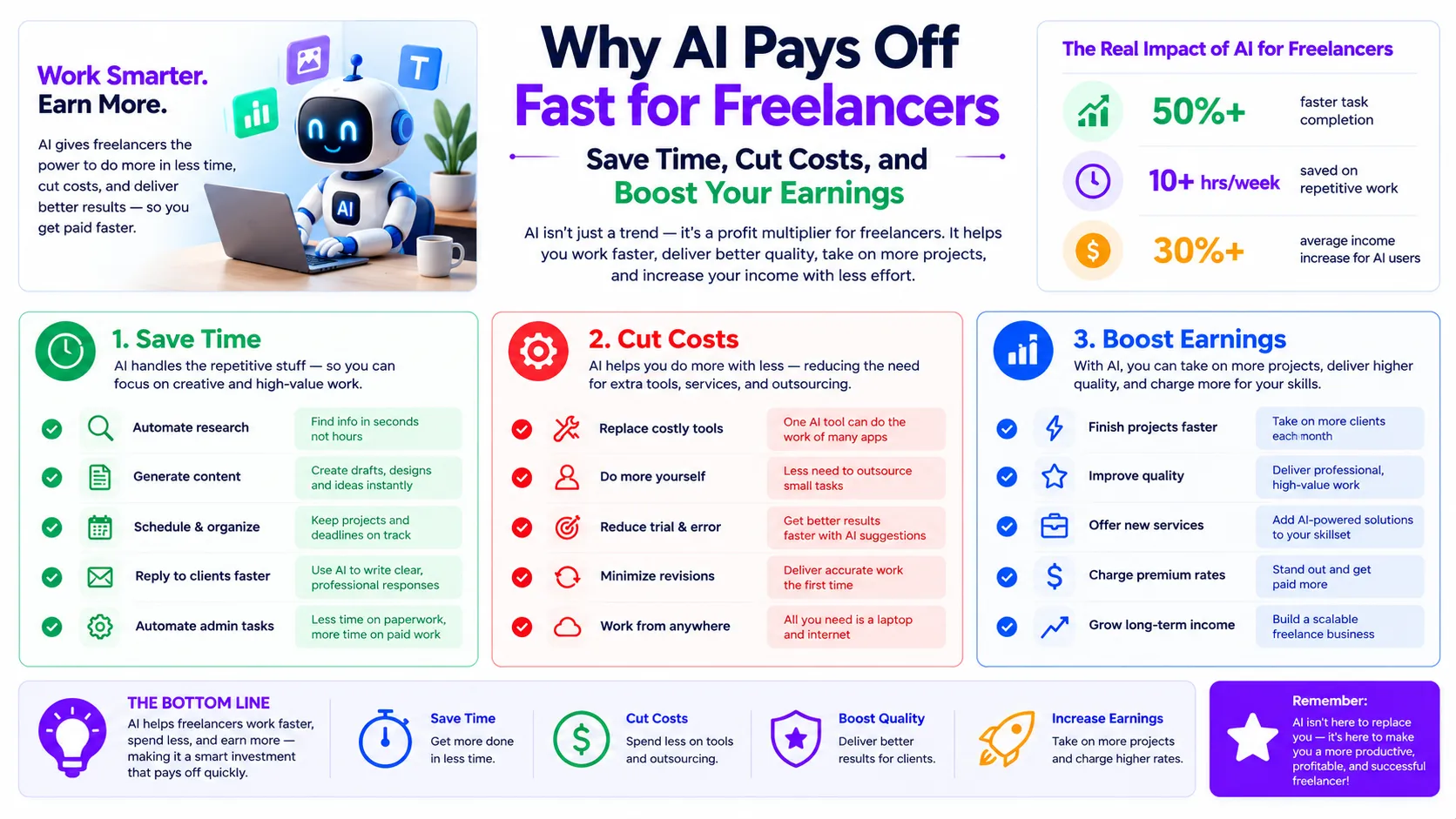
The math on AI tools for freelancers is rarely close. So the real question is not whether to use AI. It is which tools, for what, without drowning in subscriptions you forget you are paying for. Let us build the stack the smart way.
The Foundation: One Good AI Assistant
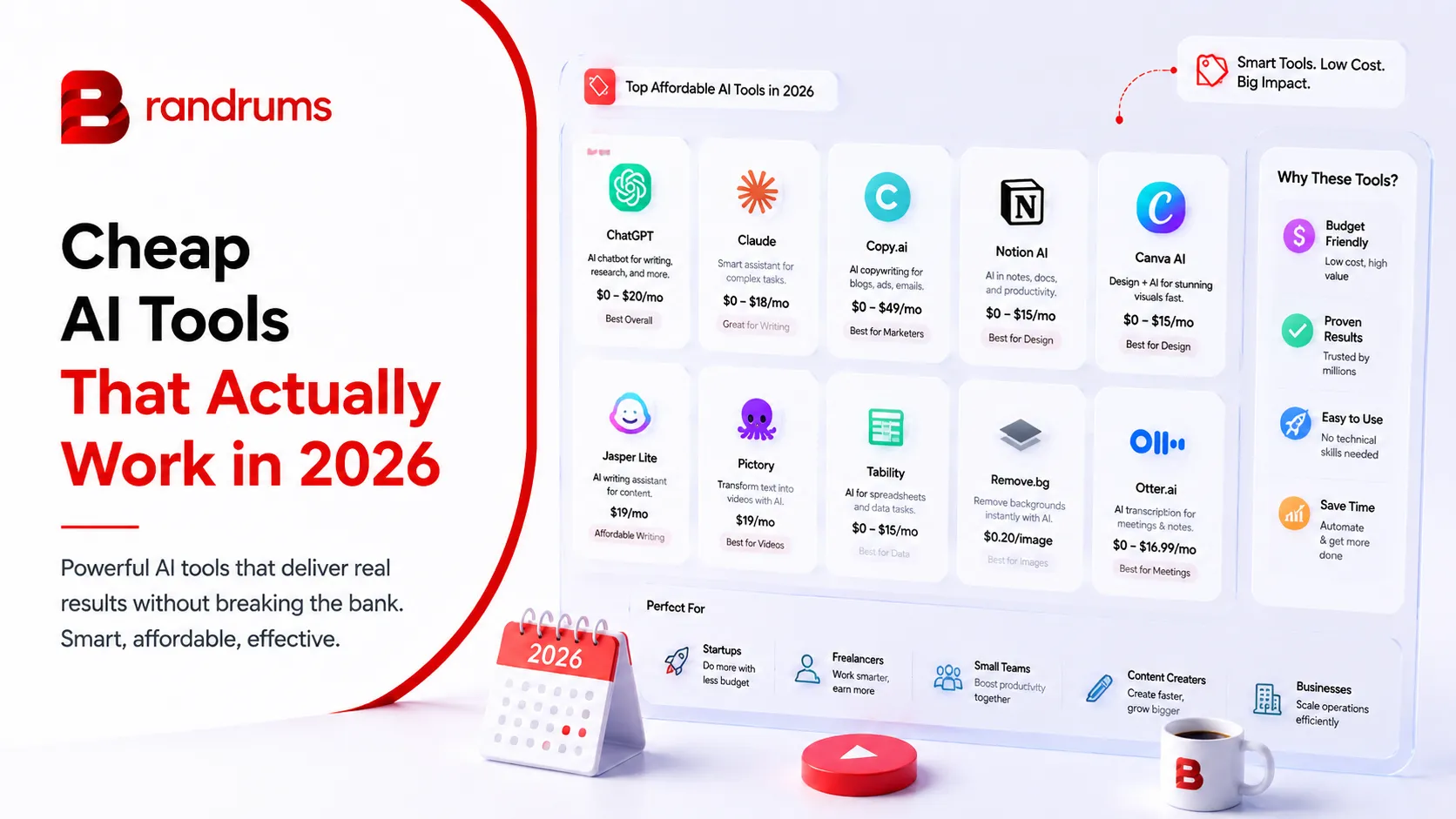
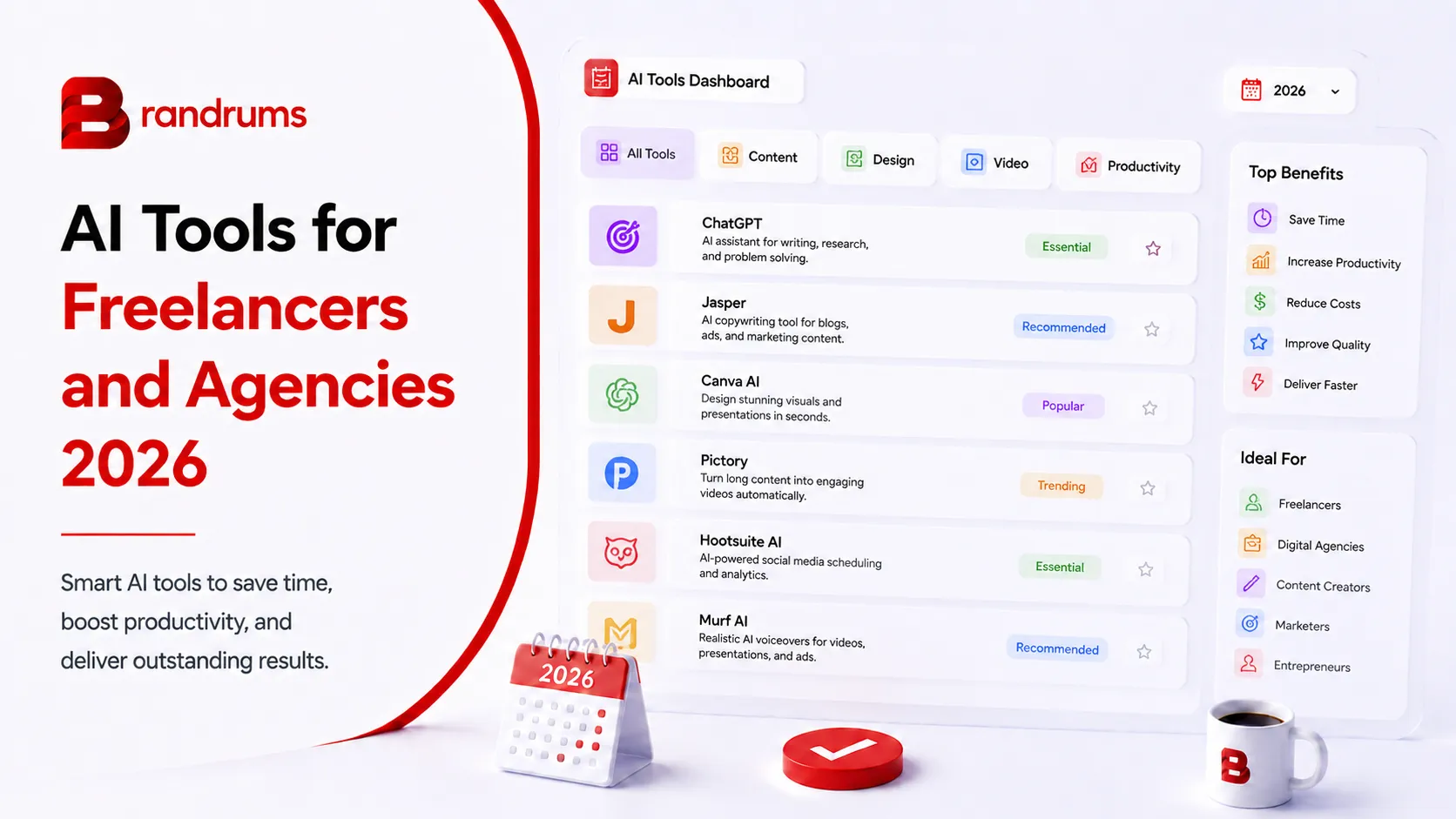
Start here, full stop. A general assistant like ChatGPT or Claude at around $20 a month is the single highest-leverage tool in the entire kit. It drafts, edits, brainstorms, summarizes, researches, and reformats. For agencies, ChatGPT tends to be the workhorse for marketing and content. Claude is the one people reach for on long-document work and nuanced writing. If you do nothing else from this guide, get genuinely fluent with one of these. It is the difference between AI being a party trick and AI being the assistant you cannot remember working without. Spend a week using it for everything, and you will feel the shift. The fluency point is the one that separates freelancers who get huge value from AI and those who shrug it off after a week. The tool rewards practice. The first few days you will write clumsy requests and get mediocre results, conclude it is overhated or overhyped, and nearly give up. Push through that. By the end of a week of using it for real work, drafting proposals, untangling client briefs, rewriting your own rough paragraphs, you develop an instinct for how to ask, and the quality of what comes back jumps dramatically. That instinct is the actual asset, not the subscription. Once you have it, the same $20 tool that felt underwhelming on day one becomes the thing you reach for a dozen times a day. Mini case study: a solo brand designer added a single $20 assistant for the unglamorous parts of the job: proposals, client update emails, and turning messy discovery-call notes into clean creative briefs. She estimated it saved about five hours a week, roughly $1,800 a month of recovered time at her $90 rate, against a $20 cost. She reinvested those hours into one extra client. The tool never touched her actual design work; it cleared the admin crowding it out.
For Writers and Content People
Beyond the core assistant, a couple of additions earn their spot in a writer's stack.
An editing tool like Grammarly at around $12 a month to catch what you miss when you are reading your own work for the fifth time and your eyes have glazed over.
A research tool like Perplexity Pro at roughly $17 a month if you fact-check constantly and want sources attached to every answer.
The combination of one assistant plus one editor covers the entire writing pipeline for most freelancers, from blank page to polished, client-ready draft. That is a complete content operation for around $32 a month.
For Designers and Creatives
Creative freelancers and agencies lean on a different cluster of tools. Canva Pro at $13 to $15 a month for fast, on-brand design. AI image and video tools for concepting and generating assets. This is actually where agencies pull ahead of everyone else, since they adopt creative AI tools harder than any other sector and use them to produce more work in less time without sacrificing quality.
For the Agency Itself: Client and Ops Work
If you run an agency, the assistant is just the start. The bigger gains come from the unglamorous operational stuff that quietly eats your team's billable hours.
A meeting transcriber like Otter at around $8 a month so nobody is frantically scribbling notes during client calls instead of listening.
An AI-enhanced CRM to keep leads and client communications organized without manual data entry.
Automation tools to connect your apps so information stops getting copied by hand between systems.
An agency that automates reporting and admin frees its actual humans to do the creative and strategic work clients pay premium rates for. That is the whole business model, sharpened. When your team spends less time on status reports and more time on the work that wins awards and renewals, your margins improve without raising a single rate. A day in an AI-assisted agency workflow
No single step is dramatic. Together they let the same team carry far more work. Walk through a single client project with the stack running. The kickoff call is transcribed into a summary with action items. The assistant turns those notes into a structured brief in minutes, which a human sharpens. Writers draft and polish; designers concept faster and finish in Canva. The assistant drafts client update emails. An automation pulls the numbers into a report instead of someone rebuilding it by hand. No single step is dramatic. Added together across every project, they are the difference between an agency that comfortably handles six clients and one that handles ten with the same headcount. The Complete Stack, Costed Out
A complete freelance or agency operation for the price of a couple of dinners out.
Tool | Role | Monthly cost |
|---|---|---|
ChatGPT or Claude | Core assistant: writing, research, ideas | $20 |
Grammarly | Editing and proofreading | ~$12 |
Canva Pro | Design and visuals | $13-$15 |
Otter.ai | Meeting transcription | ~$8 |
Perplexity Pro (optional) | Sourced research | ~$17 |
Total | Full freelance/agency operation | $40-$100 |
The Smart Move: Stack Free Tiers, Pay for One or Two
You do not need to subscribe to everything. The savviest freelancers in 2026 combine one paid subscription with several free tiers rather than paying for ten tools. Free ChatGPT, free Claude, free CRM, free research up to a limit. Pay for the one or two tools you live inside all day, and let the free tiers cover the rest. There is even a bundle trick worth knowing: some services bundle multiple AI models into one subscription for around $30 a month total, which is far cheaper than paying $20 each for several assistants separately. If you genuinely want access to more than one model, a bundle beats stacking individual subscriptions. Why would a freelancer want more than one model in the first place? Because they have different strengths, and once you are fluent you start to notice them. One tends to write cleaner long-form prose, another is sharper at quick research or structured tasks, a third has a tone you prefer for client-facing copy. You do not need this on day one, and most freelancers do their best work by mastering a single assistant first. But if you reach the point where you are reaching for different tools for different jobs, a bundle is the cost-efficient way to keep them all on hand without your subscription total quietly creeping toward $80 a month for capability you use in scattered bursts.
Turn AI Into a Client Offering
Building deliverables on AI and want them to look like more than templated output? Brandrums builds AI solutions and automation agencies can use internally or fold into client work.
See Our AI SolutionsTalk to Us
Do Not Become a Subscription Hoarder
The flip side of all this is real, and it bites a lot of freelancers. It is easy to sign up for five AI tools in a quarter, actually use two of them, and quietly bleed $200 a month. If you log into a tool and most of its features are untouched, downgrade or cancel. You can always upgrade when you actually need the advanced stuff. Keep your stack honest
Every tool maps to a real, repeated task
You actually open it most weeks
You are not paying for features you never configured
You review the whole stack every quarter
You cancel anything you cannot tie to saved time or revenue
The discipline is simple: pay for what you use, not what you intended to use. Every tool in your stack should map to a real, repeated task. If it does not, it is a leak, not a tool.
When Agencies Should Bring In a Partner
There is a ceiling on what off-the-shelf tools do. When an agency wants custom client solutions, AI-powered features baked into the work you deliver, or automation that connects systems no single tool talks to, that is build territory. It is also a way to offer clients something your competitors simply cannot, which is exactly the kind of differentiation that justifies higher rates. That is where partnering up makes more sense than fighting integrations solo at midnight. Bringing in a team that builds this for a living means you ship something polished instead of something held together with duct tape.
Build Your Stack This Week
One assistant, one editor or design tool, one transcriber. Get fluent, then expand where you feel a pinch. When you are ready to turn AI into a client offering, Brandrums can build it with you.
See Our AI SolutionsTalk to Us
Frequently Asked Questions
What AI tools should freelancers use in 2026?
Start with one general AI assistant like ChatGPT or Claude at around $20 a month for writing, research, and brainstorming. Add a $12 editing tool like Grammarly, a $17 research tool like Perplexity Pro if you fact-check often, and Canva Pro at $13 to $15 for design. A full freelancer stack runs about $40 to $100 a month total.
Is AI worth it for freelancers?
Yes. A freelancer billing $50 an hour recoups a $40 a month AI toolkit with about 48 minutes of saved time per week. Most assistants save that before lunch on Monday. Professionals who save just two to three billable hours a month break even on a $40 toolkit.
How do agencies use AI?
Agencies use AI for content creation, design, meeting transcription, CRM management, and automation. Agency and tech teams average 8 to 12 hours of AI tool usage per week, the highest of any sector. The biggest gains come from automating reporting and admin so human staff can focus on creative and strategic work.
How much should a freelancer spend on AI tools?
About $40 to $100 a month for a complete functional stack. The smartest approach is to combine one or two paid subscriptions with several free tiers rather than paying for every tool. Pay for the tools you live inside all day and let free tiers cover the rest.
Can AI replace a freelancer's skills?
No. AI speeds up the repetitive parts of creative and knowledge work, but it does not replace judgment, taste, client relationships, or strategy. The freelancers who win treat AI as leverage on their existing skills, producing more and faster, not as a substitute for the expertise clients pay for.
Ready to build the AI setup that fits your business?
Whether you are a solo founder testing the waters or a growing team scaling into serious automation, we help clients pick the lightest AI stack that earns its keep. Same discipline we apply through website development, web application development, SaaS development, and digital marketing retainers. Tell us what you are trying to automate and we will recommend a setup. Or check our pricing options if you are scoping engineering support alongside the tooling.
Tags
About the Author

Daniel Brooks
Daniel covers web development, artificial intelligence, product design, and the technology decisions that help modern businesses grow.