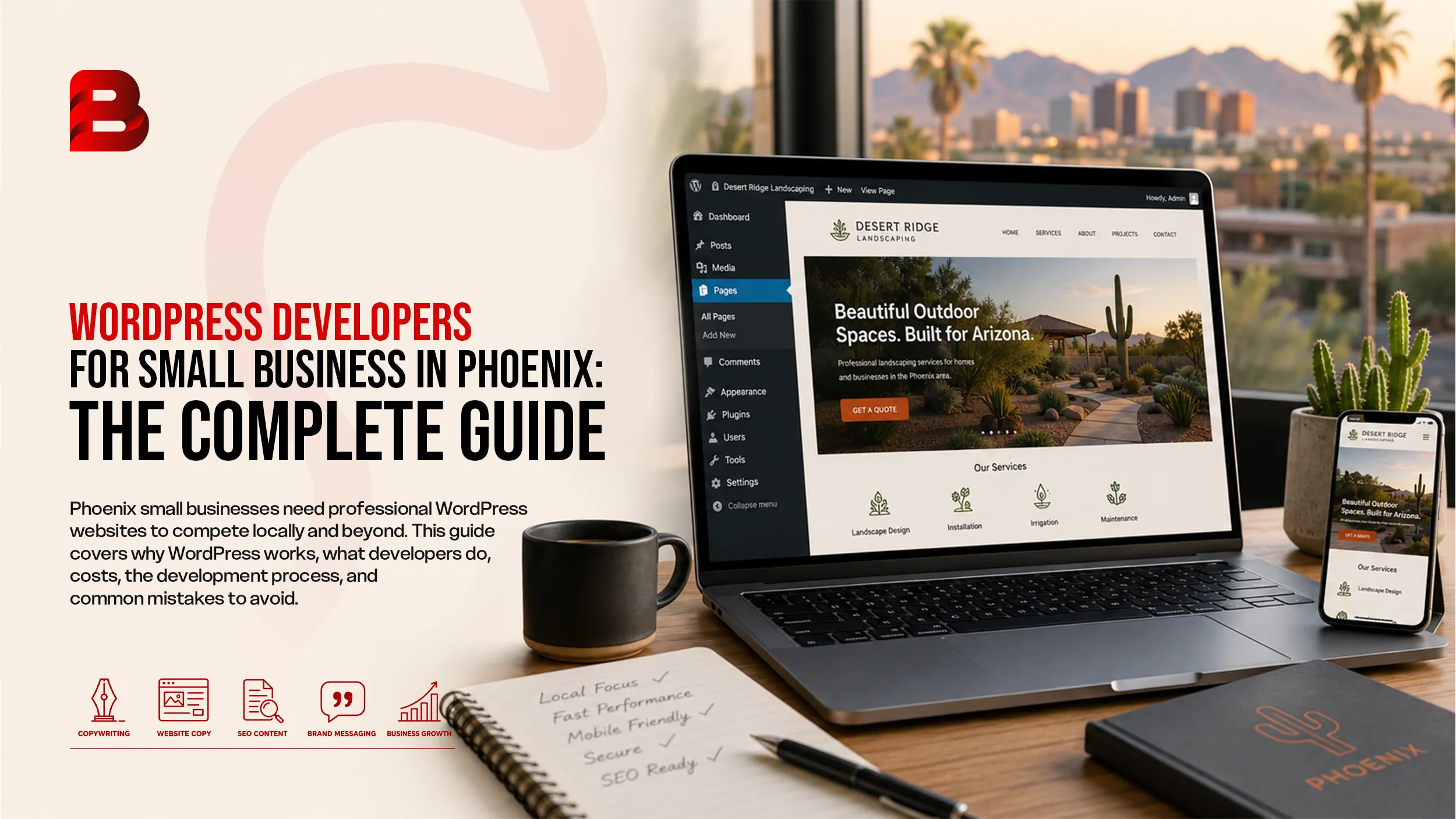
Running a small business in Phoenix means competing in one of the fastest-growing metro areas in the country. From Scottsdale boutiques to Tempe tech startups and Mesa service providers, local business owners are discovering that a professional website isn't optional anymore; it's the digital storefront that determines whether a customer calls you or your competitor. This is exactly why so many entrepreneurs are searching for WordPress developers for small businesses in Phoenix who understand both the platform and the local market.
In this guide, we'll walk through everything you need to know: why WordPress remains the top choice for small business websites, what a professional Phoenix-based developer actually does, how much it costs, what the process looks like from start to finish, and how to avoid the common mistakes that cost business owners time and money. We'll also touch on related services like ecommerce development California businesses often need when they operate across state lines, since many Phoenix-based companies serve customers well beyond Arizona.
1. Why WordPress Is Still the #1 Choice for Small Business Websites
WordPress powers a significant share of websites across the internet, and for small businesses specifically, it remains the most practical option. Here's why:
Affordability: WordPress itself is free and open-source, which means your costs go toward design development, and hosting rather than expensive licensing fees.
Flexibility: Whether you run a restaurant, a law firm, a landscaping company, or an online store, WordPress can be customized to fit your exact business model.
SEO-friendly architecture: WordPress sites are structured in a way that search engines can easily crawl and index, giving small businesses a fair shot at ranking locally.
Massive plugin ecosystem: From booking systems to email marketing integrations, there's a plugin for nearly every business need.
Easy content management: Business owners without technical skills can update text, images, and blog posts without touching code.
Scalability: A WordPress site can grow from a five-page brochure site into a full ecommerce store as your business expands.
These advantages are precisely why hiring skilled WordPress developers for small business in Phoenix pays off when a professional knows how to configure the platform correctly from day one, avoiding the technical debt that comes from DIY website builders.
2. The Phoenix Small Business Landscape: Why Local Matters
Phoenix isn't just growing, it's transforming. New residents are arriving from California, the Midwest, and beyond, bringing fresh competition and fresh demand across nearly every industry. In this environment, small businesses need websites that do more than look nice; they need to convert visitors into paying customers.
A locally based WordPress developer brings advantages that an out-of-state freelancer or an overseas agency often can't match:
Understanding of local SEO: A Phoenix developer knows how to optimize for "near me" searches, Google Business Profile integration, and neighborhood-specific keywords like Arcadia, Ahwatukee, or Desert Ridge.
Familiarity with local competitors: They've likely worked with businesses in your industry and know what works in the Phoenix market.
Time zone alignment: No waiting overnight for responses you can hop on a call during normal business hours.
In-person meetings when needed: Some business owners prefer sitting down face-to-face to discuss branding and strategy.
Awareness of seasonal business cycles: Phoenix has unique seasonal patterns (snowbird season, summer slowdowns) that affect marketing and website priorities.
3. What Does a WordPress Developer Actually Do?
Many small business owners aren't entirely sure what they're paying for when they hire a developer. Here's a breakdown of the core responsibilities:
3.1 Website Design and Layout
This includes choosing or building a theme, arranging page layouts, selecting color schemes and typography that reflect your brand, and ensuring the site looks professional on both desktop and mobile devices.
3.2 Custom Functionality
Beyond the basic look, developers build features specific to your business appointment booking, contact forms, membership portals, quote request tools, or integrations with your CRM.
3.3 Plugin Selection and Configuration
A good developer doesn't just install plugins randomly. They choose lightweight, well-maintained plugins that won't slow down your site or create security vulnerabilities.
3.4 Performance Optimization
Page speed directly affects both user experience and search rankings. Developers optimize images, implement caching, and choose reliable hosting to keep your site fast.
3.5 Security Hardening
WordPress is a popular target for hackers precisely because it's so widely used. Developers implement firewalls, regular backups, login protection, and malware scanning.
3.6 SEO Foundation
This includes proper heading structure, meta tags, XML sitemaps, schema markup, and mobile responsiveness all the technical groundwork that helps your site rank.
3.7 Ongoing Maintenance
WordPress core, themes, and plugins need regular updates. Many developers offer maintenance packages to keep everything running smoothly and securely.
5. How Much Do WordPress Developers Charge in Phoenix?
Pricing varies significantly based on experience, project scope, and complexity. Here's a general breakdown to help you budget:
Basic brochure website (5-8 pages): Typically ranges from $1,500 to $5,000
Mid-size business website with custom features: Usually falls between $5,000 and $12,000
Ecommerce website: Often starts around $8,000 and can exceed $25,000 depending on product catalog size and complexity
Ongoing maintenance plans: Commonly range from $99 to $500+ per month depending on the level of service
Hourly rates for freelancers: Generally fall between $50 and $150 per hour, while agencies may charge more
Keep in mind that the cheapest option isn't always the best value. A poorly built website can cost you more in the long run through lost sales, security breaches, or the need for a complete rebuild down the road.
6. Questions to Ask Before Hiring a WordPress Developer
Before signing any contract, ask potential developers these questions:
Can I see examples of websites you've built for businesses similar to mine?
Do you build custom themes, or do you rely on pre-made templates?
What is included in your maintenance and support packages?
How do you handle SEO during the build process?
Will I own the website outright, or are there licensing restrictions?
What is your typical project timeline?
How do you handle revisions and scope changes?
Do you offer training so I can update content myself?
What happens if something breaks after launch?
Can you provide references from past clients?
7. The Website Development Process: What to Expect
A professional engagement typically follows these stages:
Step 1: Discovery and Strategy
The developer learns about your business, goals, target audience, and competitors. This stage often includes a review of your current site (if you have one) and a discussion of what success looks like.
Step 2: Sitemap and Wireframing
Before any design work begins, the structure of the site is mapped out what pages exist, how they connect, and what the user journey looks like.
Step 3: Design Mockups
Visual concepts are created, often starting with the homepage, so you can approve the direction before full development begins.
Step 4: Development
The actual build happens here coding the theme, setting up plugins, building custom functionality, and populating content.
Step 5: Content Integration
Text, images, videos, and other media are added. This is also when on-page SEO elements like meta titles and descriptions are finalized.
Step 6: Testing
The site is tested across browsers and devices, checking for broken links, form functionality, page speed, and mobile responsiveness.
Step 7: Launch
The site goes live, DNS settings are updated, SSL certificates are verified, and analytics tracking is installed.
Step 8: Post-Launch Support
Most reputable developers offer a support window after launch to fix any issues that arise, along with optional ongoing maintenance plans.
8. Essential Features Every Small Business Website Needs
Mobile responsiveness: The majority of local searches happen on smartphones
Clear calls to action: Every page should guide visitors toward a next step
Fast loading speed: Slow sites lose visitors within seconds
Contact information above the fold: Phone number, address, and hours should be easy to find
Google Maps integration: Especially important for businesses with a physical location
Customer testimonials and reviews: Social proof builds trust quickly
SSL security certificate: Required for both trust and SEO
Blog or resources section: Supports ongoing SEO efforts and establishes authority
Accessible design: Ensures the site works for visitors using screen readers or other assistive technology
Key Ecommerce Features to Consider:
Secure payment gateway integration (Stripe, PayPal, Square)
Inventory management tools
Shipping calculators and tax automation
Product filtering and search functionality
Abandoned cart recovery emails
Customer account portals
Mobile-optimized checkout process
10. Local SEO: Why It's Non-Negotiable for Phoenix Businesses
Building a beautiful website means nothing if potential customers can't find it. Local SEO ensures your business shows up when someone searches for services "near me" or specifically in Phoenix, Scottsdale, Tempe, Mesa, Chandler, or Glendale.
A skilled developer will handle:
Google Business Profile optimization and verification
Local schema markup so search engines understand your location
NAP (Name, Address, Phone) consistency across the web
Location-specific landing pages if you serve multiple areas
Local keyword research tailored to Phoenix neighborhoods
Building citations on local business directories
Encouraging and managing customer reviews
11. Common Mistakes Small Businesses Make When Building a Website
Choosing price over quality: The cheapest developer often delivers the most expensive long-term headaches
Skipping mobile optimization: A desktop-only mindset alienates the majority of visitors
Ignoring page speed: Bloated themes and unoptimized images drive visitors away
Weak or missing calls to action: Visitors need clear direction on what to do next
No SEO strategy from the start: Retrofitting SEO after launch is harder than building it in from day one
Overcomplicating the design: Cluttered pages confuse visitors and hurt conversions
Forgetting about maintenance: An unmaintained site becomes a security risk over time
Not owning your own domain and hosting: Always ensure you have full control over your assets
Many small businesses that start with a simple informational website eventually want to sell products or services online. WordPress, paired with WooCommerce, is one of the most popular ways to do this because it's flexible, cost-effective, and doesn't lock you into a proprietary platform.
This is where the conversation often extends beyond Phoenix. Business owners expanding their reach whether they're shipping products nationwide or partnering with vendors on the West Coast frequently look into ecommerce development California teams as well, since California's tech talent pool is deep and many agencies there specialize in high-volume online stores. A well-connected Phoenix developer can often collaborate with or recommend ecommerce development California specialists for larger, more complex builds, while still managing your core WordPress site locally. If your business model includes multi-state fulfillment or you're scaling toward a bigger online storefront, it's worth discussing whether your Phoenix team has experience partnering with ecommerce development California firms for enterprise-level features like advanced inventory management or multi-warehouse logistics.
12. Custom WordPress Development vs. Pre-Made Themes
One of the biggest decisions in the development process is whether to use a pre-built theme or invest in fully custom development. Both approaches have their place:
Pre-Made Themes
Pros: Lower upfront cost, faster turnaround, generally well-tested for common issues.
Cons: Limited uniqueness, potential for bloated code with unused features, harder to customize deeply.
Custom Development
Pros: Tailored exactly to your business needs, typically faster loading since there's no unnecessary code, unique branding that stands out from competitors.
Cons: Higher upfront investment, longer development timeline.
For most small businesses just starting out, a customized pre-made theme strikes the right balance between budget and quality. As the business grows, moving toward more custom development often makes sense.
13. Maintenance and Security: What Happens After Launch
A website launch isn't the finish line, it's the starting point of ongoing upkeep. WordPress releases regular core updates, and plugins are updated even more frequently. Skipping these updates creates security vulnerabilities that hackers actively look for.
A solid maintenance plan typically includes:
Regular WordPress core, theme, and plugin updates
Automated daily or weekly backups
Uptime monitoring
Malware scanning and removal
Broken link checks
Performance monitoring and speed optimization
Monthly reporting on site health
14. How to Evaluate a Developer's Portfolio
When reviewing past work, look beyond how pretty the sites look. Ask yourself:
Do the sites load quickly when I click through them?
Are they mobile-friendly?
Do they include clear calls to action?
Is the navigation intuitive?
Do the sites reflect a range of industries, or just one niche?
Are there any client testimonials backing up the developer's claims?
15. Working With a Freelancer vs. an Agency
Both options can work well, depending on your needs and budget.
Freelancers
Typically more affordable, offer direct communication with the person doing the work, and are a good fit for smaller, straightforward projects. The tradeoff is limited bandwidth if they're busy or unavailable, your project timeline could be affected.
Agencies
Bring a team of specialists (designers, developers, SEO experts, project managers), which is helpful for more complex projects. Costs are generally higher, but you get more redundancy and a broader skill set under one roof.
16. Long-Term Website Strategy for Growing Phoenix Businesses
Your website shouldn't be a "set it and forget it" project. As your business grows, your site should evolve with it. Consider building a roadmap that includes:
Quarterly content updates and blog posts to support SEO
Annual design refreshes to keep the site feeling current
Ongoing conversion rate optimization based on analytics data
Expansion into ecommerce if you're currently service-based only
Integration with marketing tools like email automation and CRM systems
Regular security audits, especially as you add new features
Businesses that treat their website as a living, evolving asset rather than a one-time expense consistently outperform competitors who let their site stagnate for years.
17. Bringing It All Together
Choosing the right partner among the many WordPress developers for small business in Phoenix is one of the most impactful decisions you'll make for your business's digital presence. The right developer doesn't just build you a website, they build you a tool that generates leads, builds trust, and grows alongside your business.
Whether you need a simple informational site, a full ecommerce build, or ongoing support and strategy, take the time to vet your options carefully. Ask the right questions, review real examples of past work, and make sure whoever you hire understands both the technical side of WordPress and the practical realities of running a small business in the Phoenix market. And if your growth plans extend beyond Arizona, don't hesitate to explore partnerships with ecommerce development California specialists who can support larger-scale online retail operations alongside your core Phoenix-built website.
Frequently Asked Questions
Frequently Asked Questions
Q1: How long does it take to build a WordPress website for a small business?
Most small business websites take between 4 and 8 weeks from initial discovery to launch, depending on the complexity of the project and how quickly content and feedback are provided.
Q2: Do I need to know how to code to manage my WordPress site afterward?
No. WordPress is designed with a user-friendly dashboard that allows business owners to update text, images, and blog posts without any coding knowledge. Most developers also provide basic training after launch.
Q3: Is WordPress secure enough for a small business website?
Yes, when properly maintained. WordPress itself is secure, but sites become vulnerable when plugins, themes, or the core software aren't kept up to date. A managed maintenance plan significantly reduces this risk.
Q4: Can a Phoenix WordPress developer also help with online stores?
Absolutely. Many Phoenix-based developers build WooCommerce stores directly, and some collaborate with specialized ecommerce development California teams for larger or more complex online retail projects.
Q5: What's the difference between hosting and a domain name?
Your domain name is your website's address (like yourbusiness.com), while hosting is the server space where your website's files actually live. You need both, and it's important to ensure you personally own both accounts rather than having them locked under a developer's account.
Q6: How much should I budget monthly for website maintenance?
Most small businesses spend between $99 and $300 per month for basic maintenance, security monitoring, and backups. More complex sites or ecommerce stores may require higher-tier plans.
Q7: Will a new website actually help me get more customers?
A well-built, properly optimized website can significantly increase leads and sales, but it works best when paired with an ongoing SEO and marketing strategy rather than treated as a one-time project.
Tags
About the Author

Emily Carter
Emily writes about digital marketing, brand strategy, and practical ways businesses can build a stronger online presence for the Brandrums editorial team.