
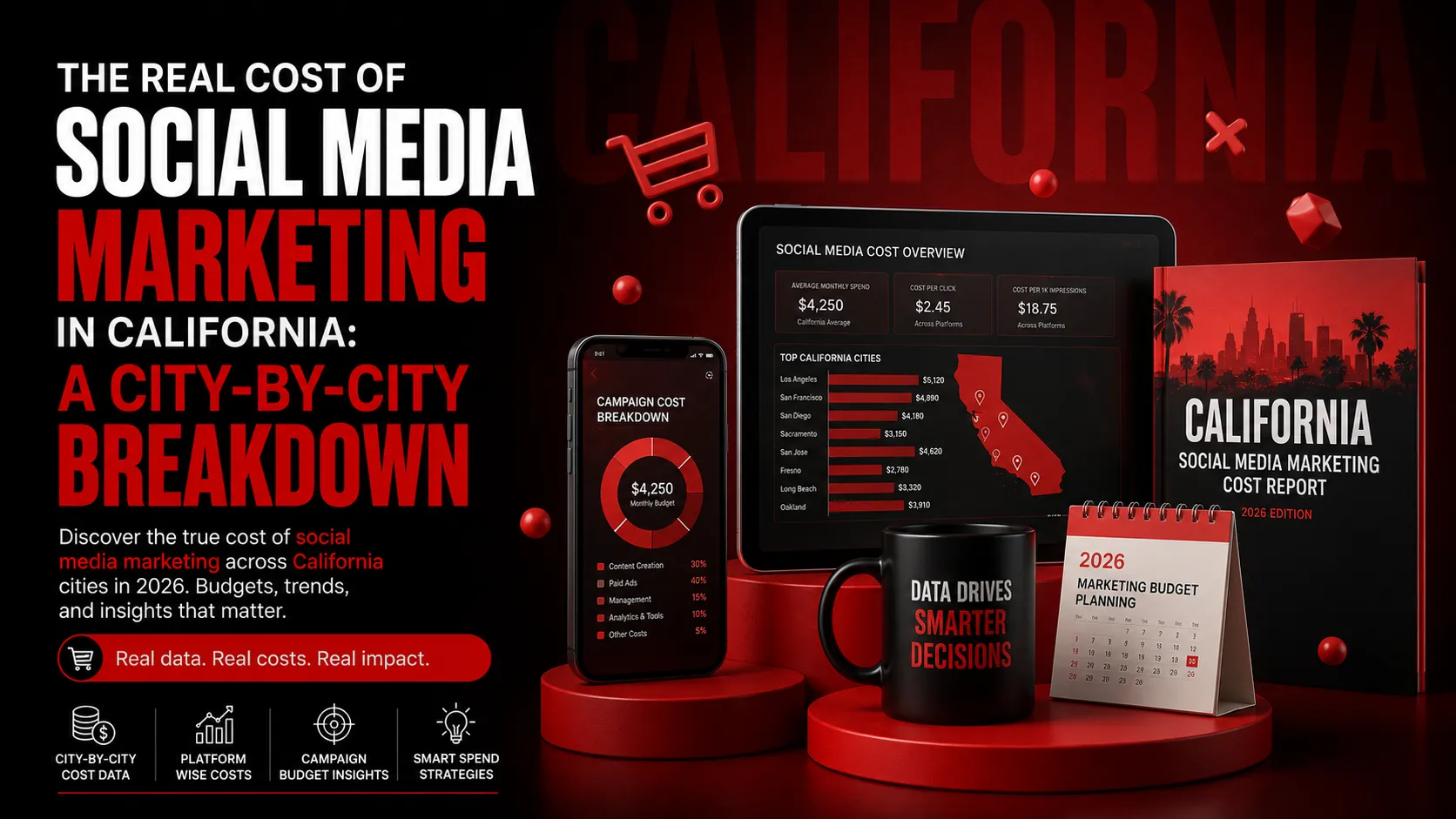
If you run a business anywhere between San Diego and Sacramento, you've probably asked yourself the same question every owner eventually asks: how much should I actually be paying for social media marketing? The honest answer is that it depends heavily on where you're located, because pricing for social media marketing California businesses rely on shifts dramatically from one metro area to the next. A boutique agency quoting a coffee shop in Fresno will land on a very different number than one quoting a tech startup in Palo Alto, and both of those numbers will look nothing like what a law firm in Beverly Hills is paying for a full-service retainer.
This guide breaks down what businesses are really spending across California's major cities, what drives those price differences, and how to figure out where your budget should sit based on your market, your goals, and your competition.
Why Location Actually Changes the Price
It's tempting to assume that social media marketing is a flat-rate service that costs the same no matter where you are, since the work itself content creation, scheduling, ad management, community engagement looks similar on paper regardless of zip code. In practice, geography changes pricing for a handful of very concrete reasons.
Cost of living and labor rates. Agencies and freelancers price their time based on what they need to earn to sustain a business in their market. A social media manager in San Francisco has rent, salaries, and overhead that look nothing like a social media manager working out of Bakersfield or Stockton. That difference gets passed straight through to the client invoice.
Local competition density. In markets saturated with businesses fighting for the same customer attention think Los Angeles restaurants, San Diego tourism, or Silicon Valley SaaS companies ad auctions get more expensive because more advertisers are bidding on the same audience. This drives up the paid media portion of any marketing budget, independent of what an agency charges for management.
Talent pool and specialization. Bigger metro areas attract more specialized talent: video editors, paid social strategists, influencer relationship managers. That specialization commands a premium, but it also often produces stronger results, which changes the value equation even if the sticker price is higher.
Client expectations and industry mix. A city dominated by tech, entertainment, or luxury goods tends to expect more polished creative and faster turnaround, which pushes agencies toward higher-tier pricing models. A city with more service-based small businesses plumbers, dentists, local retailers tends to see simpler, more affordable packages because the expectations and complexity are lower.
Understanding these forces before you start requesting quotes will save you from sticker shock and help you evaluate whether a proposal is actually fair for your market.
The Core Cost Categories You're Paying For
Before diving into specific cities, it helps to separate social media marketing costs into their real components, because most quotes bundle these together in a way that hides where your money is actually going.
Strategy and management fees what you pay an agency or freelancer to plan, create, schedule, and optimize your content and campaigns.
Content production photography, videography, graphic design, copywriting. This can be included in a retainer or billed separately.
Paid advertising spend the actual dollars going to Meta, TikTok, LinkedIn, or X to run ads. This is separate from management fees and often the larger line item.
Tools and software scheduling platforms, analytics dashboards, design tools, social listening software.
Influencer and partnership costs payments to creators for sponsored posts or collaborations, which vary enormously based on follower count and market.
Every city breakdown below reflects blended pricing across these categories, based on typical small-to-midsize business engagements, not enterprise-level contracts.
Los Angeles: The Premium Creative Market
Los Angeles sits at the top of the pricing curve for a simple reason: the city's marketing talent pool overlaps heavily with the entertainment industry, which means creative production quality expectations are higher than almost anywhere else in the state. Agencies here are used to producing polished, cinematic content because that's what LA audiences and LA clients expect.
Freelancer rates: $50–$120/hour, with specialists in video content often charging toward the top of that range.
Small agency retainers: $2,000–$6,000/month for management of 2–3 platforms with moderate content production.
Mid-size agency retainers: $6,000–$15,000/month, often including video production, influencer coordination, and paid ad management.
Paid ad spend: Highly competitive due to industries like entertainment, beauty, fitness, and hospitality bidding aggressively. Expect cost-per-click on Meta platforms to run 20 40% higher than the state average.
Businesses in LA often justify these costs because the audience size and purchasing power in the metro area is enormous, and strong content here has a better shot at organic virality due to the concentration of trendsetters and influencers.
San Francisco and the Bay Area: Tech-Driven Pricing
San Francisco and the broader Bay Area — including San Jose, Palo Alto, and Oakland operate under a different pricing logic. Costs here are shaped less by entertainment style creative production and more by the tech industry's expectations around data, targeting precision, and B2B lead generation.
Freelancer rates: $60–$150/hour, with paid social specialists and B2B content strategists commanding the highest rates in the state.
Small agency retainers: $3,000–$8,000/month.
Mid-size agency retainers: $8,000–$20,000/month, frequently including LinkedIn strategy, marketing automation integration, and conversion tracking setup.
Paid ad spend: LinkedIn advertising in the Bay Area is notably expensive due to the density of B2B SaaS competition, with cost-per-click frequently exceeding $8–$12 for competitive keywords.
Companies here often invest more heavily in analytics and attribution tooling than in raw content volume, since Bay Area clients tend to prioritize measurable pipeline generation over follower growth or engagement metrics.
San Diego: Balanced Coastal Pricing
San Diego offers a middle ground — a market with strong tourism, healthcare, biotech, and military-adjacent industries, but without the extreme cost pressure of LA or the Bay Area.
Freelancer rates: $40–$90/hour.
Small agency retainers: $1,500–$4,500/month.
Mid-size agency retainers: $4,500–$10,000/month.
Paid ad spend: Moderate competition, with tourism and hospitality driving seasonal spikes in ad costs, particularly in the months leading into summer.
San Diego businesses often get strong value here because agencies compete on quality without needing to charge LA-level premiums, making it one of the more efficient markets in the state for small to midsize marketing budgets.
Sacramento: The Value Market
As California's capital, Sacramento has a marketing landscape shaped heavily by government-adjacent organizations, healthcare systems, and a growing small business community that has been steadily expanding as people relocate from pricier coastal cities.
Pricing Type | Rate |
|---|---|
Freelancer Rate | $30–$70/hour |
Small Agency Retainer | $1,200–$3,500/month |
Mid-Size Agency Retainer | $3,500–$7,500/month |
Paid ad spend: Lower competition than coastal metros, meaning cost-per-click and cost-per-lead figures tend to run noticeably below the state average.
For budget-conscious businesses, Sacramento often delivers the best return relative to spend, since agencies here are hungry for long-term client relationships and tend to offer more flexible, scalable packages.
San Jose and Silicon Valley: Enterprise-Level Complexity
While technically part of the Bay Area, San Jose and the deeper Silicon Valley corridor deserve their own mention because of how enterprise-focused the marketing ecosystem has become. Startups and established tech firms alike expect data-driven strategy from day one.
Pricing Type | Rate | Additional Details |
|---|---|---|
Freelancer Rate | $70–$160/hour | Typically for specialists with SaaS or B2B experience |
Small Agency Retainer | $3,500–$9,000/month | Suitable for focused campaigns and ongoing support |
Mid-Size Agency Retainer | $9,000–$25,000/month | Often includes account-based marketing and multi-channel attribution |
Paid ad spend: Among the highest in the state, especially on LinkedIn, where B2B software companies routinely spend $15,000–$50,000+ monthly on paid campaigns alone.
Orange County (Irvine, Anaheim, Newport Beach): Affluent Suburban Pricing
Orange County blends affluent consumer markets with a strong base of e-commerce, healthcare, and real estate businesses, producing pricing that sits comfortably between LA's premium rates and San Diego's balanced market.
Pricing Type | Rate |
|---|---|
Freelancer Rate | $45–$100/hour |
Small Agency Retainer | $2,000–$5,500/month |
Mid-Size Agency Retainer | $5,500–$13,000/month |
Paid ad spend: Real estate and e-commerce competition keeps costs moderately elevated, particularly around luxury goods and coastal lifestyle branding.
Fresno and the Central Valley: The Most Affordable Region
Fresno, Bakersfield, and the broader Central Valley represent the most cost-effective region in the state for marketing services, driven by lower overhead costs and a smaller pool of highly specialized agencies.
Pricing Type | Rate |
|---|---|
Freelancer Rate | $25–$55/hour |
Small Agency Retainer | $800–$2,500/month |
Mid-Size Agency Retainer | $2,500–$6,000/month |
Paid ad spend: Significantly lower cost-per-click across most industries, making this region attractive for businesses looking to stretch a limited budget further.
The tradeoff is a smaller talent pool, meaning businesses sometimes need to work with remote agencies based in larger cities to access more specialized skill sets, which can offset some of the local cost savings.
Long Beach and the South Bay: Industrial and Local Business Pricing
Long Beach's economy leans heavily on logistics, manufacturing, and local retail, which produces a marketing landscape less focused on flashy content and more on lead generation and local visibility.
Pricing Type | Rate |
|---|---|
Freelancer Rate | $35–$80/hour |
Small Agency Retainer | $1,500–$4,000/month |
Mid-Size Agency Retainer | $4,000–$9,000/month |
Paid ad spend: Lower competition outside of e-commerce niches, with local service businesses often seeing strong returns from modest ad budgets.
Oakland and the East Bay: The Emerging Middle Market
Oakland has increasingly become a landing spot for businesses priced out of San Francisco, and its marketing costs reflect that transitional identity still influenced by Bay Area tech culture, but without quite the same premium.
Freelancer rates: $50–$110/hour.
Small agency retainers: $2,200–$6,000/month.
Mid-size agency retainers: $6,000–$14,000/month.
Paid ad spend: Slightly below San Francisco proper, but still elevated compared to inland cities.
Putting the City Data Together: A Quick Comparison
City/Region | Small Agency Retainer | Mid-Size Agency Retainer | Freelancer Rate |
|---|---|---|---|
Los Angeles | $2,000–$6,000/month | $6,000–$15,000/month | $50–$120/hour |
San Francisco/Bay Area | $3,000–$8,000/month | $8,000–$20,000/month | $60–$150/hour |
San Diego | $1,500–$4,500/month | $4,500–$10,000/month | $40–$90/hour |
Sacramento | $1,200–$3,500/month | $3,500–$7,500/month | $30–$70/hour |
San Jose/Silicon Valley | $3,500–$9,000/month | $9,000–$25,000/month | $70–$160/hour |
Orange County | $2,000–$5,500/month | $5,500–$13,000/month | $45–$100/hour |
Fresno/Central Valley | $800–$2,500/month | $2,500–$6,000/month | $25–$55/hour |
Long Beach/South Bay | $1,500–$4,000/month | $4,000–$9,000/month | $35–$80/hour |
Oakland/East Bay | $2,200–$6,000/month | $6,000–$14,000/month | $50–$110/hour |
These figures are directional rather than exact — actual quotes will shift based on your industry, the number of platforms you want managed, and how much original content production is involved.
What Actually Drives Cost Beyond Location
Location sets the baseline, but several other variables swing pricing significantly within any single city.
Number of platforms managed. Managing Instagram alone costs less than managing Instagram, TikTok, Facebook, and LinkedIn simultaneously, since each platform has its own content format requirements, posting cadence, and algorithm quirks.
Content production complexity. A business that needs original video content, professional photography, and custom graphics will pay considerably more than one that's comfortable with templated posts and stock imagery.
Posting frequency. A brand posting once a week has a much lighter workload than one posting daily across multiple platforms with Stories, Reels, and community management layered on top.
Community management and response time. Businesses that need active, fast community management — responding to comments and DMs within an hour, for example — pay a premium over those comfortable with daily or bi-daily check-ins.
Reporting and analytics depth. Basic monthly reports cost far less than granular weekly dashboards with custom KPIs, attribution modeling, and competitor benchmarking.
Industry regulation. Healthcare, finance, and legal businesses often require compliance-aware content review, which adds time and therefore cost to any engagement.
Agency vs. Freelancer vs. In-House: A Cost Comparison
Every business eventually has to decide whether to hire an agency, bring on a freelancer, or build an in-house team. Here's how those options typically compare across California markets.
Freelancers offer the lowest barrier to entry and the most flexibility, but quality and reliability vary widely. A strong freelancer in a mid-tier market like Sacramento or Long Beach can deliver agency-quality work at a fraction of the cost, but you're relying on one person's bandwidth, which creates risk if they get sick, go on vacation, or take on too many clients at once.
Agencies provide redundancy — if one team member is out, someone else can step in — along with broader skill sets across strategy, design, copywriting, and paid media. The tradeoff is higher cost and, in some cases, less personalized attention if you're a smaller account within a larger agency's client roster.
In-house hires make the most sense once your marketing spend justifies a full-time salary. A junior social media coordinator in California typically commands $45,000–$65,000 annually depending on region, while a senior social media manager can run $70,000–$110,000 or more, especially in the Bay Area or Los Angeles. Add benefits, software licenses, and training costs, and the true cost of an in-house hire often exceeds what businesses initially expect.
For most small and midsize businesses evaluating social media marketing California vendors, a hybrid approach — a lean in-house point of contact working alongside a freelancer or agency for execution — tends to strike the best balance between cost and quality.
Hidden Costs Businesses Often Miss
Many businesses budget for the obvious line items and get blindsided by costs that don't show up until later.
Onboarding and strategy development fees. Some agencies charge a separate upfront fee — often $500–$3,000 — to conduct research, competitor analysis, and initial strategy development before ongoing retainer work begins.
Ad account setup and pixel implementation. Getting tracking pixels, conversion events, and ad accounts properly configured takes time, and not every quote includes this in the base retainer.
Stock photo and video licensing. If your business doesn't have its own photography, licensing fees for stock content can add up over a year of consistent posting.
Software subscriptions passed through to clients. Some agencies mark up scheduling and analytics tools rather than absorbing them into their fee, so ask directly whether tool costs are included or billed separately.
Revision rounds beyond the agreed scope. Extra rounds of content revisions beyond what's outlined in a contract often incur additional hourly charges.
Crisis management and reputation response. If your brand faces a PR issue or a viral negative comment thread, some agencies charge extra for the rapid-response work required to manage it.
Asking about each of these directly during the proposal stage will prevent budget surprises three or six months into a contract.
How Much Should You Actually Budget?
A reasonable rule of thumb across California markets is to budget social media marketing at roughly 5–12% of your overall revenue if marketing is a core growth driver for your business, with paid advertising spend layered on top of management fees. For a small local business doing $500,000 in annual revenue, that might translate to $2,000–$5,000 per month in combined management and ad spend. A fast-growing e-commerce or SaaS business often pushes that percentage higher, sometimes into the 15–20% range during aggressive growth phases.
The single biggest budgeting mistake businesses make is treating management fees and ad spend as the same bucket. A $3,000/month agency retainer with only $500/month in ad spend behind it will rarely produce meaningful results in competitive markets like Los Angeles or San Francisco, where organic reach alone struggles to move the needle.
Case Examples Across Industries
A boutique fitness studio in Santa Monica spends roughly $4,500/month split between a small agency retainer ($2,800) and paid ad spend ($1,700), focusing heavily on Instagram and TikTok content built around class footage and trainer personalities.
A B2B software company in San Jose allocates $18,000/month, with $9,000 going toward a specialized LinkedIn-focused retainer and $9,000 toward paid campaigns targeting enterprise decision-makers, reflecting how expensive B2B acquisition costs are in competitive tech markets.
A family-owned restaurant in Fresno operates on a lean $1,200/month budget, working with a local freelancer for content creation and running a modest $300/month in local geo-targeted ads, an approach that's realistic given the lower cost environment in the Central Valley.
A dental practice in San Diego spends around $3,500/month, prioritizing consistent local content, review management, and moderate ad spend aimed at new patient acquisition within a 10-mile radius of their office.
These examples underline a consistent theme: budgets scale not just with business size, but with how competitive the local market is for that specific industry.
Trends Shaping Future Costs
Several shifts are likely to affect how much California businesses pay for social media marketing over the next few years.
AI-assisted content production is beginning to lower the cost of content creation itself, since tools can now generate first-draft copy, basic graphics, and even short-form video edits faster than a human working alone. Agencies that adopt these tools efficiently may pass some savings to clients, though many are using the efficiency gains to expand service scope instead of lowering prices.
Rising short-form video demand continues to push costs upward for agencies that can produce high-quality Reels and TikTok content, since video production remains more labor-intensive than static content, even with AI assistance.
Increased ad platform competition in categories like healthcare, home services, and e-commerce is likely to keep paid media costs climbing in dense metro areas, particularly as more small businesses shift budget away from traditional advertising and into social platforms.
Consolidation among agencies in smaller markets like Fresno and Bakersfield may gradually narrow the pricing gap between inland and coastal cities as fewer, larger agencies absorb smaller shops.
Final Thoughts
There's no single right answer to what social media marketing should cost, because the honest answer always depends on where your business operates, how competitive your industry is locally, and what level of content quality your market expects. What's clear from looking across the state is that social media marketing California businesses invest in varies by tens of thousands of dollars annually depending on whether you're in Los Angeles, San Francisco, Fresno, or Sacramento, and understanding that variance is the first step toward building a realistic, effective budget.
Whether you're a small business in the Central Valley working with a modest monthly retainer or a tech company in Silicon Valley running a five-figure monthly ad program, the goal is the same: match your spend to your market's realistic cost structure, not a generic national average that doesn't reflect what's actually happening in your city.
Frequently Asked Questions
1. What is the average cost of social media marketing in California? Costs typically range from $800 to $25,000+ per month depending on the city, agency size, number of platforms managed, and whether paid advertising is included. Inland cities like Fresno and Sacramento tend to be the most affordable, while Los Angeles, San Francisco, and San Jose command premium pricing.
2. Why is social media marketing more expensive in Los Angeles and San Francisco than in Fresno or Sacramento? Higher cost of living, denser competition for advertising space, and a more specialized talent pool all push prices up in major coastal metros. Inland cities have lower overhead and less competitive ad auctions, which keeps costs down.
3. Is it cheaper to hire a freelancer or an agency in California? Freelancers are generally cheaper on an hourly basis, but agencies offer more redundancy, broader skill sets, and consistency. The right choice depends on your budget, how much oversight you can provide, and how complex your content needs are.
4. How much should a small business budget for social media marketing per month? Most small businesses budget between $1,200 and $5,000 per month combined for management and ad spend, though this varies significantly by city and industry competitiveness.
5. Does paid advertising cost more in some California cities than others? Yes. Cities with dense competition in specific industries, such as tech in San Jose or entertainment and beauty in Los Angeles, tend to have higher cost-per-click and cost-per-lead figures than less competitive inland markets.
6. What's included in a typical social media marketing retainer? Most retainers include content strategy, scheduling, basic graphic design, community management, and monthly reporting. Video production, paid ad management, and influencer coordination are often billed separately or included only in higher-tier packages.
7. Are there hidden costs businesses should watch for? Yes. Common hidden costs include onboarding fees, stock photo and video licensing, software subscriptions passed through to the client, extra revision rounds, and ad account setup fees not included in the base retainer.
8. How does industry affect social media marketing costs in California? Regulated industries like healthcare, finance, and legal services often require additional compliance review, which adds time and cost. Highly competitive industries like real estate, e-commerce, and hospitality also tend to see higher paid advertising costs due to auction competition.
9. Is it worth hiring an in-house social media manager instead of an agency? It depends on your marketing volume. In-house hires make more financial sense once your monthly agency spend approaches or exceeds the cost of a full-time salary and benefits, which in California typically starts around $45,000–$65,000 annually for a junior role.
10. How can a business get the best value for social media marketing in California? Focus on matching your budget to your local market's realistic pricing, ask vendors to break down management fees separately from ad spend, clarify what's included versus billed separately, and consider a hybrid approach combining in-house oversight with freelance or agency execution.
Tags
About the Author

Emily Carter
Emily writes about digital marketing, brand strategy, and practical ways businesses can build a stronger online presence for the Brandrums editorial team.