The Headline Numbers
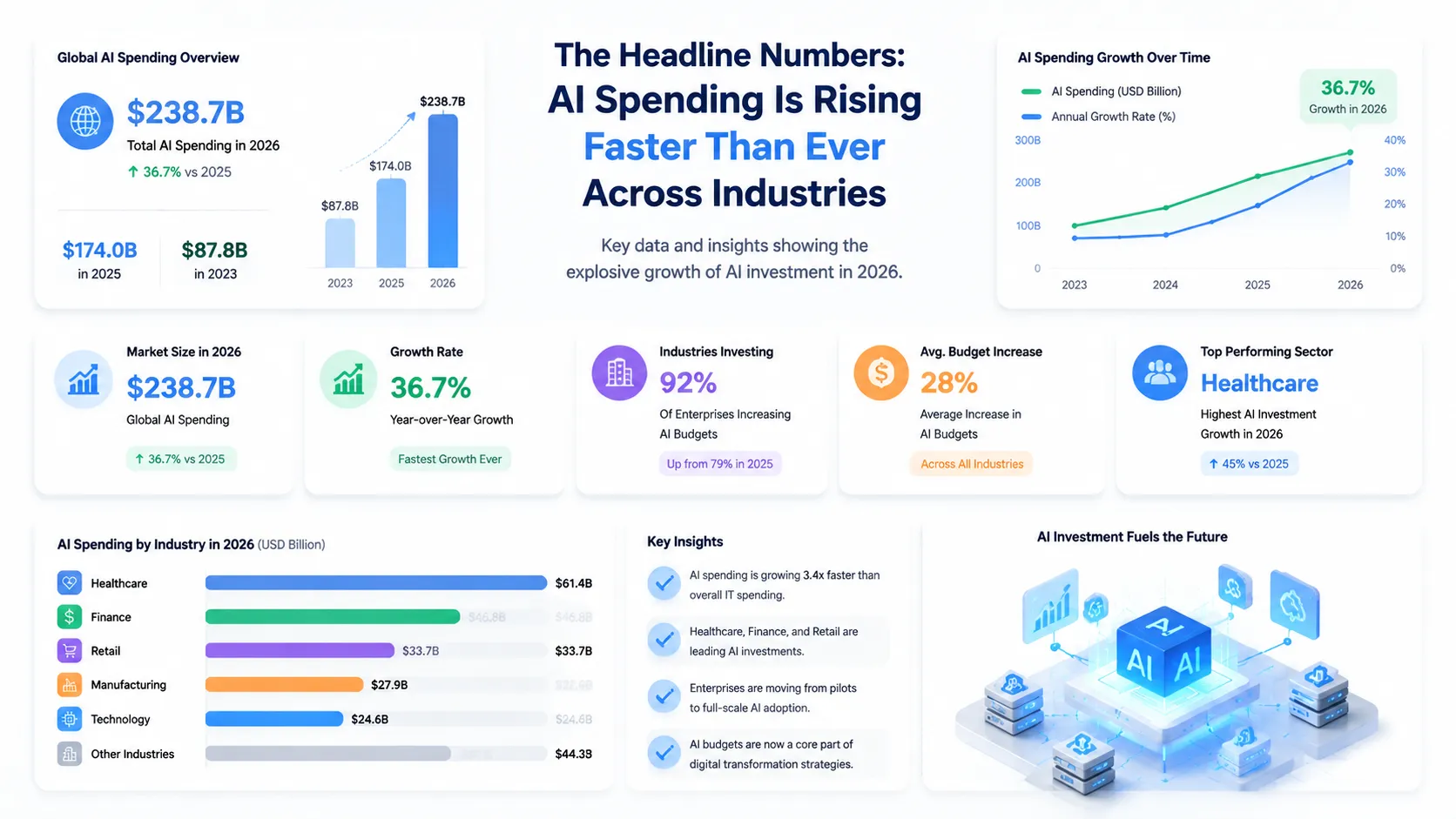
AI adoption is nowhere close to uniform. Some industries have woven it into the core of how they operate. Others are still poking at it from a cautious distance. And the gap between those two groups is widening every quarter. If you want to know whether your business is ahead, behind, or right on pace, it helps to see where the money is actually flowing. Start with the big picture. Global enterprise AI spending reached roughly $186 billion in 2026, up about 47 percent from the year before. Across the board, 86 percent of organizations say their AI budget is increasing this year, another 12 percent say it is holding steady, and nearly 40 percent expect increases of 10 percent or more.
hero image for this blog, top of post, full width
Adoption varies widely by sector, and the gap is where opportunity lives. This is not a sector deciding whether to invest. It is most of the economy deciding how much. One more anchor stat: 88 percent of organizations now report using AI in at least one business function, up from 78 percent a year earlier. AI crossed the mainstream threshold a while ago. The live question now is depth, not whether.
Financial Services: The Biggest Spender
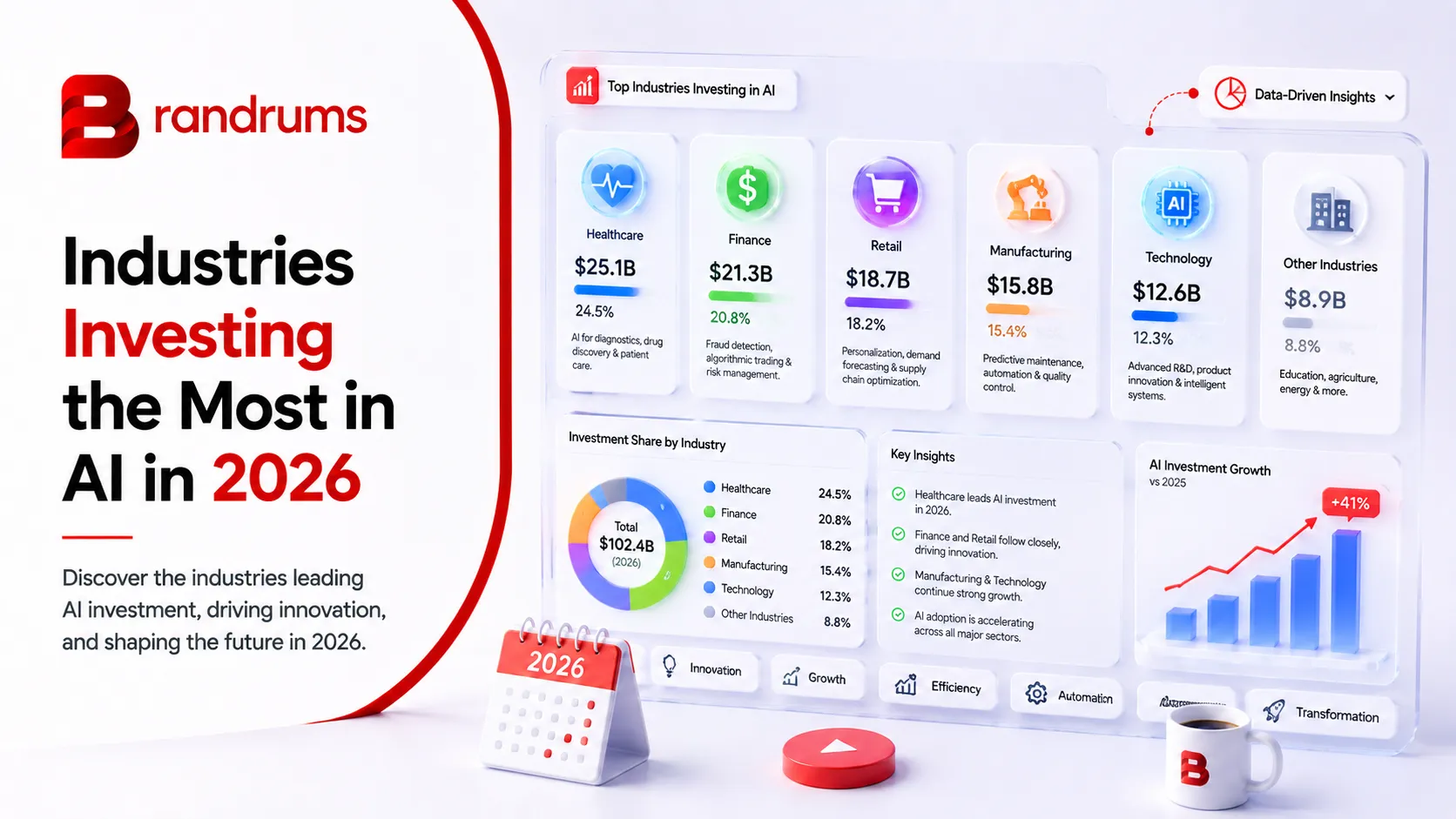
Finance leads in raw dollars, with AI spending around $38.2 billion, the largest share of any sector. It is easy to see why. Banks and investment firms run on text, numbers, documents, and analysis, which is exactly what AI is built to chew through at scale. The use cases are everywhere: fraud detection, risk modeling, algorithmic trading, and customer personalization. Fraud detection alone sees adoption near 89 percent among AI-using finance firms. When milliseconds and pattern recognition translate directly into money, the investment case writes itself. Investment firms have been especially aggressive, using AI to spot patterns human analysts simply cannot see fast enough. Sector snapshot: a mid-sized bank deploying AI fraud detection can flag suspicious transactions in real time across millions of accounts, catching patterns a human team would need days to surface. The return is measured in fraud losses prevented, which is why finance tolerates higher per-project costs than almost any other sector.
There is a second reason finance leads on spending: the cost of being wrong is enormous, so the willingness to invest in getting it right is correspondingly high. A retailer with a slightly off recommendation loses a marginal sale. A bank with a slightly off risk model loses real money and possibly regulatory standing. That asymmetry pushes financial firms to fund AI heavily and to demand robust, well-tested systems rather than quick experiments. It also means finance was an early and demanding customer for enterprise AI, which helped mature the whole category for everyone else.
Technology and SaaS: The Highest Adoption Rate
If finance spends the most, tech adopts the most. Around 92 percent of technology companies use AI in some form, and the sector pours the highest share of its IT budget into it, north of 18 percent. Inside software companies, AI now writes a large chunk of code, and a strong majority of developers use AI coding assistants daily. Tech also builds AI directly into the products it sells, so the investment compounds. They use it internally to move faster and ship it externally as a feature. That double benefit is why the sector keeps pulling ahead. This compounding is worth dwelling on, because it explains why the gap between tech and everyone else keeps widening rather than closing. When a software company gets better at using AI internally, it ships products faster. When those products have AI features, the company learns even more about what works. Each cycle feeds the next. Other industries adopt AI to improve operations, which is valuable, but technology companies adopt it to improve the very thing they sell, which creates a flywheel. For businesses outside tech, the practical lesson is not to try to match that flywheel but to borrow its output: the accessible, battle-tested tools that tech companies built and now sell to everyone else at $20 a month.
Healthcare: The Fastest Accelerator
Healthcare is the comeback story of the year. Adoption jumped from around 38 percent in 2024 to roughly 67 percent in 2026, one of the sharpest climbs of any industry. The growth is fueled by regulatory clarity, a wave of FDA-cleared AI medical devices, and hard evidence that AI-assisted diagnostics reduce error rates.
Healthcare adoption nearly doubled in two years, one of the sharpest climbs anywhere. The applications are serious and high-stakes: reading medical images, supporting clinical decisions, and handling the mountain of documentation that burns out clinical staff. Healthcare spends more per project than most sectors because compliance and security are non-negotiable, but the trajectory is pointed straight up. The documentation angle deserves a mention because it is where the near-term savings concentrate. Clinicians spend a staggering share of their time on paperwork rather than patients, and that administrative load is a leading driver of burnout. AI that drafts clinical notes, summarizes patient histories, and handles routine documentation gives that time back to care. It is less headline-grabbing than an AI reading a scan, but it is often where hospitals see the fastest, clearest return, because it attacks a cost and a staffing problem at the same time. That combination of obvious need and measurable payback is a big part of why healthcare adoption nearly doubled in just two years.
Retail and E-Commerce: AI Across the Whole Journey
Retail sits around 77 percent adoption and has spread AI across the entire customer journey, from product discovery to post-purchase support. Direct contact with millions of customers generates exactly the kind of data that AI feeds on. The wins are concrete and measurable. AI product recommendations lift average order values by 10 to 30 percent. Demand forecasting cuts both stockouts and overstock. Chatbots handle the bulk of routine questions. Retailers using generative AI report strong returns, and the top performers see outsized payback per dollar invested. Sector snapshot: an online retailer that adds AI-driven product recommendations to its checkout flow can lift average order value by double digits without spending a cent more on traffic. Stack that with demand forecasting that trims wasted inventory, and the margin improvement compounds across the whole operation.
Professional Services and Agencies: The Highest Spend Per Head
Here is a number that surprises people. Professional and business services spend the most per employee on AI, around $3,470 a head, ahead of even technology companies at roughly $2,800.
Professional services spend the most per head, ahead of even tech. Agencies and consultancies live on cognitive, analytical work, which is precisely where AI delivers, and it shows in usage intensity. Agency and tech teams average 8 to 12 hours a week inside AI tools, while slower-moving sectors like finance sit at 3 to 5 hours, often held back by compliance friction rather than lack of interest.
Manufacturing and the Sectors With the Most Room to Grow
Not every industry is racing ahead, and that is its own kind of opportunity. Manufacturing sits around 52 percent adoption, well behind the leaders, despite obvious use cases in predictive maintenance, quality control, and supply chain forecasting. The barriers are real: legacy equipment, heavy upfront integration, and workforces that need retraining. But the upside is large precisely because so few competitors have moved. The same logic applies to construction, agriculture, and parts of logistics. These sectors trail on adoption, which means the businesses inside them that move now are not fighting for a marginal edge. They are stepping into clear space while their competitors hesitate. Trailing-sector adoption is arguably one of the highest-leverage AI moves available in 2026, because you capture an advantage before it becomes table stakes.
The Full Picture at a Glance
Industry | Approx. adoption | Standout metric |
|---|---|---|
Technology / SaaS | ~92% | Highest IT budget share to AI (18%+) |
Financial services | ~84% | Largest raw spend (~$38.2B) |
Retail / e-commerce | ~77% | 10-30% lift in average order value |
Healthcare | ~67% | Fastest growth (+29 points since 2024) |
Professional services | High | Most spend per employee (~$3,470) |
Manufacturing | ~52% | Trailing, big upside remaining |
What This Means for Your Business
The data is interesting on its own, but the point is what you do with it. A few honest takeaways depending on where you sit.
If you are in a leading sector (finance, tech, retail, professional services), your competitors are already using AI. Standing still is quietly falling behind. The question is how fast you can close the gap, not whether you need to.
If you are in a slower-moving sector (manufacturing, agriculture, and others trailing the pack), you have a genuine window. Adopting now puts you ahead of your direct competitors instead of scrambling to catch up in two years.
Either way, the budget trend is the tell. When 86 percent of organizations are increasing AI spend at once, the safe-looking choice of waiting is the actual risk.
The good news is you do not need a finance-sized budget to compete. The same accessible tools that let a tiny e-commerce shop go up against a corporation are available to you right now, today. What matters is applying them to the right parts of your business, which is exactly where most of the value is won or lost.
Where Does Your Industry Stand?
Brandrums helps businesses across industries figure out which AI moves actually move the needle for their specific situation.
See Our AI SolutionsTalk to Us
Frequently Asked Questions
Which industry invests the most in AI?
Financial services leads in raw AI spending at around $38.2 billion in 2026, the largest share of any sector, driven by fraud detection, risk modeling, algorithmic trading, and customer personalization. Technology has the highest adoption rate at about 92 percent, and professional services spend the most per employee at around $3,470 per head.
How much are companies spending on AI in 2026?
Global enterprise AI spending reached roughly $186 billion in 2026, up about 47 percent from the prior year. Across all sectors, 86 percent of organizations say their AI budget is increasing this year, and nearly 40 percent expect increases of 10 percent or more.
Which industry is adopting AI the fastest?
Healthcare is the fastest accelerator, jumping from around 38 percent adoption in 2024 to roughly 67 percent in 2026. The growth is driven by regulatory clarity, a wave of FDA-cleared AI medical devices, and evidence that AI-assisted diagnostics reduce error rates.
What does AI investment by industry mean for small businesses?
If you are in a leading sector, your competitors already use AI and standing still means falling behind. If you are in a slower sector, you have a window to adopt now and get ahead of direct competitors. Either way, the broad budget increase signals that waiting is the riskier choice.
Do I need a big budget to compete on AI?
No. The same accessible, low-cost tools that large companies use are available to small businesses. What matters is applying them to the right parts of your business, not how much you spend. Smaller players regularly level the playing field with the same off-the-shelf AI tools enterprises use.
Ready to build the AI setup that fits your business?
Whether you are a solo founder testing the waters or a growing team scaling into serious automation, we help clients pick the lightest AI stack that earns its keep. Same discipline we apply through website development, web application development, SaaS development, and digital marketing retainers. Tell us what you are trying to automate and we will recommend a setup. Or check our pricing options if you are scoping engineering support alongside the tooling.
Tags
About the Author

Daniel Brooks
Daniel covers web development, artificial intelligence, product design, and the technology decisions that help modern businesses grow.