What Is Google AI Mode and Why Should Local Businesses Care?
Google AI Mode is not a futuristic concept anymore. It is here, and it is fundamentally changing how consumers find local businesses online. Instead of scrolling through traditional blue-link search results, users are now getting direct, conversational answers generated by Google's Gemini AI model. These answers synthesize information from multiple websites, review platforms, and business directories to give users exactly what they need, often without them ever clicking through to a website.
For local business owners, this shift is critical. When a potential customer asks Google AI Mode, "What is the best plumber near me?" or "Where can I find a reliable web design agency in San Diego?", the AI pulls information from a handful of sources. If your website is not one of those sources, you do not exist in that conversation. You are invisible.
Here is the reality: most small business websites were built for traditional search. They were designed to rank on page 1 of Google's classic results page, not to be understood and cited by an AI system. The websites that win in Google AI Mode are the ones that are fast, well-structured, locally relevant, and packed with clear, authoritative content that AI can easily extract and reference.
The good news? You can fix this. But first, you need to know where you stand. That is exactly what this audit checklist is for.
How Google AI Mode Changes Local Search
Before we get into the checklist, let us understand what is actually different about Google AI Mode compared to traditional search.
In traditional search, Google ranks websites based on hundreds of factors including keywords, backlinks, page speed, and user engagement. The results are a list of links, and users click through to websites to find answers.
In Google AI Mode, the experience is fundamentally different. The AI understands the intent behind a query, pulls information from multiple sources, and synthesizes it into a direct answer. The user gets a conversational response that may include recommendations, comparisons, and specific details, all generated by AI.
What this means for local businesses:
- Your content needs to be AI-readable. Clear, well-structured content that answers specific questions is more likely to be cited by AI systems.
- Local signals matter more than ever. Google Business Profile, reviews, NAP (Name, Address, Phone) consistency, and local citations are critical trust signals that AI uses to verify your business.
- Technical performance is non-negotiable. Slow, broken, or unstructured websites are invisible to AI crawlers.
- Authority and originality win. AI systems prefer to cite websites that demonstrate expertise, authority, and trustworthiness (E-E-A-T).
The businesses that understand this shift and adapt their websites accordingly will dominate local AI search. The ones that do not will watch their visibility decline month after month.
The 15-Point Google AI Mode Website Audit Checklist
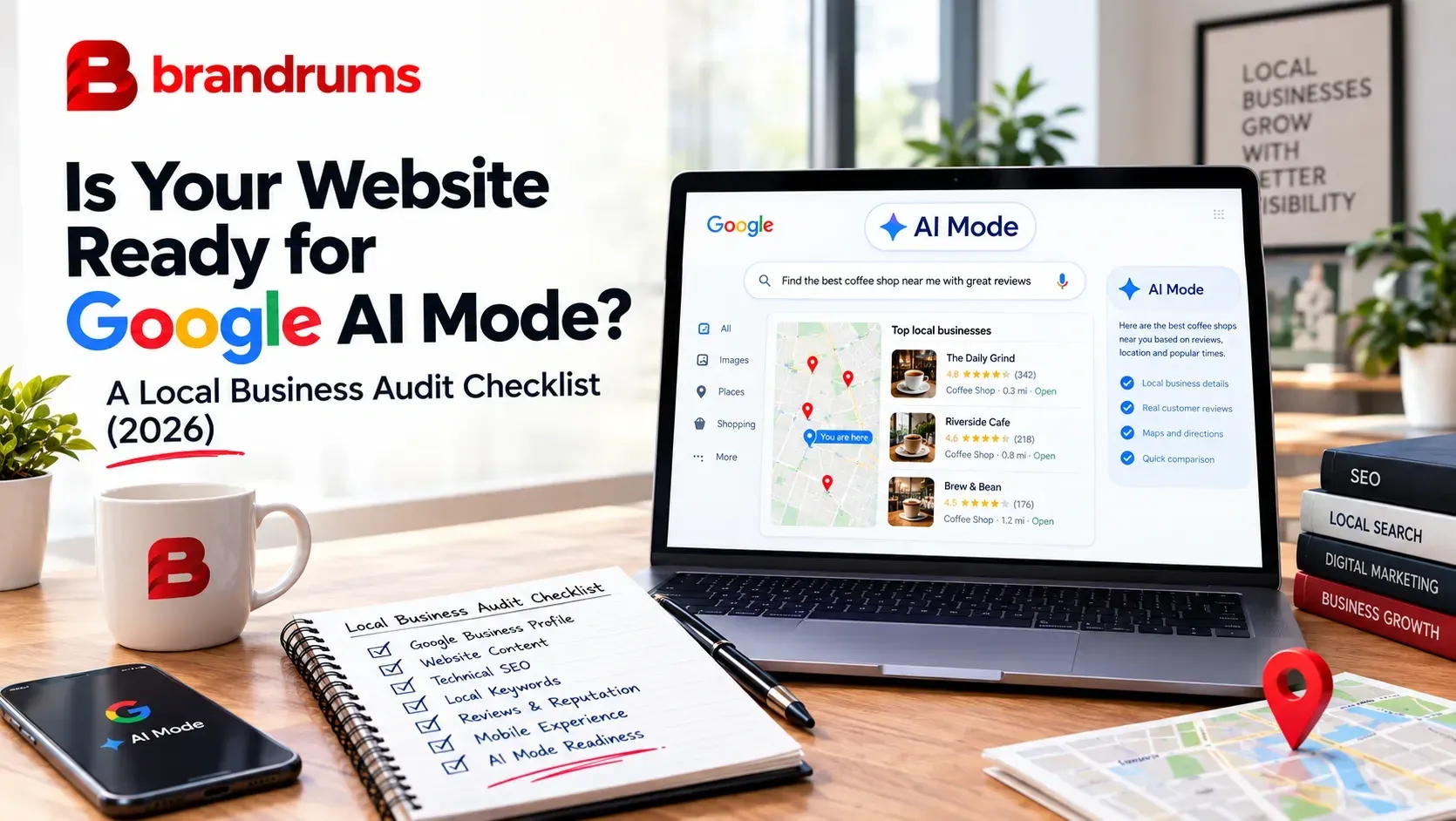
Use this checklist to assess your website's readiness for Google AI Mode. For each item, give yourself a yes or no. If you answered no to more than 3 items, your website needs work before AI search leaves you behind.
Technical Performance
1. Does your website load in under 3 seconds on mobile?
Page speed is one of the most important ranking factors for both traditional and AI search. Google's own research shows that 53% of mobile users abandon sites that take longer than 3 seconds to load. For AI Mode, slow websites are even less likely to be crawled and cited. Test your site speed using Google PageSpeed Insights and aim for a score of 90 or above on mobile.
2. Is your website fully mobile-responsive?
Over 60% of Google searches happen on mobile devices. If your website does not display properly on smartphones and tablets, you are losing the majority of your potential customers. Open your site on your phone right now. Can you read the text without zooming? Can you tap buttons easily? Can you complete a purchase or contact form without frustration? If not, you have a problem.
3. Do you have structured data markup (schema.org) implemented?
Structured data is the language that helps AI systems understand your content. Without it, your website is just a collection of words that AI has to interpret on its own. With it, you are explicitly telling search engines what your business does, where it is located, what services it offers, and what your customers think of it. Implement schema markup for LocalBusiness, Service, FAQ, and Review to give AI systems the structured information they need. Learn more at schema.org.
4. Is your website secure (HTTPS) with a valid SSL certificate?
Security is a trust signal for both users and AI systems. Websites without HTTPS are flagged as insecure, and AI systems are less likely to cite them. Check your URL bar. Do you see the padlock icon? If not, contact your hosting provider immediately.
Content Quality and Structure
5. Does your homepage clearly state what you do and where you do it?
Within 5 seconds of landing on your homepage, a visitor (or an AI crawler) should know exactly what your business does, where it is located, and who it serves. If your homepage is vague, generic, or focused on your company history instead of customer value, you are failing this test.
6. Do you have dedicated service pages for each of your core offerings?
AI systems look for specific, detailed information about your services. A single page that lists everything you do is not enough. Each core service should have its own page with detailed descriptions, pricing information (if applicable), FAQs, and clear calls to action. This structure helps AI understand exactly what you offer and match you to relevant queries.
7. Does your content answer common customer questions?
Think about the questions your customers ask most frequently. "How much does web design cost?" "How long does it take to build an app?" "What is included in your SEO services?" If your website does not answer these questions clearly, AI Mode will get the answers from your competitors instead. Create a comprehensive FAQ section and make sure the answers are detailed, helpful, and written in natural language.
8. Is your content original, authoritative, and regularly updated?
AI systems prefer to cite websites that demonstrate expertise and authority. Thin, generic, or outdated content signals low quality. Make sure your content is original (not copied from competitors), demonstrates real expertise, and is updated regularly. A blog with fresh, relevant content is one of the best ways to build authority in AI search.
Local SEO Signals
9. Is your Google Business Profile fully optimized?
Your Google Business Profile is the single most important local SEO asset you have. Make sure it is fully completed with accurate NAP information, business hours, photos, services, a compelling business description, and regular posts. Encourage your customers to leave reviews and respond to every review promptly.
10. Is your NAP (Name, Address, Phone) information consistent across all online directories?
Inconsistent NAP information confuses AI systems and hurts your local visibility. Use a tool like BrightLocal or Moz Local to audit your citations and fix any inconsistencies. Your business name, address, and phone number should be identical everywhere your business appears online.
11. Do you have at least 20 genuine customer reviews across Google and other platforms?
Reviews are one of the strongest trust signals for AI systems. They provide social proof, demonstrate customer satisfaction, and give AI systems real data to cite. Aim for a steady stream of genuine reviews on Google, Yelp, industry-specific platforms, and social media. Never buy fake reviews. AI systems are getting better at detecting them, and the penalties are severe.
12. Do you have location-specific content on your website?
If you serve specific cities or regions, make sure your website reflects that. Create location-specific pages or content that mentions the areas you serve. "Web design services in San Diego" is much more powerful for local AI search than just "web design services."
AI-Specific Optimization
13. Is your content written in clear, natural language that AI can easily understand?
AI systems struggle with jargon, overly complex sentences, and vague language. Write like you are talking to a customer, not a textbook. Use short sentences, simple words, and clear explanations. Define any technical terms you use. Make it easy for both humans and AI to understand exactly what you are saying.
14. Do you use clear heading hierarchy (H1, H2, H3) throughout your website?
Heading tags are how AI systems understand the structure and hierarchy of your content. Your homepage should have one H1 tag (your main headline). Each section should have H2 tags. Subsections should have H3 tags. This structure helps AI quickly identify the most important information on each page and extract it for AI-generated answers.
15. Have you tested what Google AI Mode says about your business?
This is the most important test of all. Go to Google, activate AI Mode, and ask questions that your customers would ask. "What is the best [your service] company in [your city]?" "How much does [your service] cost?" "What should I look for when hiring a [your service] provider?" See if your business appears in the AI-generated answer. If it does not, you know exactly what you need to fix.
What Our Free AI-Readiness Audit Covers
At Brandrums, we have helped dozens of local businesses prepare their websites for the AI search era. Our free AI-readiness audit goes beyond this checklist and gives you a detailed, actionable report that covers:
- Technical performance analysis: Page speed, mobile responsiveness, Core Web Vitals, and crawlability
- Content structure review: Heading hierarchy, content gaps, and AI-readability scoring
- Local SEO assessment: Google Business Profile optimization, NAP consistency, and review profile
- Competitive analysis: How your website compares to your top 3 local competitors in AI search
- Prioritized action plan: Specific, ranked recommendations for what to fix first for maximum impact
The audit takes less than 5 minutes to complete, and you will receive a detailed report within 24 hours. No strings attached, no sales pitch. Just a clear, honest assessment of where your website stands and what you need to do to compete in AI search.
The Bottom Line: Do Not Wait Until AI Search Leaves You Behind
Here is the reality: Google AI Mode is not coming. It is here. Every month, more users switch to AI-powered search, and the businesses that are not prepared are losing visibility, leads, and revenue. The shift is happening now, and the gap between prepared businesses and unprepared businesses is growing every day.
The good news is that you do not have to figure this out alone. At Brandrums, we have been helping local businesses navigate search engine changes for years. We understand what Google AI Mode looks for, and we know exactly how to make your website visible in AI-generated answers.
Book your free AI-readiness website audit today. It takes 5 minutes, it costs nothing, and it will tell you exactly where your website stands and what you need to do to compete in the AI search era. Do not wait until your competitors figure it out first. The time to act is now.
Explore more from Brandrums
Want to measure your website's ROI? Read our Website Redesign ROI Guide.
Planning a rebuild? Use our Web App Redesign Checklist.
Weighing your options? See WordPress vs custom web app.
Frequently Asked Questions
What is Google AI Mode?
Google AI Mode is an AI-powered search experience that uses Google's Gemini model to understand queries, synthesize information from multiple sources, and provide direct, conversational answers. For local businesses, this means your website content needs to be structured so AI systems can easily understand, extract, and cite your information.
How does Google AI Mode affect local SEO?
Google AI Mode changes local SEO by prioritizing websites with clear, well-structured content, strong local signals (Google Business Profile, reviews, NAP consistency), and authoritative information. Websites that are slow, unstructured, or lack local relevance are less likely to be cited in AI-generated answers. The shift means local businesses need to focus on being the most authoritative, well-structured source of information in their niche and geography.
Is my website ready for Google AI Mode?
Most small business websites are not fully ready for Google AI Mode. Key readiness factors include fast load times, mobile responsiveness, structured data markup, clear content hierarchy, strong local SEO signals, and authoritative, well-written content. The best way to know for sure is to run through the 15-point checklist above or book a free AI-readiness audit with a qualified agency like Brandrums.
How do I optimize my website for AI search?
To optimize for AI search, focus on five key areas: (1) clear, self-contained content that answers common customer questions, (2) structured data markup using schema.org, (3) strong local SEO signals including Google Business Profile and reviews, (4) fast, mobile-friendly performance, and (5) authoritative, original content that AI systems can confidently cite. Think of it as making your website easy for both humans and machines to understand.
What is an AI-readiness website audit?
An AI-readiness website audit evaluates your website's technical performance, content structure, local SEO signals, and overall ability to be understood and cited by AI search engines like Google AI Mode. It identifies specific issues that may prevent your business from appearing in AI-generated answers and provides a prioritized action plan to fix them.
How much does it cost to optimize for Google AI Mode?
The cost varies depending on the current state of your website and the scope of work needed. A basic technical fix might cost a few hundred dollars, while a comprehensive AI-readiness overhaul including content restructuring, schema implementation, and local SEO optimization could range from $1,500 to $5,000 or more. The best way to get an accurate estimate is to start with a free audit, which will tell you exactly what needs to be done.
Tags
About the Author

Emily Carter
Emily writes about digital marketing, brand strategy, and practical ways businesses can build a stronger online presence for the Brandrums editorial team.