Why a CEO Should Care About This Now
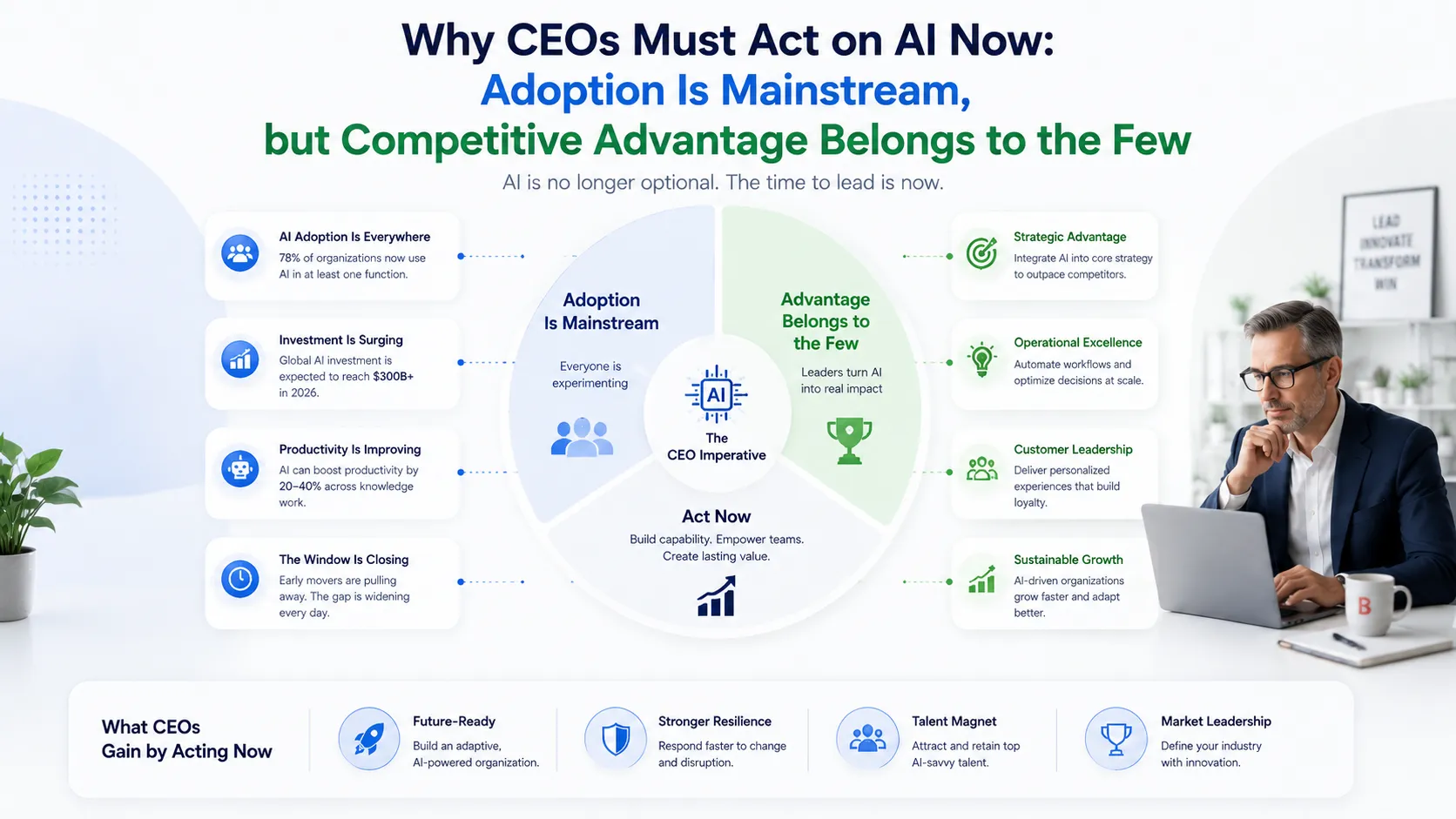
If you run a company, you do not need to understand how AI models work under the hood any more than you need to understand internal combustion to run a logistics business. What you do need is a clear read on where this technology is heading, because the decisions you make in the next year or two will compound. The trends below are not abstract. Each one carries a strategic implication you can act on. Skip the hype and the doom, and here is what actually matters for the people steering the ship. One number frames everything else. AI adoption has crossed the mainstream: 88 percent of organizations now use AI in at least one function. But only about 7 percent have fully scaled it, and just 6 percent qualify as high performers who attribute 5 percent or more of their earnings to AI. The technology is everywhere. The value is concentrated. That gap is the entire strategic story.
hero image for this blog, top of post, full width
Almost everyone is using AI. Almost no one has scaled it. That gap is the opportunity.
Trend 1: The Gap Between Using AI and Profiting From It Is Widening
Most companies are dabbling. Very few are winning. The 6 percent of organizations that qualify as AI high performers are pulling away from everyone else, because they have moved past scattered experiments to AI woven through multiple functions. The strategic takeaway: simply "having AI" is no longer an advantage, because nearly everyone has it. The advantage now belongs to companies that scale it deliberately across the business. Companies that take a structured approach, piloting, measuring, then scaling, typically reach 3 to 5 times ROI within 12 to 18 months. The dabblers get a productivity bump and a pile of subscriptions. As a CEO, your job is to push your organization from the 88 percent who use AI into the small group that profits from it. What to do with this: stop measuring AI by tools adopted and start measuring it by functions transformed. One process scaled end to end beats ten pilots that never leave the lab.
Trend 2: Agentic AI Moves From Buzzword to Workflow
The most important technical shift is the rise of agentic AI: systems that do not just answer questions but take actions and complete multi-step tasks on their own. Around 23 percent of organizations are already scaling agentic AI, with another 39 percent experimenting. Telecom and retail are leading the way.
Agentic AI is the trend most likely to reshape workflows in the next two years. The difference matters. A regular AI assistant drafts an email when you ask. An AI agent can monitor your inbox, draft responses, schedule the follow-ups, and update your CRM, stringing the steps together without you prompting each one. This is the trend most likely to reshape how work actually gets done over the next two years. The strategic takeaway: start understanding where agents could own entire workflows in your business, not just assist with single tasks. The companies experimenting now will have a real head start when this matures, and it is maturing fast. A note of realism, because this is where hype runs ahead of reality. Agentic AI today is powerful but still needs supervision, especially on anything high-stakes or customer-facing. The smart move is not to hand an agent the keys to your business overnight. It is to find a contained, well-defined workflow, give the agent that one job, and keep a human checking its work while you learn its limits. Treat the next year or two as the period where you build the institutional knowledge of where agents help and where they stumble. By the time the technology is fully dependable, you will already know exactly where to deploy it, while competitors who waited will be starting from zero.
Trend 3: Budgets Are Rising Across the Board
This is as close to unanimous as business trends get. In 2026, 86 percent of organizations report increasing their AI budgets, and 92 percent plan to increase AI investment over the next three years. Nearly 40 percent expect increases of 10 percent or more this year alone. The strategic takeaway is uncomfortable but clear: your competitors are spending more on AI, almost without exception. The safe-feeling choice to wait and see is, in this environment, the actual risk. This does not mean spending recklessly. It means having a deliberate, funded AI strategy rather than treating it as an experiment you will get to eventually. When nearly every organization is increasing investment at once, standing still is a relative decline.
Trend 4: The ROI Is Real, but It Is Not Automatic
Here is where a good CEO stays skeptical. Yes, the returns are real: companies report an average of 3.7 times return for every dollar invested in generative AI, and a majority of users save $500 to $2,000 a month. But those returns are not evenly distributed, and they are not automatic. The companies seeing strong ROI did the unglamorous work: they cleaned their data, trained their people, redesigned processes, and measured results. The ones treating AI as a magic box that prints money got a pile of subscriptions and disappointment. The advertised cost of a tool is often only 20 to 40 percent of its true first-year cost once you count integration, training, and the productivity dip. What to do with this: fund the implementation, not just the license. Budget for data work, training, and change management. That is where the gap between 3.7x ROI and a wasted year is actually decided.
Trend 5: AI Is Becoming a Talent and Culture Issue
This is the trend CEOs underrate most. AI is no longer just an IT or operations question. It is reshaping who you hire, how you train, and what your culture rewards. Employees save 5.6 hours a week with AI, but only if they actually adopt the tools, and adoption is a culture problem as much as a technology one. The companies pulling ahead build AI fluency across teams rather than locking it in a specialist silo. They reward people for finding smarter ways to work, and they make it safe to experiment. The strategic takeaway: your AI advantage will be limited by your slowest-adopting team, not your best tool. Culture is the multiplier, and it is the part you cannot buy off a shelf. There is a leadership trap worth naming here. Employees often hesitate to adopt AI not because they are resistant to change but because they are unsure whether they are allowed to, or worried that being more efficient might make them look replaceable. If the message from the top is ambiguous, people default to caution and your investment stalls. The CEOs who get adoption right send a clear signal: using AI to work smarter is expected and rewarded, the goal is to free people for higher-value work rather than to cut headcount, and experimenting is safe even when it occasionally fails. That clarity does more for your AI ROI than any tool selection, because it unlocks the adoption that every other benefit depends on. Technology decisions are easy to copy. A culture that actually adopts is not, which is precisely why it is where durable advantage comes from.
Turn AI Trends Into a Strategy
Knowing the trends is one thing. Building a plan around them is another. Brandrums helps leadership teams translate where AI is heading into concrete, funded moves.
See Our AI SolutionsTalk to Us
The CEO Cheat Sheet
If you remember nothing else, remember these five moves.
Trend | What it means for you |
|---|---|
Use vs profit gap | Scale AI across functions; stop counting tools, start counting transformed processes |
Agentic AI | Find workflows agents can own end to end, not just assist |
Rising budgets | Fund a deliberate AI strategy; waiting is the real risk |
Real but earned ROI | Pay for implementation and data work, not just licenses |
Talent and culture | Build AI fluency across teams; your slowest adopter is your ceiling |
The Bottom Line
The CEOs who will look smart in two years are not the ones who adopted the most tools. They are the ones who understood that AI shifted from a technology question to a strategy question, and acted accordingly. The technology is mainstream. The differentiation is in execution: scaling deliberately, funding implementation, and building a culture that adopts. You do not need to become a technical expert. You need to make AI a real, funded part of your strategy and push your organization across the gap between using it and profiting from it. That is the whole job, and right now it is wide open, because most of your competitors are still dabbling.
Build Your AI Strategy With People Who Do This Daily
If you would rather not translate these trends into a roadmap alone, Brandrums works with leadership teams to turn AI direction into funded, measurable moves.
See Our AI SolutionsTalk to Us
Frequently Asked Questions
What AI trends should CEOs know in 2026?
Five matter most: the widening gap between using AI and profiting from it (only 7 percent have fully scaled it), the rise of agentic AI that takes actions rather than just answering, near-universal budget increases (86 percent of organizations), real but earned ROI that requires funding implementation, and AI becoming a talent and culture issue rather than just an IT one.
What is agentic AI and why does it matter?
Agentic AI refers to systems that take actions and complete multi-step tasks on their own, rather than just answering questions. Around 23 percent of organizations are already scaling it, with another 39 percent experimenting, led by telecom and retail. It is the trend most likely to reshape how work gets done over the next two years.
What is the ROI of AI for companies?
Companies report an average of 3.7 times return for every dollar invested in generative AI, and structured adopters reach 3 to 5 times ROI within 12 to 18 months. But returns are not automatic. They require cleaning data, training people, redesigning processes, and funding implementation, not just buying licenses.
Why do so few companies profit from AI?
While 88 percent of organizations use AI in at least one function, only about 7 percent have fully scaled it and just 6 percent qualify as high performers. The technology is mainstream but the value is concentrated among companies that scale deliberately across functions rather than running scattered pilots.
Should CEOs increase AI investment in 2026?
The trend is nearly unanimous: 86 percent of organizations are increasing AI budgets and 92 percent plan to increase investment over three years. The strategic risk is no longer overspending but underinvesting while competitors pull ahead. The goal is a deliberate, funded strategy rather than reckless spending or waiting.
Ready to build the AI setup that fits your business?
Whether you are a solo founder testing the waters or a growing team scaling into serious automation, we help clients pick the lightest AI stack that earns its keep. Same discipline we apply through website development, web application development, SaaS development, and digital marketing retainers. Tell us what you are trying to automate and we will recommend a setup. Or check our pricing options if you are scoping engineering support alongside the tooling.
Tags
About the Author

Daniel Brooks
Daniel covers web development, artificial intelligence, product design, and the technology decisions that help modern businesses grow.