The Good News, First
Startups have a specific AI problem. You are not a hobbyist who can mess around for free with no consequences, and you are not an enterprise with a comfortable budget line labeled "AI initiatives." You are somewhere in the middle, watching runway, trying to figure out whether AI is a smart bet or a money pit dressed up as innovation. So let us break down exactly where the money goes, what each tier buys you, and where startups consistently overspend. Real numbers, current for 2026, no vendor spin. This is the cheapest year in history to start with AI, and that is not a marketing line. Average AI software prices have actually dropped around 15 percent since 2024, driven by fierce competition among providers all fighting for your subscription. Free tiers are genuinely capable. Tools that used to cost a fortune to access now sit at $20 a month. The number to remember: for most startups, you can launch meaningful AI for under $5,000, or $20 to $100 per user per month using off-the-shelf tools instead of building anything custom. Every time a vendor pitches a bigger, more complex solution, this is your reality check.
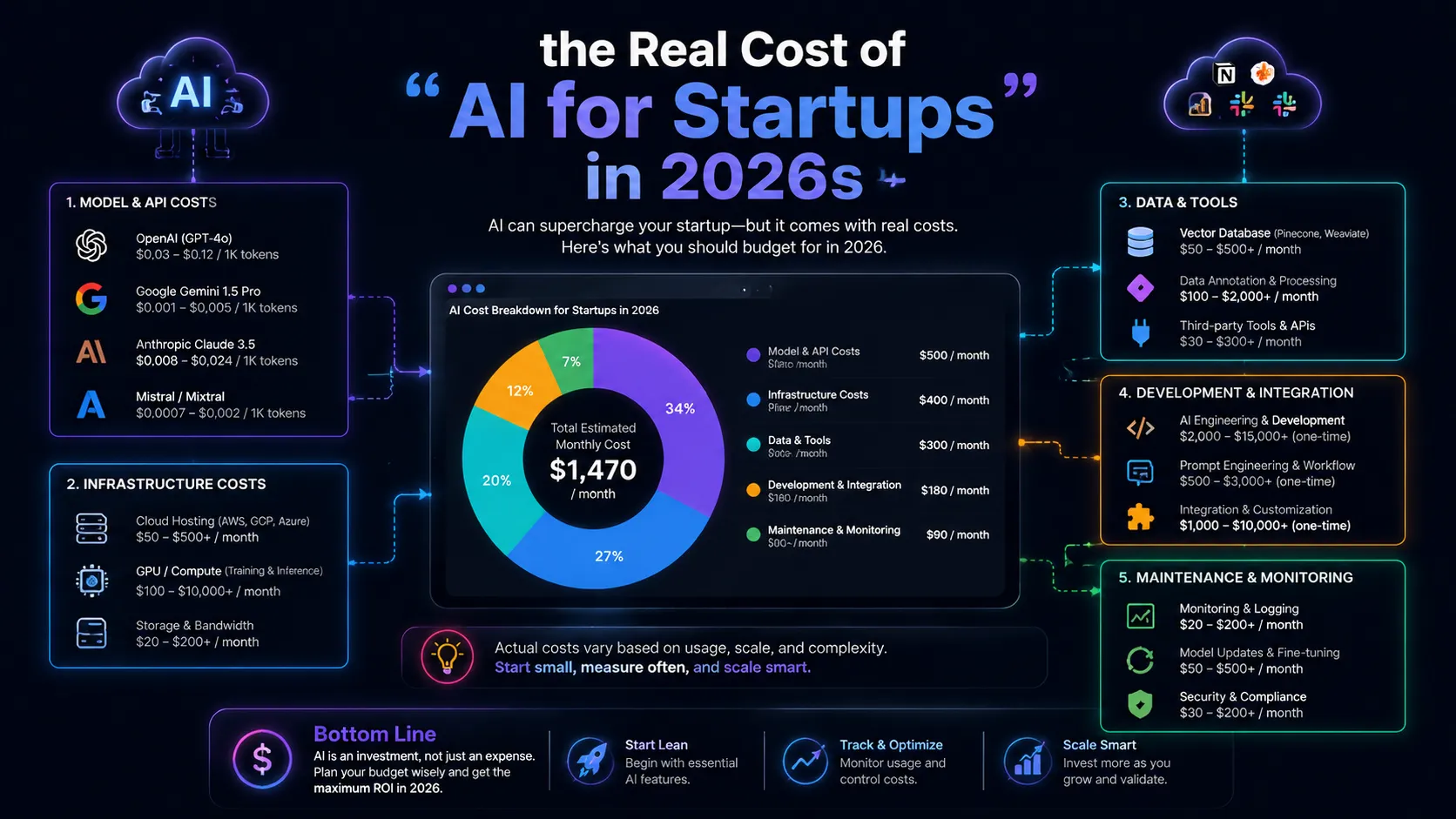
hero image for this blog, top of post, full width
Tier 1: The Lean Startup Stack ($50 to $500 a Month)
This is where almost every startup should live at the beginning, and many should stay longer than they think.
Start at Tier 1. Let proven returns, not FOMO, pull you up the tiers. At this tier you are subscribing to tools that plug into work you already do. A general AI assistant at $20. A writing or content tool. A meeting transcriber. Maybe a design tool and an AI-enhanced CRM feature. Stack a few of these and you land in the $50 to $500 range depending on how many seats and features you need. What you get back is the entire point. Businesses using AI tools report average productivity gains of 25 to 40 percent, with most well-chosen tools paying for themselves in under a year. For a startup counting every week of runway, "pays for itself in months" is a rare and beautiful sentence.
Need | Tool type | Monthly cost |
|---|---|---|
Writing, research, analysis | AI assistant (ChatGPT, Claude) | $20 |
Content and marketing | Content tool or assistant | $0-$50 |
Meeting notes | Transcriber (Otter) | ~$8 |
Design | Canva Pro | $13-$15 |
Sales and contacts | AI-enhanced CRM | $0-$100 |
Tier 2: Workflow Automation ($2,000 to $8,000 a Month)
You hit this tier when AI stops merely helping with tasks and starts replacing whole manual processes. Automated reporting pipelines. Document processing. Customer communication that triggers off behavior instead of someone remembering to send it. The tool costs go up, but the bigger expense here is implementation. Someone has to map your current workflow, find the automation points, wire the tools together, and test everything before it goes live. Plan for $5,000 to $15,000 in one-time setup per major workflow on top of the monthly tooling cost. The payoff scales too. An automated reporting workflow that saves your operations lead 15 hours a week does not just save time. It gives you decision speed you did not have before, which is exactly the kind of edge that matters when you are small and trying to outmaneuver bigger competitors. That ROI is real, even though it is hard to fit on a vendor's pricing page. The signal that you are genuinely ready for Tier 2 is specific: you have a process that is both repetitive and clearly defined, it is consuming real hours every week, and you have already proven with Tier 1 tools that AI handles the individual pieces well. When all three are true, automating the whole workflow is a sound investment. When they are not, Tier 2 spending tends to produce expensive, fragile automations that break the moment your process changes. The setup cost is the part to respect here. Paying $10,000 to wire up a workflow you are still figuring out is how startups end up rebuilding the same automation twice. Nail the process manually first, then automate the version you know works.
Tier 3: Custom AI ($8,000 to $20,000+ a Month, or a Project Fee)
This is building something specific to you: a model trained on your data, a proprietary recommendation engine, an AI feature baked into your own product. Agency custom builds typically run $10,000 to $50,000 as a one-time project, and ongoing custom operations can run $8,000 to $20,000+ a month once you factor in maintenance. Here is the honest advice most startups need to hear. Do not jump to Tier 3 before you have squeezed everything possible out of Tiers 1 and 2. The startups that build custom AI too early almost always regret it, because custom means you are now in the software maintenance business whether you wanted to be or not. Models need retraining. Data pipelines need monitoring. It is real, ongoing work that pulls focus from your actual product. Rule of thumb: most companies in the small-to-mid range exhaust pre-built tools before investing in custom models. The ones that jump to custom first usually overspend and underdeliver.
The Hidden Costs That Wreck Startup Budgets
The sticker price is never the whole price. Here are the costs that quietly drain runway if you do not plan for them.
Setup and training time. The advertised monthly fee is often only 20 to 40 percent of your true first-year cost once you add setup, training, and the productivity dip while your team adapts.
Integration. Connecting AI tools to your existing systems can run $500 to $5,000.
Usage-based billing. Tools that charge per API call or token get more expensive as you grow. Wonderful for the vendor, surprising for you.
In-house hires. An AI specialist costs $80,000 to $180,000 a year plus overhead, which is exactly why agency pilots at $5,000 to $20,000 are a lower-risk way to test the water.
Data cleanup. Your AI is only as good as the data behind it, and a messy early-stage CRM produces messy results.
What "true cost" actually looks like
Take a tool advertised at $50 a month. On paper that is $600 for the year. Now add the real first-year extras: roughly 25 hours of setup and learning, a $1,500 integration to connect it to your existing systems, and a couple of weeks of slightly reduced output while the team adapts. Suddenly your $600 tool has a true first-year cost closer to $3,000 to $4,000.
The subscription is often just 20 to 40 percent of what the tool really costs in year one. This is not a reason to avoid the tool. It is a reason to budget honestly so the cost does not ambush you in month two. Startups that plan for the full number make calm decisions. The ones that only see the sticker price end up scrambling. Build or Buy? Get It Right the First Time. The build-versus-buy decision is where most startup AI budgets are won or lost. Brandrums helps startups choose so you do not overpay for capability you are not ready to use.
A Sample First-Year Startup AI Budget
To make the tiers concrete, here is how a typical seed-stage startup might spend across its first year, growing only as each phase proves out.
Spend almost nothing while learning. Add capability only after proving you need it.
Stage | What you are doing | Monthly spend |
|---|---|---|
Months 1-3 | Free tiers plus one $20 assistant; finding real needs | $20-$60 |
Months 4-7 | Full Tier 1 stack across the small team | $100-$300 |
Months 8-10 | First workflow automation (one process) | $300-$800 + setup |
Months 11-12 | Optimize, cut idle tools, scale what works | $300-$1,000 |
The Startup AI Playbook
If I had to compress this entire breakdown into one approach, it is this. Spend efficiently, learn fast
Start at Tier 1. Prove ROI on a single, specific use case before spending more.
Pilot before you scale. Run one tool with one team, measure the result, then expand.
Measure outcomes, not vibes. Track hours saved or revenue added, not how impressive the tool feels.
Audit quarterly. Cut anything sitting idle. Idle subscriptions are pure runway leak.
Move up tiers only when the numbers demand it. Let proven returns, not FOMO, pull you forward.
Follow that and you will spend efficiently, learn fast, and avoid the expensive trap of building big before you know what works. Organizations that pilot, measure, and scale deliberately typically achieve 3 to 5 times ROI on their AI investments within 12 to 18 months. The ones that spray money at every shiny tool do not.
Map Your AI Spend to Your Runway
If you would rather not figure out the build-versus-buy math alone while running a company, Brandrums maps AI investments to your stage and your runway.
See Our AI SolutionsTalk to Us
Frequently Asked Questions
How much does AI cost for a startup in 2026?
Most startups can launch meaningful AI for under $5,000, or $20 to $100 per user per month using off-the-shelf tools. AI spending falls into three tiers: tool adoption ($50 to $500 per month), workflow automation ($2,000 to $8,000 per month plus setup), and custom AI ($8,000 to $20,000+ per month or a $10,000 to $50,000 one-time build).
Should a startup build custom AI or use existing tools?
Use existing tools first. Most startups should exhaust off-the-shelf tools before building custom, because custom AI puts you in the software maintenance business with retraining and monitoring costs. Build custom only when you have genuinely outgrown pre-built tools and have a specific need no product solves.
What is the ROI of AI for startups?
Businesses using AI tools report average productivity gains of 25 to 40 percent, with most well-chosen tools paying for themselves in under a year. Companies report an average 3.7x return for every dollar invested in generative AI, though returns concentrate among those deploying AI across multiple functions rather than in isolated pilots.
Is it cheaper to hire an AI specialist or use an agency?
For most startups, an agency is lower risk. An in-house AI specialist costs $80,000 to $180,000 a year plus overhead, while an agency pilot project runs $5,000 to $20,000. Agencies let you test AI capability without a full-time salary commitment before you scale.
What is the biggest AI budget mistake startups make?
Building custom AI too early. Jumping to a custom model before exhausting cheaper off-the-shelf tools means taking on maintenance costs and engineering distraction before you have even proven the use case. Start lean, prove ROI, then scale up only when the numbers justify it.
Ready to build the AI setup that fits your business?
Whether you are a solo founder testing the waters or a growing team scaling into serious automation, we help clients pick the lightest AI stack that earns its keep. Same discipline we apply through website development, web application development, SaaS development, and digital marketing retainers. Tell us what you are trying to automate and we will recommend a setup. Or check our pricing options if you are scoping engineering support alongside the tooling.
Tags
About the Author

Daniel Brooks
Daniel covers web development, artificial intelligence, product design, and the technology decisions that help modern businesses grow.