
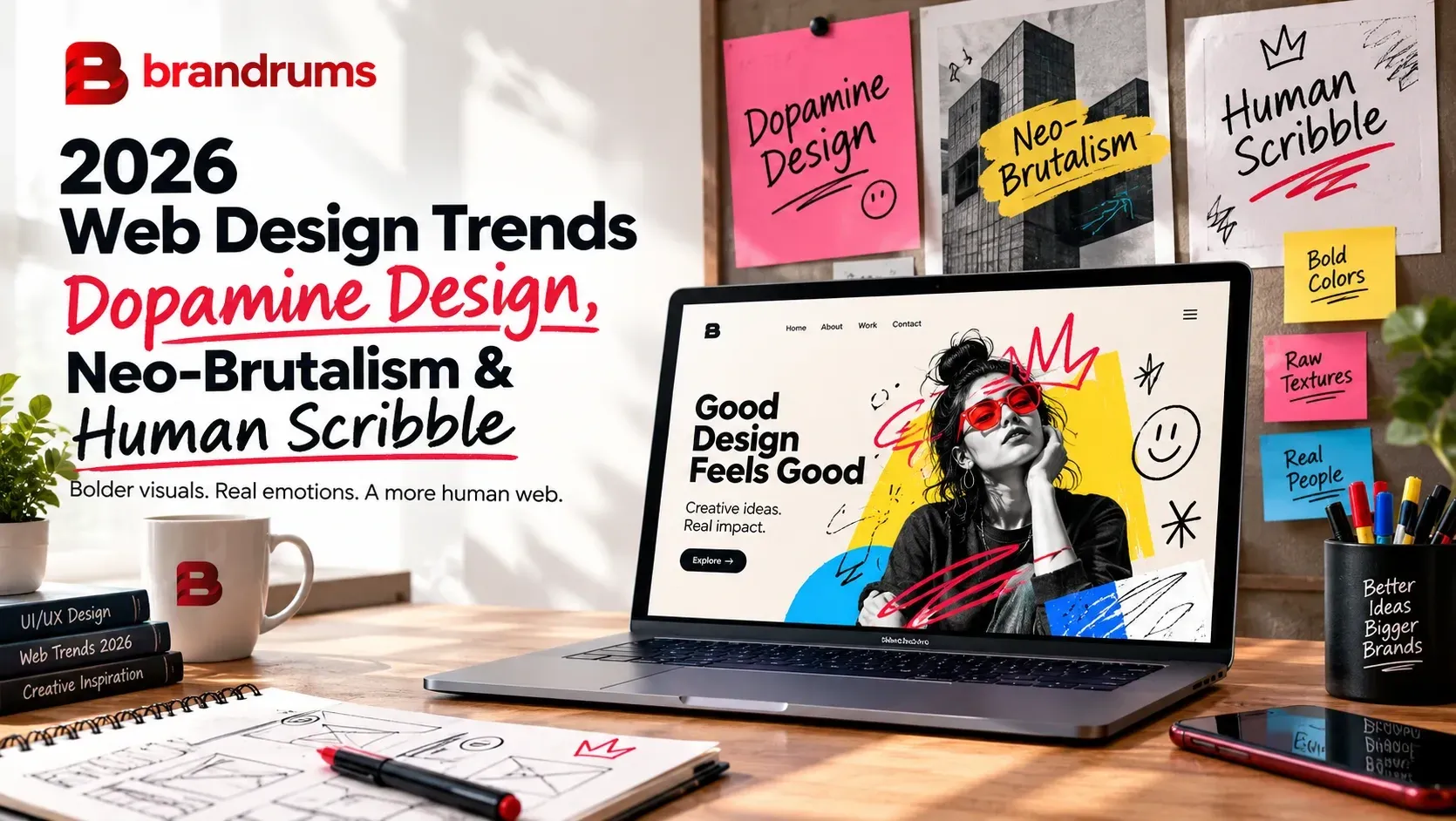
What's Inside: Web design in 2026 is bold, expressive, and unapologetically human. We analyzed hundreds of websites, studied reports from Figma, Wix, and VistaPrint, and identified the 10 trends that will define the year. If your website still looks like it was designed in 2020, you are losing customers before they even read your homepage. Here is everything you need to know to modernize your online presence — and the good news is, we build all of this at Brandrums.
Why Your Website Is Losing You Money Right Now
Let me be blunt with you — I have been designing websites for years, and I can tell within 5 seconds of landing on your homepage whether you are converting visitors or driving them away. It is not about having a "pretty" site. It is about having a site that makes people feel something, trust you, and take action.
Here is the reality: it takes just 50 milliseconds for users to form an opinion about your website. In 2026, that opinion is shaped by visual personality, emotional connection, usability, and mobile experience. Over 60% of web traffic now comes from mobile devices, and if your site is not optimized for that, you are invisible to most of your potential customers.
The brands that embrace modern design trends see up to 2x higher conversion rates compared to those using outdated templates. That is not a small difference — that is the difference between a business that struggles and a business that scales.
Trend 1: Dopamine Design — Color Is Back, Baby
Remember when every website was white, gray, and navy blue? Yeah, those days are over. Dopamine design is all about joy, energy, and visual excitement. Bright, saturated color palettes are making a massive comeback, fueled by Y2K nostalgia and the desire for digital experiences that feel alive.
Neon gradients, high-contrast pairings, and playful hues are replacing muted tones. Brands like Lush, Headspace, and Starface are leading this trend. Dopamine design works especially well for lifestyle, beauty, youth-focused, and creative brands. The key is balancing vibrancy with readability — your content must still be easy to scan.
How to apply it: Choose 2-3 bold brand colors, use them in gradients and accents, and pair with clean white space to let the colors pop.
Trend 2: Neo-Brutalism (Anti-Design) — Beautifully Ugly
This one is not for everyone, and that is exactly the point. Neo-brutalism embraces raw, unpolished visuals that stand out in a sea of sleek, minimalist templates. Think bold typography, exposed grids, stark color contrasts, and intentionally imperfect layouts. It is design that refuses to play by the rules.
This trend is ideal for creative agencies, portfolios, music brands, and any brand that wants to project authenticity and edge. Neo-brutalism signals that you are not trying too hard — and that confidence is magnetic.
How to apply it: Use a limited color palette (often black, white, and one accent), oversized typography, and visible grid lines or borders.
Trend 3: Human Scribble — Imperfect on Purpose
In a world of AI-generated, hyper-polished aesthetics, the human scribble trend pushes back. Hand-drawn doodles, sketch-like overlays, and imperfect lines inject spontaneity and a distinctly human presence into digital design.
This trend is a direct response to the rise of AI design tools. Brands that incorporate hand-drawn elements signal authenticity and creativity. It works beautifully for personal brands, creative businesses, and any brand that wants to feel approachable.
How to apply it: Add hand-drawn arrows, circles, or underlines to key elements. Use sketch-style icons instead of polished ones. Include a handwritten font for accents.
Trend 4: Retrofuturism — The Future as Imagined in the Past
Retrofuturism fuses nostalgia with optimism, bringing vintage visions of the future into modern web design. Expect neon accents, chrome textures, pixel art, bold gradients inspired by sci-fi films, arcade games, and early web aesthetics.
This trend works especially well for lifestyle brands, portfolios, music and entertainment sites, and tech companies that want to project innovation with personality.
How to apply it: Use chrome text effects, pixel art icons, neon glows on buttons, and gradient backgrounds inspired by 80s sci-fi movie posters.
Trend 5: Maximalism — More Is More
Maximalism is the opposite of minimalism. Bold typography, collage layouts, layered elements, and rich textures create immersive digital experiences. The key to successful maximalism is controlled chaos — every element should feel intentional.
Lifestyle brands, personal portfolios, and creative agencies often use maximalism to reflect individuality and playfulness. La Palatine, for example, blends real photos and digital elements in surprising ways.
How to apply it: Layer images and text, use oversized headlines, mix fonts and colors, and do not be afraid of white space — just use it intentionally.
Trend 6: Light Skeuomorphism — Subtle Depth
Skeuomorphism — when digital elements mimic real-world objects — is making a subtle return. Instead of heavy textures and bulky realism, light skeuomorphism involves a lighter, more refined touch with subtle shadows, delicate gradients, soft surfaces, and lightly embossed effects.
This trend combines a stripped-back version of Apple's early UI aesthetic with a sleeker, brighter 3D realism. It works well for SaaS companies, tech products, and e-commerce sites that want to feel tangible and trustworthy.
How to apply it: Add subtle shadows to cards and buttons, use soft gradients on interactive elements, and create depth with layered surfaces.
Trend 7: Micro-Interactions — The Details That Delight
Micro-interactions are subtle animations that respond to user actions — a button that changes color on hover, a loading animation that delights, a form that shakes when you enter wrong information. These tiny details create a sense of polish and responsiveness.
In 2026, micro-interactions are no longer optional. Users expect websites to feel alive and responsive. Brands that implement thoughtful micro-interactions see higher engagement and longer session durations.
How to apply it: Add hover effects to buttons and links, animate page transitions, use loading states that entertain, and provide visual feedback for every user action.
Trend 8: AI-Integrated Design — The Future Is Now
AI is no longer just a tool for building websites — it is becoming part of the design itself. AI-integrated design means dynamic layouts that adapt to user behavior, personalized content recommendations, and interfaces that learn from user interactions.
In 2026, the most forward-thinking websites use AI to create unique experiences for every visitor. This is not about replacing designers — it is about using AI to enhance personalization at scale.
How to apply it: Implement AI-powered chatbots, use dynamic content blocks that change based on user behavior, and leverage AI for A/B testing design variations.
Trend 9: Bold Typography — Words as Design
Typography is taking center stage in 2026. Oversized, expressive fonts are being used as primary design elements — not just for readability, but for visual impact. Variable fonts that change weight and style dynamically are becoming standard.
Bold typography works for any brand that wants to make a statement. The key is ensuring readability across all devices and maintaining sufficient contrast.
How to apply it: Use a display font for headlines, experiment with variable font weights, and do not be afraid to go big — literally.
Trend 10: Dark Mode & Theming — Let Users Choose
Dark mode is no longer a nice-to-have — it is expected. In 2026, the best websites offer user-controlled theming, allowing visitors to choose between light, dark, or auto modes based on their system preferences.
Dark mode reduces eye strain, saves battery life on OLED screens, and creates a premium, modern feel. Brands that offer theming options see higher user satisfaction scores.
How to apply it: Design a complete dark mode palette, respect system preferences, and ensure all images and graphics work in both modes.
How to Choose the Right Trend for Your Brand
Not every trend is right for every brand. Here is our framework for choosing:
- Brand personality: Is your brand playful or serious? Bold or refined?
- Industry expectations: A law firm should not use neo-brutalism, but a music festival should
- Target audience: Gen Z responds to maximalism and dopamine design; enterprise clients prefer light skeuomorphism
- Usability: Never sacrifice user experience for visual trends
Frequently Asked Questions
How often should I redesign my website?
We recommend a full redesign every 2-3 years, with quarterly updates to keep content and design elements fresh. In 2026, websites that feel outdated lose up to 40% of potential customers.
Will these trends work for my industry?
Every trend can be adapted to any industry. The key is interpretation — a healthcare brand can use dopamine design with calming colors, while a creative agency can use neo-brutalism with refined typography.
How much does a trend-focused website cost?
At Brandrums, our Starter package begins at $299 for a custom-designed website. Our Essential ($649) and Business ($1,299) packages include advanced design features, animations, and ongoing support.
Can you update my existing website with these trends?
Absolutely. We regularly help businesses modernize their existing websites. We will audit your current site, identify what is holding you back, and create a strategy for improvement.
Key Takeaways: Design That Works
- 2026 is about personality — bold colors, human touches, and authentic design win
- Mobile-first is non-negotiable — over 60% of traffic comes from mobile devices
- Choose 2-3 trends that fit your brand — do not try to do everything
- Conversion matters more than aesthetics — beautiful sites that do not convert are expensive art projects
- Professional help pays for itself — custom design delivers 2x the conversions of DIY templates
Ready to Future-Proof Your Website?
Do not let your website be the reason you lose customers. Let Brandrums design a website that is modern, conversion-focused, and uniquely yours. Our team of designers and developers has helped over 50 businesses transform their digital presence.
Step 1: Get a free brand audit to see where your current site stands
Step 2: Browse our portfolio to see what we can do for you
Step 3: Choose a package that fits your budget and goals
Step 4: Launch a website that actually works for your business
Explore More from Brandrums
Curious about AI's role in design? Read our article on AI vs. Human Web Design in 2026 to understand why agencies still matter.
Ready to start your project? Contact our team for a free consultation and discover how we can transform your digital presence.
Check out our full range of services — from web design to branding to digital marketing.